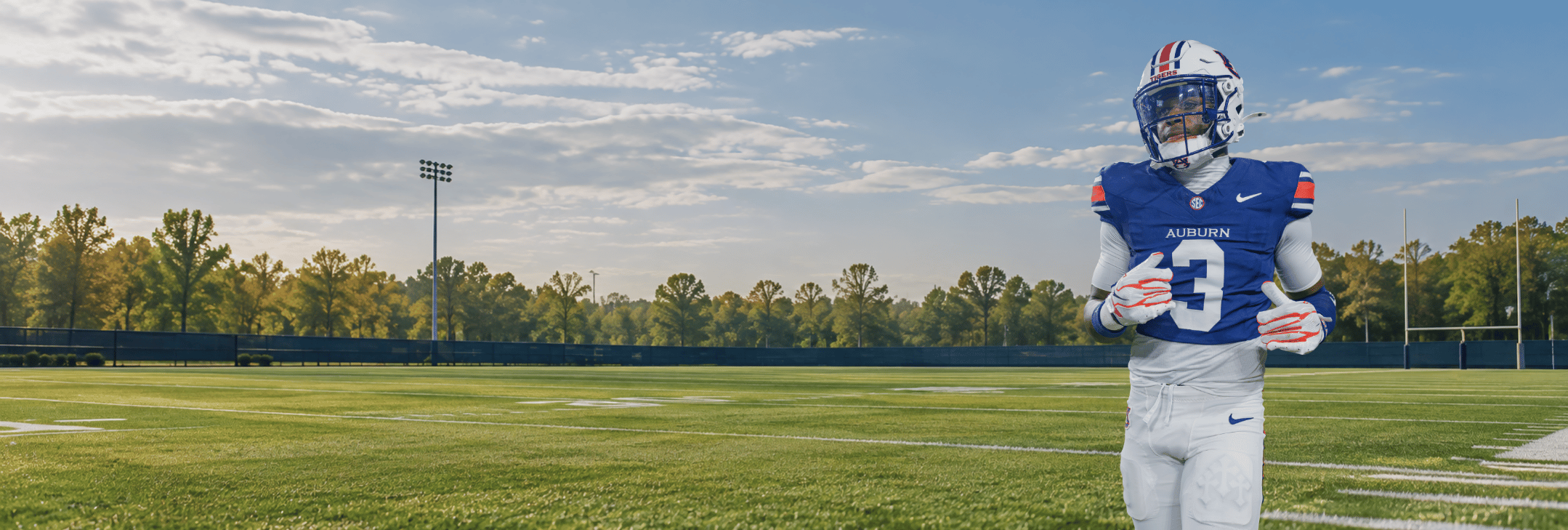

How Auburn’s Young Safety Is Turning High School Success Into SEC Potential
From a championship-winning career at Thompson High School to an encouraging freshman season in the SEC, AnQuon Fegans is developing into an important young defensive back for the Auburn Tigers. With elite high school production, a family connection to Auburn football and valuable early college experience, the Alabama native is working to establish his place in the Tigers’ secondary.
At safety, a defender must learn to see the game before it happens. A quarterback’s eyes shift, a receiver changes his route, or a running back finds a narrow opening, and the defensive back has only a moment to recognize the development and respond. For AnQuon Fegans, that responsibility has become the foundation of his football journey.
The Auburn Tigers defensive back arrived in college carrying an impressive résumé from Thompson High School in Alabaster, Alabama. He had helped lead the Warriors to a state championship, earned recognition as one of the state's top players and established a reputation for creating turnovers. His high school career included 234 tackles, 22 interceptions and 11 forced fumbles, according to Auburn's official roster biography. Those numbers reflected a defender who consistently found ways to influence games.
College football, however, demands more than a decorated high school record. The speed of the game increases, offensive players become more precise, and defensive mistakes can quickly become points on the scoreboard. Fegans entered that environment in 2025 and appeared in all 12 of Auburn's games as a freshman. His first season offered a valuable foundation as he continued developing within one of college football's most competitive conferences.
- Full Name: AnQuon Fegans
- Sport: American football
- Position: Safety
- Height: 6 feet, 0 inches
- Weight: 200 pounds
- Birthplace: Not publicly confirmed; hometown is Alabaster, Alabama
- School/College: Thompson High School; Auburn University
- Current Team: Auburn Tigers
- Conference: Southeastern Conference (SEC)
- Jersey Number: No. 3
- Class: Sophomore in 2026
- Years Active: High school career through college football; Auburn career began in 2025
Fegans developed his football foundation in Alabama, a state where high school football carries deep community significance. He attended Thompson High School in Alabaster, playing for head coach Mark Freeman and competing for one of the state's established programs.
Thompson provided an environment in which talented players were expected to perform within a championship-caliber team. The Warriors won the Alabama Class 7A state title during Fegans' high school career, giving him experience in a program accustomed to high expectations.
His individual production distinguished him within that environment. Across his high school career, he accumulated 234 tackles, 22 interceptions and 11 forced fumbles. Such totals illustrate his involvement in multiple phases of defense: tackling ball carriers, challenging passing attacks and creating opportunities for his team to regain possession.
Auburn's official biography also identifies Fegans as a team captain, an indication of the responsibility he carried within the Thompson program. He earned Class 7A state back of the year recognition and participated in the Alabama-Mississippi All-Star Game and the Under Armour All-American Game. Those selections placed him among a group of high school players recognized beyond their local competition.
His academic record also mattered. Auburn lists him on the A-B Honor Roll, while basketball provided another avenue for athletic participation. Although detailed accounts of his childhood influences and personal training routines are not publicly documented in the available sources, his high school accomplishments establish a clear record of preparation and competitive success.
Fegans' transition to Auburn represented the next step for a player who had already attracted considerable recruiting attention. He was regarded as one of Alabama's leading prospects, with recruiting services including Rivals, On3, ESPN and 247Sports ranking him among the state's top players. Auburn's biography also notes that several services placed him among the leading national prospects at his position.
The significance of that recognition extended beyond rankings. Auburn was recruiting a defensive back whose high school production suggested a capacity to find the football and make decisive plays. His experience as a captain and participant in prominent all-star events added to his preparation for the demands of college football.
Fegans began his Auburn career in 2025. He made his collegiate debut against Baylor on August 29 and went on to appear in all 12 games that season, one of only three Auburn freshmen to accomplish that feat, according to the university's official account.
His playing time gave him an early introduction to the SEC's physical and tactical demands. He recorded three tackles in each of his first two conference road games, against Oklahoma on September 20 and Texas A&M on September 27. He also registered multiple tackles against Georgia and Kentucky, demonstrating that his freshman contributions extended across a range of opponents.
The defining statistical moment of his first season came against Kentucky on November 1, when he recorded his first career interception in the fourth quarter. The play represented a meaningful milestone for a defensive back whose high school career had been marked by takeaways.
A week later, Fegans produced a season-high five tackles against Vanderbilt on November 8. He later recorded two tackles and a pass breakup against Mercer on November 22. By the end of the season, he had totaled 24 tackles, establishing a measurable starting point for his college career.
Fegans' record suggests a safety whose value comes from involvement in the play rather than a single narrow responsibility. His high school totals included both substantial tackling production and repeated interceptions, while his freshman statistics showed that he could contribute consistently even as he adjusted to college football.
For a safety, effective play requires a balance between patience and aggression. The defender must read offensive formations, recognize route combinations, understand run responsibilities and choose when to attack the football. Interceptions require more than athletic ability; they also depend on positioning, awareness and the timing of a decision.
Fegans' 22 high school interceptions provide strong evidence of a sustained ability to produce turnovers at that level. His college interception against Kentucky offered an early sign that this aspect of his game could translate to Auburn.
His 24 tackles as a freshman also reflected regular involvement in defensive action. Recording at least one tackle in 11 of his 12 appearances, he demonstrated consistency in contributing to the defense.
At six feet and 200 pounds on Auburn's 2026 roster, Fegans has the listed physical profile of a safety capable of contributing in the secondary and supporting the run defense.
Fegans' football résumé combines team success, individual recognition and early college production. At Thompson, he helped the Warriors win a Class 7A state championship, served as team captain and earned state-level recognition. His 234 career tackles, 22 interceptions and 11 forced fumbles stand among the most significant documented achievements of his high school career.
His selection for the Alabama-Mississippi All-Star Game and Under Armour All-American Game further reflected his standing as a highly regarded prospect. Academic recognition through the A-B Honor Roll added another dimension to his high school record.
At Auburn, his first-season achievements included appearing in all 12 games in 2025, recording 24 tackles, intercepting a pass against Kentucky and producing a season-high five tackles against Vanderbilt. These accomplishments did not establish him as a finished product, but they provided a foundation on which to build.
Football is often described through statistics, but a player's development also takes place within a network of family, education and personal responsibility. In Fegans' case, family is a documented part of his Auburn story.
The university identifies his parents as Antwon Sr. and Tanquella Fegans and lists seven siblings. His older brother, Antwon Jr., also played safety at Auburn. That connection gives Fegans a direct family link to the same program in which he is developing his own college career.
Fegans is listed as studying in Auburn's College of Business. His academic status matters alongside his athletic responsibilities, because college football players must manage coursework and training while adapting to the demands of competition.
Entering the 2026 season as a sophomore, Fegans returned to Auburn with a full year of collegiate experience behind him. The university's 2026 preseason coverage reported that he returned after missing some practice time because of injuries. Auburn head coach Alex Golesh also praised the defensive improvement displayed during the team's second scrimmage in August, mentioning Fegans among the safeties involved in the defensive group.
The next stage of Fegans' development will involve turning experience into consistency. Continued progress in reading offenses, communicating with fellow defensive backs, tackling reliably and capitalizing on opportunities to intercept passes would strengthen his case for a larger role.
His future standing will ultimately depend on performance, competition within Auburn's safety group and the coaching staff's defensive plans. His high school résumé gives him a promising background, while his freshman season demonstrates that he has already experienced the pace and demands of SEC football.
It is too early to define Fegans' long-term legacy at Auburn. He remains an emerging player, and his college career is still in its early stages. Nevertheless, the foundation is clear: a championship-winning high school background, significant turnover production, leadership experience and an encouraging first year in college football.
For Auburn, developing young defensive backs who can recognize offensive intentions and finish plays is essential to building a dependable secondary. Fegans has shown the potential to contribute to that objective, although his ultimate impact will be determined by what he accomplishes in the seasons ahead.
His story is not simply about carrying a celebrated high school record into college. It is about adapting to a more demanding level, learning from early opportunities and converting potential into dependable performance.
AnQuon Fegans arrived at Auburn with the credentials of an accomplished Alabama high school defender. He left his freshman season with 24 tackles, a first collegiate interception and appearances in all 12 games. Those results established a foundation, not a final destination.
Now a sophomore, Fegans faces the challenge that defines many promising young football players: proving that early potential can become lasting production. His championship experience, family connection to Auburn and history of creating turnovers give him a compelling starting point.
The next chapter will be written through preparation, competition and performance on the field. If Fegans continues to develop the awareness and consistency that helped distinguish him at Thompson, he has an opportunity to become a more influential presence in Auburn's secondary. For now, his journey is one of steady progress and the work of turning promise into impact.