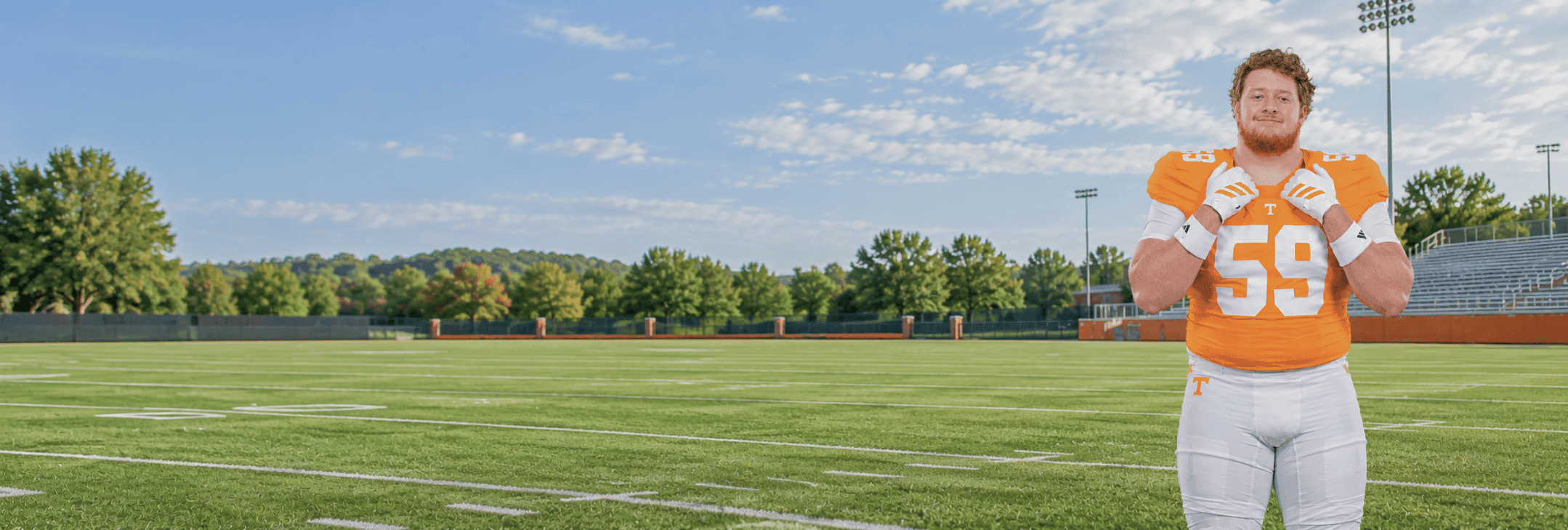

The Making of Tennessee Football’s Next Offensive Line Contributor
From Archbishop Moeller High School in Cincinnati to the University of Tennessee, offensive lineman Charlie Powell III is developing the technique, discipline, and experience needed to compete at the highest level of college football. His early collegiate appearances mark the beginning of a journey built around preparation, patience, and continued growth.
In football, the players who receive the loudest applause are often those who cross the goal line, throw the decisive pass, or make a game-changing interception. Yet behind nearly every successful offensive play is a group of athletes whose contributions begin long before the ball reaches the skill positions. Offensive linemen must recognize defensive alignments, communicate adjustments, establish leverage, and protect their teammates through the chaos of every snap.
For Charlie Powell III, that demanding responsibility represents an opportunity to build his future in college football.
A native of Cincinnati, Ohio, Powell joined the University of Tennessee Volunteers in July 2025 after developing his game at Archbishop Moeller High School. Standing 6 feet 3 inches tall and weighing 312 pounds on Tennessee’s 2026 roster, he brings the physical profile of a college offensive lineman to a program competing in the Southeastern Conference. His high school résumé included a conference championship, a state championship appearance, and recognition for his work in pass protection.
Powell’s story is still in its early chapters. Rather than an established career defined by extensive statistics or individual awards, his development offers a closer look at the foundation of offensive line play: learning a demanding system, earning opportunities, and preparing for the moment when a reserve role can become something more.
- Full Name: Charlie Powell III
- Sport: American football
- Position: Offensive lineman
- Jersey Number: 59
- Height:6 feet 3 inches
- Weight: 312 pounds
- Birthplace/Hometown: Cincinnati, Ohio
- High School: Archbishop Moeller High School
- College: University of Tennessee, Knoxville
- Current Team: Tennessee Volunteers
- Class: Sophomore in 2026
- Years Active: High school career followed by collegiate football beginning in 2025; exact starting year in high school competition is not publicly documented.
- Major: Finance
Powell’s football journey began in Cincinnati, where he attended Archbishop Moeller High School, a program with a strong presence in Ohio high school football. The school provided the setting for his development as an offensive lineman and the competition through which he established himself as a prospect for the next level.
Powell progressed through a competitive high school program and developed the blocking skills necessary to attract the attention of a major college football program.
Offensive line prospects face a distinctive developmental challenge. Unlike positions where speed and individual production can be immediately visible, line play requires a combination of strength, balance, footwork, awareness, and coordinated movement. A player must learn to deliver force without losing positioning, recognize changing defensive fronts, and remain composed when an opponent attempts to disrupt the play.
For Powell, those responsibilities became central to his preparation at Archbishop Moeller, where his senior-season performance would provide a meaningful measure of his readiness for college football.
Powell’s final high school season in 2024 represented an important step in his development. According to Tennessee’s official biography, he helped Archbishop Moeller reach a state championship appearance and capture a conference title during his senior year. He also earned First Team All-Greater Catholic League recognition.
One statistic particularly illustrates the importance of his work in pass protection: Powell allowed just two sacks across 377 pass-blocking snaps during that senior campaign. That performance offers a concrete indication of his effectiveness in a critical area of offensive line play.
Pass protection demands more than size. Offensive linemen must maintain appropriate spacing, respond to rushers who change direction, and prevent defenders from reaching the quarterback before a passing play can develop. A strong performance over hundreds of pass-blocking snaps suggests the ability to execute assignments consistently, although the statistic alone does not capture every aspect of his technique or overall game.
His high school accomplishments helped establish the foundation for the next stage of his career. In July 2025, Powell committed to Tennessee and enrolled before the start of fall camp. His arrival placed him in a collegiate environment where the speed, physicality, and complexity of the game would require further adjustment.
The transition from high school to the Southeastern Conference is a substantial challenge for any young lineman. College defenders bring greater strength, more sophisticated pass-rushing techniques, and the ability to exploit small mistakes. Offensive linemen must also absorb a new playbook and learn to coordinate their movements within a faster, more demanding system.
For Powell, the opportunity to learn within Tennessee’s program represented the beginning of that next phase rather than the conclusion of his development.
Powell’s freshman season in 2025 offered his first experience in live collegiate competition. Tennessee records show that he appeared in two games, making his debut-season appearances at right tackle in home victories over East Tennessee State on September 6 and UAB on September 20. He played four snaps against each opponent, totaling eight documented offensive snaps. He earned a redshirt for the season.
Those numbers are modest, but they are an important part of an honest assessment of his career. Powell was beginning to acclimate to college football, and his appearances gave him an initial opportunity to execute his assignments in actual game situations.
For a young offensive lineman, even a limited number of snaps can carry practical value. Live competition tests communication, alignment, timing, and technique under conditions that practice cannot fully reproduce. Every rep also offers coaches an opportunity to evaluate how a player applies instruction and responds to the speed of the game.
His appearances at right tackle established an early collegiate position, although the available record does not establish that he is permanently assigned to that spot. Tennessee’s current roster lists him as an offensive lineman without specifying a single position on the line.
The redshirt season also provided room for continued development. It would be inaccurate to portray Powell as an established starter or to attribute major statistical achievements to him at this stage. His documented collegiate experience remains limited, making his progress in preparation and future opportunities more relevant than unsupported predictions about his eventual role.
Powell’s most clearly documented strength is his work in pass protection. Allowing only two sacks over 377 pass-blocking snaps during his senior season suggests that he was able to contribute to the protection plan with consistency. That record provides a more useful measure of his high school performance than broad claims about his athletic ability that cannot be independently verified.
At 312 pounds, Powell has the size to compete in the interior and tackle positions along an offensive line, though his precise long-term role will depend on Tennessee’s personnel needs and coaching evaluations. His documented freshman appearances came at right tackle, a position that demands sound footwork, awareness of edge rushers, and the ability to maintain protection as defenders attack from different angles.
Successful offensive line play also requires teamwork. Linemen must move together, recognize stunts and blitzes, and communicate quickly enough to prevent defensive pressure from breaking through. A missed assignment by one player can compromise the entire play.
Powell’s next stage of development will involve refining those fundamentals against college-level competition. His available statistics do not establish specific training habits, strength-testing results, or a detailed scouting evaluation of his run-blocking ability. Those areas remain unverified, but they are important components of the growth expected from a young offensive lineman.
Powell’s résumé is best understood through several documented milestones rather than an extensive collection of individual statistics.
His high school achievements include First Team All-Greater Catholic League honors in 2024, a conference championship, and a state championship appearance with Archbishop Moeller. His two-sack allowance across 377 pass-blocking snaps stands out as a measurable accomplishment from that season.
At Tennessee, his first collegiate milestone came in September 2025, when he appeared in games against East Tennessee State and UAB. Those appearances gave him his first experience in live college competition and contributed to his initial season of development within the Volunteers’ program.
As of the 2026 roster listing, Powell is a sophomore wearing jersey No. 59. No individual collegiate awards, records, championships, or major statistical totals are listed in the official player biography reviewed. His current profile is therefore one of early development rather than an established record of collegiate honors.
Football at the collegiate level requires more than physical preparation. Players must balance practice, meetings, film study, strength training, travel, and academic responsibilities while adjusting to a more independent environment.
Powell is listed as a finance major at the University of Tennessee. That academic detail provides one verified glimpse into his life beyond the field.
Powell has already experienced the transition from being a high school contributor to competing for opportunities within a major college program. That adjustment calls for patience and a willingness to learn. For offensive linemen in particular, progress often depends on repetition: understanding an assignment, correcting a technical mistake, and applying the lesson against increasingly difficult competition.
Tennessee’s 2026 roster lists Powell as a sophomore, measuring 6 feet 3 inches and 312 pounds. His official career biography records two appearances during the 2025 season, and the available player statistics do not provide a documented 2026 game-by-game performance record.
His high school pass-protection record gives him a credible starting point. The next challenge is translating those skills to the college game and demonstrating consistency against SEC-caliber opponents. Continued work on footwork, leverage, hand placement, recognition, and communication can help a young lineman improve his readiness for expanded responsibilities.
For Powell, the future remains a process rather than a predetermined outcome. Each practice and opportunity to compete can contribute to the experience required to become a more dependable member of Tennessee’s offensive front.
It is too early to assess Powell’s lasting impact on Tennessee football. His collegiate career has only begun, and his public record does not yet include the extensive playing time or individual achievements necessary to establish a legacy.
Still, his journey illustrates an important feature of offensive line development: the distance between potential and proven performance is covered through preparation. His high school accomplishments earned him a place in a demanding college program, while his first collegiate appearances provided an initial measure of the adjustments still ahead.
For Tennessee, developing young offensive linemen is an ongoing investment in the depth and continuity of the team. Powell’s progress will be measured not simply by his physical dimensions, but by how effectively he learns the system, executes assignments, and earns the trust of his teammates and coaches.
Charlie Powell III’s football story is still unfolding. From his senior-season success at Archbishop Moeller to his first game appearances with the Tennessee Volunteers, he has taken meaningful steps toward establishing himself at the collegiate level.
His First Team All-GCL recognition and record of allowing just two sacks over 377 pass-blocking snaps provide tangible evidence of his high school preparation. His early experience at Tennessee, meanwhile, marks the beginning of a more demanding chapter in which consistency, technique, and patience will matter as much as physical ability.
Powell has not yet built a collegiate résumé defined by extensive playing time or major honors. That is precisely why his next steps matter. The challenge ahead is to turn preparation into opportunity and opportunity into sustained performance.
For an offensive lineman, progress is rarely measured by how often his name appears in a highlight reel. It is measured by the protection he provides, the assignments he executes, and the trust he earns one snap at a time. Powell’s foundation has been established; the next chapter will be determined by what he builds upon it.