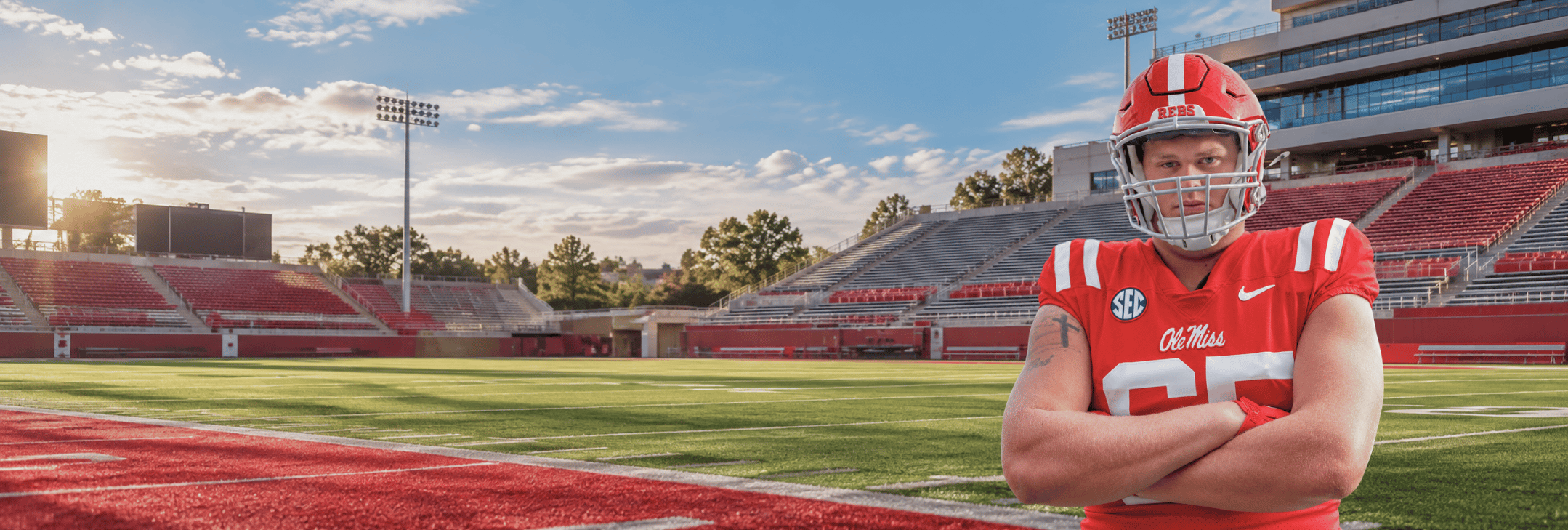
From a decorated Osceola High School career in Central Florida to early SEC playing time at Ole Miss, Connor Howes has built his football journey around preparation, versatility and steady development. Now a sophomore, the 6-foot-6 offensive lineman is beginning to turn potential into meaningful responsibility for the Rebels.
For an offensive lineman, opportunity can arrive without warning.
Connor Howes learned that in the middle of the 2026 season, when circumstances pushed him from a developing depth piece into the Ole Miss lineup. After spending his freshman season learning the demands of major-college football and contributing primarily on special teams, Howes was suddenly asked to help protect the quarterback and stabilize the right side of the Rebels' offensive line.
The moment was not entirely unexpected. At 6-foot-6 and 315 pounds, Howes has long possessed the physical dimensions coaches look for in an SEC offensive lineman. What mattered was whether his preparation could catch up with his potential.
By his sophomore season, the answer was beginning to emerge.
After entering 2026 as one of Ole Miss' younger offensive-line options, Howes earned the first start of his college career against Charlotte on Sept. 12. It represented an important transition in a career that, until then, had largely been about learning, developing and waiting for the next opportunity.
- Full Name: Connor Roy Howes
- Sport: Football
- Position: Offensive Line
- Jersey: No. 65
- Height: 6-foot-6
- Weight: 315 pounds
- Age: 19
- Birthplace: Not publicly listed; born January 15, 2007
- Hometown: Saint Cloud, Florida
- High School: Osceola High School
- College: University of Mississippi
- Current Team: Ole Miss Rebels
- Class: Sophomore
- Major: Criminal Justice
- Years Active: 2025-present at Ole Miss
Ole Miss lists Howes as a 6-foot-6, 315-pound sophomore with one collegiate letter. The university identifies Saint Cloud, Florida, as his hometown, Osceola as his high school and criminal justice as his major.
Howes' football development took place in Central Florida, where his size made him an obvious presence along the offensive line. He attended Osceola High School in Kissimmee and developed into one of the program's most accomplished linemen.
The available public record does not provide extensive details about his childhood or the specific moment he first became interested in football. What is clear is that his development at Osceola was marked by increasing responsibility. He eventually became a four-time team captain and twice earned his school's Offensive Lineman of the Year honor. He was also recognized as an all-state player in 2024.
His athletic development extended beyond football. Howes competed in weightlifting and track and field for three years, giving him additional opportunities to develop strength, explosiveness and movement skills that translate naturally to offensive-line play.
As a senior, he finished as a state runner-up in weightlifting and won district and regional championships. In track and field, he was a two-time regional qualifier and three-time district champion.
That multisport background helps explain why Howes' development has never been based solely on size. His athletic foundation was built through sports that demanded both raw strength and coordinated movement.
By the end of his high school career, Howes had become a nationally recognized offensive-tackle prospect. Ole Miss' official biography lists him as a three-star recruit according to Rivals, 247Sports and On3, while both On3 and 247Sports rated him among the nation's top 35 offensive tackles, at Nos. 31 and 33 respectively.
His recruiting profile was strong enough to attract offers from programs including Arkansas, Rutgers and Miami. He ultimately signed with Ole Miss as part of the Rebels' 2024-25 signing class.
Howes also earned an invitation to the U.S. Army All-American Bowl, an honor that reflected his standing among the nation's high school prospects. His Osceola program's state championship documentation listed him among the team's players to watch and noted 75 pancake blocks during his senior season.
He enrolled early at Ole Miss and participated in spring practices in 2025. That early arrival gave him additional time to adjust to the speed, physicality and technical demands of college football before his first season.
Howes' most obvious attribute is his frame. At 6-foot-6 and 315 pounds, he possesses the length and mass expected from a modern SEC offensive lineman. His experience as a tackle gives him familiarity with playing in space, while his development has also included work along the interior of the offensive line.
The 2026 Ole Miss depth chart has identified him in the competition for right-side offensive-line responsibilities, and preseason reporting highlighted him as one of the younger players capable of providing depth at tackle.
His playing style is best understood through his development rather than a long list of collegiate statistics. Offensive linemen rarely accumulate conventional numbers that capture their value, and Ole Miss does not publish traditional individual statistics for Howes. His contribution is instead measured through snaps, assignments, protection and the trust placed in him by the coaching staff.
That trust increased significantly in 2026.
Howes' major accomplishments include:
- Four-time team captain at Osceola High School.
- Two-time Osceola Offensive Lineman of the Year.
- 2024 all-state selection.
- 75 pancake blocks listed in Osceola's state championship documentation.
- State runner-up in senior-year weightlifting.
- Three-time district and regional weightlifting champion.
- Two-time regional qualifier and three-time district champion in track and field.
- U.S. Army All-American selection.
- Ole Miss early enrollee in 2025.
- Appeared in all 15 games as a true freshman.
- Earned his first collegiate letter in 2025.
- SEC First-Year Academic Honor Roll selection for 2025-26.
- Dean's Honor Roll in spring 2025 and fall 2025.
- Athletic Director's Honor Roll in spring 2026.
- First career start as an Ole Miss Rebel against Charlotte in September 2026.
The public record surrounding Howes is relatively private, but several details reveal the person behind the uniform.
He is the son of Kimberly and Steven Howes, and he has pursued a criminal justice degree at Ole Miss while balancing the demands of SEC football. His academic record has been particularly strong. He earned Dean's Honor Roll recognition in both spring and fall 2025, made the SEC First-Year Academic Honor Roll for the 2025-26 academic year and was also named to the Athletic Director's Honor Roll in spring 2026.
His development also reflects a willingness to compete beyond football. Weightlifting and track were not side notes in his athletic background; they became meaningful parts of his development and produced championships and state-level success.
There is also evidence of Howes maintaining connections with his former Osceola community. In 2026, he supported former teammate Taevion Swint at a community event and spoke publicly about the shared journey they had taken from Osceola toward college football.
Howes' sophomore season represents the most important developmental stage of his college career so far.
Ole Miss entered 2026 with significant competition along the offensive line. The Rebels returned several experienced linemen and added transfers, creating a crowded group in which younger players had to earn their opportunities. Howes was listed among the returning offensive linemen expected to compete for additional playing time.
That opportunity arrived early.
During Ole Miss' 41-38 victory over Louisville, Howes was forced into action after starting right tackle Tommy Kinsler IV went down. Contemporary reporting noted that Howes stepped into the lineup during a tightly contested game against an experienced defensive front. His performance helped establish him as a viable option for the Rebels.
One week later, Howes made his first career start against Charlotte. Ole Miss' official postgame notes confirmed that it was his first start as a Rebel.
He remained listed among the offensive linemen in Ole Miss' Sept. 19 game against LSU, another indication that his role had expanded from developmental depth into a meaningful part of the offensive-line rotation.
It is too early to define Connor Howes' ultimate legacy at Ole Miss. He is only beginning his sophomore season, and his college career has reached the stage where opportunity is becoming responsibility.
What can already be measured is the progression.
At Osceola, Howes was a captain, an all-state offensive lineman and a multisport athlete. At Ole Miss, he entered as a highly regarded but developmental prospect. His freshman season was largely about learning the college game and contributing where he could, with special teams providing his first consistent avenue onto the field.
He appeared in all 15 games in 2025, including Ole Miss' College Football Playoff run, while playing primarily on special teams and limited offensive snaps. By the following season, he had developed enough to become a legitimate option along the offensive line and eventually earn his first collegiate start.
That progression is particularly meaningful for an offensive lineman. There is rarely a dramatic statistical breakthrough. Instead, development happens through repetition: one practice rep, one protection call, one block and one assignment at a time.
For Howes, those repetitions have begun to translate into trust.
Connor Howes' story is not yet about a finished career. It is about the transition from potential to proof.
The physical tools were visible early. At Osceola, he developed into a captain and decorated offensive lineman. His strength work produced state-level success, his track background added another dimension to his athletic development, and his recruiting profile earned national attention.
But college football demanded something different.
It demanded patience, technical refinement and the ability to contribute before a starting opportunity arrived. Howes spent his freshman season doing exactly that, appearing in every game while learning the rhythms of SEC football. Then, when an opening emerged in 2026, he was prepared to step through it.
His first start against Charlotte was therefore more than a line in a gamebook. It was a marker of progression from recruit to freshman, from reserve to contributor, and from developmental prospect to a player increasingly trusted with meaningful responsibility.
At 19, with multiple seasons of eligibility ahead of him, Howes still has plenty of room to grow. His size gives him a natural foundation. His multisport background gives him athletic versatility. His academic record demonstrates discipline away from the field.
The next chapter will determine how far those qualities can take him.
For now, Connor Howes represents something valuable to Ole Miss: a young offensive lineman whose biggest opportunity may still be ahead, but who has already shown that when the moment arrives, he intends to be ready for it.