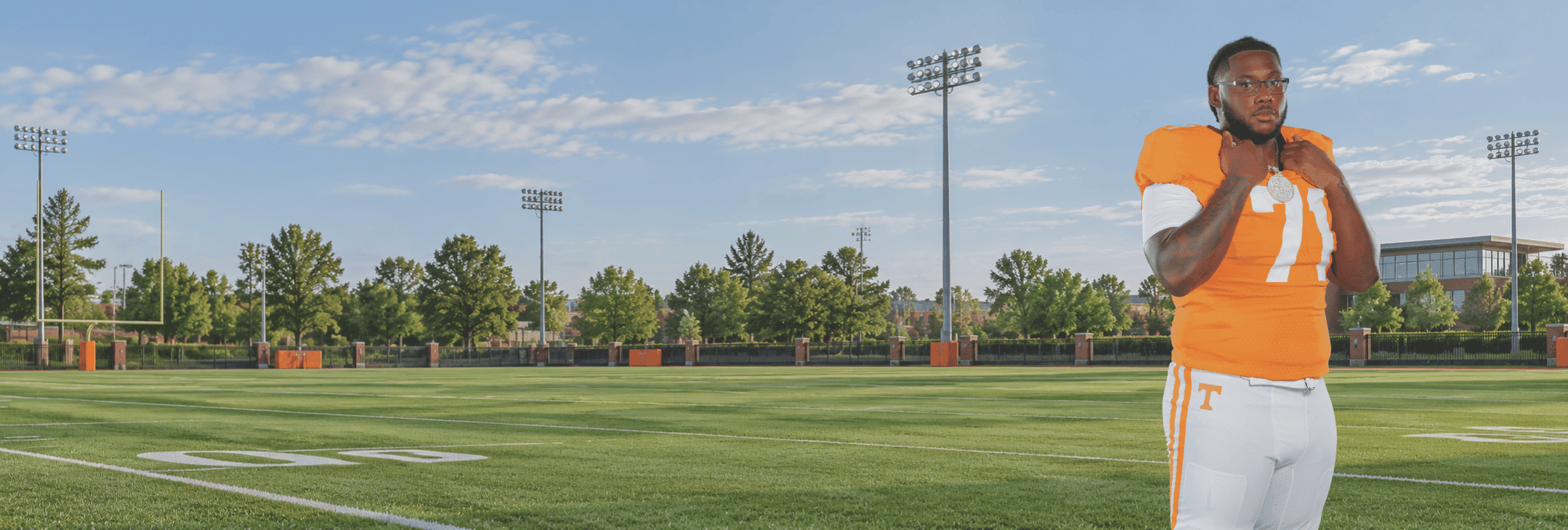

Inside the Journey of Tennessee Football’s Promising Offensive Line Prospect
From the nationally ranked St. Frances Academy program in Baltimore to the demanding environment of Southeastern Conference football, Ed Baker enters his collegiate career with size, versatility, and valuable experience against elite high school competition. His development at Tennessee represents the next step in a journey built around preparation, competition, and opportunity.
An offensive lineman rarely receives the same spotlight as a quarterback throwing a touchdown or a running back breaking into the open field. Yet, behind almost every successful offensive play is a battle won in the trenches. For Ed Baker, that often-unseen work is where his football journey has taken shape.
A native of Baltimore, Maryland, Baker arrived at the University of Tennessee after developing at St. Frances Academy, a program recognized for competing against some of the nation's strongest high school football teams. His high school experience included winning seasons, national rankings, and a championship campaign that provided a demanding foundation for the next level.
Now a freshman offensive lineman for the Tennessee Volunteers, Baker faces a different challenge. College football requires more than physical strength. It demands technical precision, communication, consistency, and the ability to execute against defenders who possess comparable athletic ability.
Baker's story is still in its early chapters. However, his recruitment, preparation, and transition to Knoxville offer an introduction to a young player seeking to establish himself in one of college football's most competitive environments.
- Full Name: Ed Baker, also identified as Edward Baker in recruiting coverage
- Sport: American football
- Position: Offensive lineman
- Jersey Number: 71
- Height: 6 feet, 4 inches
- Weight: 322 pounds
- Birthplace/Hometown: Baltimore, Maryland
- High School: St. Frances Academy
- College: University of Tennessee, Knoxville
- Current Team: Tennessee Volunteers
- Class: Freshman, 2026 season
- Recruiting Classification: Consensus three-star prospect
- Years Active: High school football through 2025; collegiate career beginning in 2026
Baker's publicly documented football journey is closely associated with Baltimore and St. Frances Academy. Although detailed accounts of his childhood, family background, and earliest introduction to football are not widely available, his high school career provides a clear starting point for understanding his development.
St. Frances Academy has built a reputation for challenging competition, and Baker's experience there placed him in an environment where offensive linemen must demonstrate discipline and physical readiness. Playing against strong opponents can expose weaknesses quickly, making preparation and execution essential.
For a young offensive lineman, those lessons extend beyond simply moving a defender. Players must recognize defensive alignments, understand assignments, maintain leverage, and work together with their teammates. The position requires coordinated movement and sound decision-making, even when the action unfolds in a crowded space.
Baker's high school accomplishments provide the strongest evidence of the competitive environment that prepared him for Tennessee.
As a junior in 2024, he started for St. Frances Academy during an 8-3 season. The Panthers faced a difficult schedule and finished eighth nationally in the MaxPreps Top 25 rankings, according to Tennessee's official player biography.
The following season brought another significant milestone. St. Frances finished 9-1 in 2025 and won the inaugural Overtime Nationals High School Football Championship, defeating Corner Canyon, a prominent program from Utah. The team finished No. 2 nationally in the MaxPreps Top 25, Rivals National High School Football Composite Rankings, and Sports Illustrated National High School Football Power 25 rankings.
Those results offer important context for Baker's development. He was not entering college directly from an untested environment. He had played for a team that competed nationally and experienced the expectations surrounding a successful program.
His individual recruiting evaluations also reflected his potential. Tennessee identified him as a powerful, versatile offensive line prospect with an impressive frame. He was a consensus three-star recruit according to 247Sports, Rivals, and ESPN. ESPN ranked him as the No. 65 offensive tackle, while 247Sports placed him at No. 62 among interior offensive line prospects. ESPN also ranked him No. 15 among players in Maryland.
These evaluations established Baker as a recruit with opportunities to develop at the collegiate level, rather than a player whose future success was already guaranteed.
Baker committed to Tennessee on June 27, 2025, after considering multiple Division I opportunities. According to the university, he chose the Volunteers over more than 20 other Division I offers, including 15 from Power Four programs.
The decision followed an extended recruiting process. Reporting from On3 described Tennessee's pursuit as a relationship that had developed over time, with the program maintaining a strong position among Baker's college choices.
That recruiting interest reflected more than his listed measurements. Offensive line prospects must demonstrate the potential to handle different blocking responsibilities, learn complex assignments, and contribute within a coordinated unit. Baker's size, versatility, and experience at St. Frances made him a prospect Tennessee wanted to develop.
His commitment also represented a transition from recruiting attention to the practical demands of college football. Once a player arrives on campus, rankings and scholarship offers become less important than daily preparation, technical improvement, and performance in practice.
At 6-foot-4 and 322 pounds on Tennessee's 2026 roster, Baker possesses the physical dimensions expected of a college offensive lineman. His size gives coaches a substantial foundation to work with, although measurements alone cannot determine how effectively a player performs against SEC competition.
Offensive line play depends on a combination of strength, balance, footwork, hand placement, and awareness. In pass protection, linemen must maintain their positioning and react to defensive movement while protecting the quarterback's throwing space. In the running game, they must execute assignments, create leverage, and sustain blocks long enough for a play to develop.
Versatility can also be valuable. A lineman capable of learning multiple positions gives a coaching staff additional options when building depth and adjusting personnel. Tennessee's official biography specifically describes Baker as a versatile prospect, but it does not establish a definitive long-term starting position.
The next phase of his development will be measured by how effectively he converts his physical tools into consistent execution.
The move from Baltimore to Knoxville represents a significant change in environment and responsibility. College football introduces a different daily rhythm, with academic commitments, strength and conditioning, film study, meetings, and practices competing for a player's attention.
Tennessee lists Baker's academic area as university exploratory. He has entered a setting where athletic and academic responsibilities must be managed together.
His high school experience also provides a foundation for understanding the importance of teamwork. Offensive linemen depend on one another to communicate adjustments and execute coordinated assignments. A missed responsibility by one player can affect the entire play. Learning to operate within that structure is an essential part of becoming a reliable college teammate.
Baker entered Tennessee as a freshman for the 2026 season after enrolling early and participating in spring practices, according to the university. Early enrollment gave him an opportunity to begin learning the program before the season, although it does not by itself establish his readiness for a starting role.
His current college production and precise playing status are not confirmed by statistics on his official roster profile. Consequently, it would be premature to describe him as a regular starter, cite unverified game appearances, or attribute specific on-field achievements to him at Tennessee.
The immediate challenge is development. Baker must adapt to college defensive fronts, refine his technique, improve his understanding of the offensive system, and demonstrate consistency against stronger and more experienced opponents.
His future role will depend on performance, practice evaluations, health, and the coaching staff's personnel decisions. For now, his most meaningful opportunity is to build the fundamentals that can turn a promising recruit into a dependable contributor.
It is too early to assess Baker's long-term legacy at Tennessee. He has not yet accumulated a documented collegiate record that would justify comparisons with established program standouts.
Nevertheless, his path illustrates an important part of college football: successful programs continually seek players who can develop the physical and technical skills required to protect quarterbacks and establish the running game.
Baker arrives with experience from a nationally competitive high school program and the benefit of a substantial recruiting process. Those are useful starting points, not guarantees. His lasting impact will ultimately depend on what he contributes to the Volunteers over the coming seasons.
Ed Baker's football story is still being written. From the demanding environment of St. Frances Academy to his arrival at Tennessee, his journey has been shaped by competitive opportunities and the promise of further development.
His size, recruiting recognition, and experience with a nationally ranked high school team provide a foundation. The work ahead, however, will determine what that foundation becomes.
For Baker, the next milestone is not simply earning a place on Tennessee's roster. It is learning to perform consistently at the college level, becoming a trusted member of the offensive line, and turning potential into measurable contribution.
In a sport where the most important work often happens away from the spotlight, his progress will be judged by the battles he wins in the trenches and by how much he helps the Volunteers succeed.