
The Iowa-Born Defensive Back Carrying a Hawkeye Football Legacy
A standout two-way athlete from Solon, Iowa, Eli Kampman arrives at the University of Iowa with high school success as a quarterback and defensive back, academic honors, and a family connection to Hawkeye football. As he begins his college career, he has an opportunity to build his own identity in one of the state's most recognizable football programs.
For Eli Kampman, the road to Iowa football begins close to home. Raised in Solon, Iowa, he developed his game in the same state where the Hawkeyes have long represented a destination for ambitious high school players. His journey to the University of Iowa carries a personal dimension, too: his father, Aaron Kampman, played for the Hawkeyes before spending a decade in the NFL.
That connection provides a meaningful backdrop, but Eli's arrival in Iowa City is also the result of his own work. At Solon High School, he contributed on both sides of the football, demonstrating the versatility of an athlete comfortable with the responsibilities of quarterback and defensive back. He also competed in track and field, earned academic recognition, and served as a team captain twice.
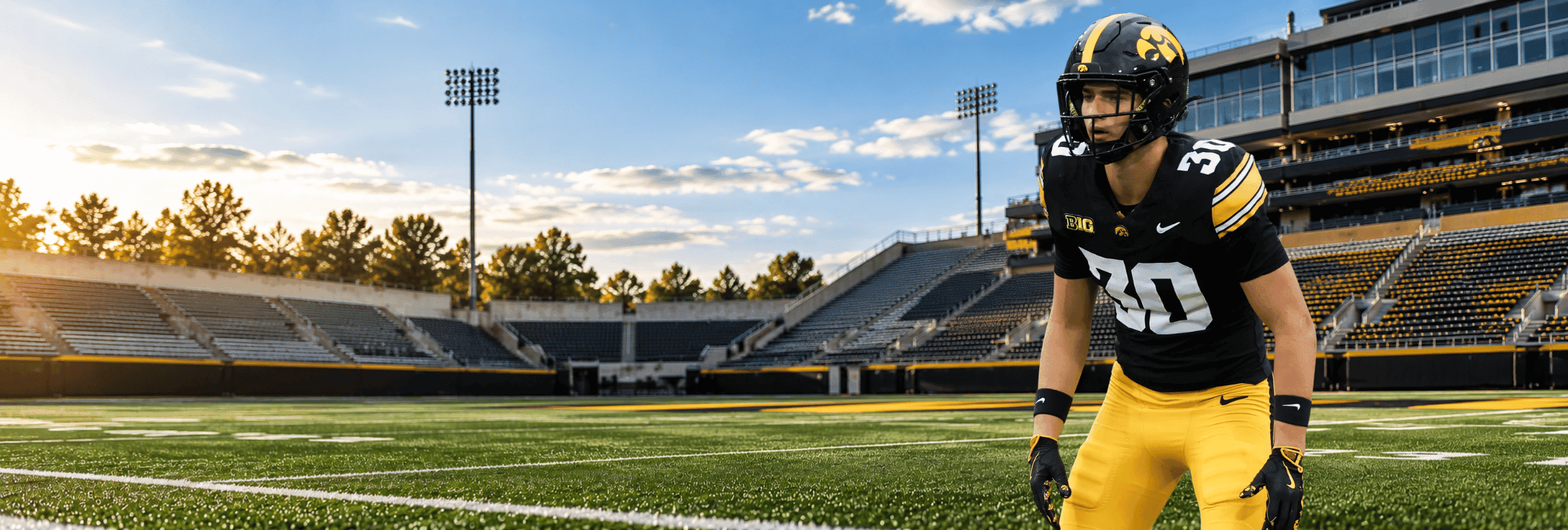
Now listed on Iowa's 2026 football roster as a freshman defensive back wearing No. 30, Kampman enters a new stage of development. His high school accomplishments offer a foundation, while college football presents a different level of competition, preparation, and opportunity.
- Full Name: Eli Kampman
- Sport: American football
- Position: Defensive back
- Jersey Number: 30
- Height: 6 feet, 2 inches
- Weight: 197 pounds
- Age: 18
- Date of Birth: March 16, 2008
- Birthplace: Solon, Iowa
- High School: Solon High School, Solon, Iowa
- College: University of Iowa
- Current Team: Iowa Hawkeyes
- Years Active: College football, 2026-present
Kampman's development took place in an environment where football was already part of his family's story. His father, Aaron Kampman, played football at the University of Iowa from 1998 through 2001 before embarking on a 10-year NFL career with the Green Bay Packers and Jacksonville Jaguars. Eli's uncle, Joe Slattery, also earned football letters at Iowa in 1998 and 1999.
Those connections give the family's Hawkeye ties a history stretching beyond a single generation. However, Eli's accomplishments should be understood on their own merits. The public record establishes his family connections but does not provide a detailed account of his childhood training, private family routines, or the specific advice his father gave him about the game.
At Solon High School, Kampman built a résumé that combined football production with academic and athletic involvement. He earned three letters in football, playing quarterback and defensive back, and also earned three letters in track and field as a sprinter.
His achievements suggest a young athlete whose development extended beyond a single position or sport. His experience as a quarterback gave him exposure to offensive responsibilities, while his defensive work provided a different perspective on reading plays and responding to opposing offenses.
Kampman's high school career featured consistent team success. According to Iowa's official biography, Solon won 29 games during his final three seasons with him in the program. The Spartans reached the state semifinals in 2023 and 2025 and the state quarterfinals in 2024.
That stretch established a competitive backdrop for his final high school seasons. Playing for a successful program meant contributing to a team with postseason expectations, although the available record does not detail his individual statistics in each playoff game.
As a quarterback, Kampman threw for 2,718 yards and 34 touchdowns. Those numbers represent a substantial body of production and demonstrate his experience directing an offense. They also distinguish him from defensive prospects whose football backgrounds have been limited to one side of the ball.
On defense, he recorded 33 tackles, forced two fumbles, and intercepted two passes. One of those interceptions resulted in a pick-six, giving him a touchdown scored directly from a defensive play.
The combination matters. Quarterback experience can provide a defender with a practical understanding of offensive concepts, passing situations, and the decisions that quarterbacks make under pressure. Kampman's background offers a basis for that perspective, although its precise effect on his college performance remains to be established.
His high school coach was Lucas Stanton, according to Iowa's official player biography. Publicly available information does not detail the individual coaching techniques or mentorship that shaped Kampman's development under Stanton.
The transition to Iowa places him among college athletes who must translate their high school experience into a more demanding environment. His official roster designation identifies him as a first-year player, and the available biography does not establish a starting role or a significant college statistical record at this stage.
That distinction is important: his high school production is documented, but his college career is still developing.
At 6-foot-2 and 197 pounds, Kampman has a physical profile suited to the demands of defensive back play. His high school statistics also show experience tackling, creating turnovers, and contributing to defensive scoring.
Interceptions and forced fumbles are particularly notable because they reflect opportunities to change possession. Kampman's two interceptions and two forced fumbles demonstrate that he made contributions in those areas at the high school level. They do not, by themselves, establish how frequently he generated turnovers or how his production compares with other defensive backs.
His quarterback background adds another dimension to his profile. Experience operating an offense can expose a player to route combinations, passing concepts, and the importance of timing. Those experiences may help a defensive back recognize offensive intentions, but college-level effectiveness will depend on how well he applies that knowledge alongside technique, speed, positioning, and discipline.
Kampman's track and field background provides another part of the picture. Three letters as a sprinter indicate experience in a sport where acceleration, conditioning, and movement mechanics matter. His exact sprint times and event-specific records are not publicly established in the available biography, so his speed cannot be quantified from the record alone.
His two-time captaincy is another meaningful credential. Leadership responsibilities at Solon suggest that coaches and teammates entrusted him with a visible role. Whether that leadership translates immediately to Iowa's locker room will depend on his adaptation to a college program with older and more experienced players.
Kampman's high school résumé includes several honors that reflect his performance in football, academics, and track and field.
His senior season brought All-State recognition as a quarterback from both the Iowa Football Coaches Association (IFCA) and the Des Moines Register. He was also selected as an Academic All-State honoree, adding scholastic achievement to his athletic credentials. Earlier, he earned Academic All-District honors in 2024 and 2025. Another milestone came in May 2026, when Kampman won a state title as part of a distance medley relay quartet. The achievement provided a final highlight to a high school career that extended across football and track and field.
His major documented accomplishments include:
- 2,718 passing yards and 34 passing touchdowns at quarterback.
- 33 tackles, two forced fumbles, and two interceptions as a defensive back.
- One defensive interception returned for a touchdown.
- Two-time football team captain.
- All-State quarterback recognition from the IFCA and Des Moines Register.
- Academic All-State and two-time Academic All-District honors.
- State champion in the distance medley relay in May 2026.
These achievements show that Kampman's preparation for college football was not confined to one area. His record reflects offensive production, defensive contributions, leadership, academic effort, and success in another sport.
Family is an important part of Kampman's connection to Iowa football. His father, Aaron, played for the Hawkeyes from 1998 to 2001 before moving into the NFL, where he played for Green Bay and Jacksonville. His uncle, Joe Slattery, also played for Iowa. Eli is one of four children in the family, according to the university's biography, which lists his parents as Aaron and Linde Kampman.
Although his father's professional career creates a natural point of comparison, Eli's own path includes a different set of accomplishments and challenges. His high school career featured two-way football, track competition, academic honors, and team leadership. Those experiences provide a foundation on which he can develop without being defined solely by his family's football history.
Academics also form a documented part of his profile. Kampman is majoring in enterprise leadership at the University of Iowa. His Academic All-State selection and Academic All-District honors suggest that he maintained a strong academic record alongside the demands of competitive athletics. Specific grades, scholarships, and future career plans have not been publicly confirmed.
Away from competition, Kampman enjoys fishing, golfing, and woodworking, according to Iowa's official biography. These interests offer a glimpse of his life beyond the football field, although the university has not published detailed accounts of how much time he devotes to each activity.
As of October 2026, Kampman is listed on Iowa's 2026-27 roster as a first-year defensive back. His listed measurements are 6-foot-2 and 197 pounds, and he wears No. 30. The official roster establishes his place in the program, but the publicly available player biography does not establish a starting position, a specific number of game appearances, or college defensive statistics.
His immediate challenge is to adapt the skills that worked at Solon to the speed and complexity of college football. Defensive backs must process offensive formations, recognize route concepts, communicate with teammates, and make decisions in tight windows. Kampman's quarterback experience may offer a useful foundation for understanding offensive intentions, while his defensive statistics show that he has already produced turnovers at the high school level.
However, the transition from high school standout to college contributor is rarely measured by a single statistic. Technique, strength development, consistency, film study, and the ability to learn a new defensive system all matter. Iowa's coaching staff will determine how and when his skills fit the team's needs.
His future role remains open. He may have opportunities to develop as a coverage defender, contribute on special teams, or compete for a larger defensive role as he gains experience. Those are possibilities rather than confirmed assignments. His progress will be best assessed through verified game participation, official statistics, and updates from the university.
Kampman's story is still in its early chapters, making any claim about his eventual college legacy premature. What can be established is that he arrives at Iowa with a diverse record of achievement and a meaningful connection to the program.
His high school production at quarterback and defensive back reflects an understanding of football from different perspectives. His captaincy demonstrates that he held leadership responsibilities at Solon, while his track and field success adds evidence of athletic range. His academic recognition also shows that his preparation extended beyond the field.
For a young player entering a program with a strong football identity in his home state, the opportunity carries both familiarity and expectation. The university is not simply a continuation of his father's story; it is the place where Eli must begin building his own.
If his high school experience provides a starting point, his college career will determine what comes next. His development will depend on how he responds to new challenges, competes for opportunities, and contributes to the Hawkeyes over time.
Eli Kampman enters Iowa football with a combination of proven high school production, two-way experience, academic accomplishment, and family ties to the Hawkeyes. His 2,718 passing yards, 34 passing touchdowns, defensive takeaways, and state championship in track and field offer a substantial foundation for a first-year college athlete.
Yet his most important chapter is still unwritten. The statistics establish what he accomplished at Solon; they do not predetermine what he will become in Iowa City.
For now, Kampman's journey is one of preparation and possibility. He has earned his place on the Hawkeyes' roster, and the next step is to turn the lessons of his high school career into consistent performance at the college level. In a program connected to his family's history, his ultimate achievement will be defining a legacy that belongs to him.