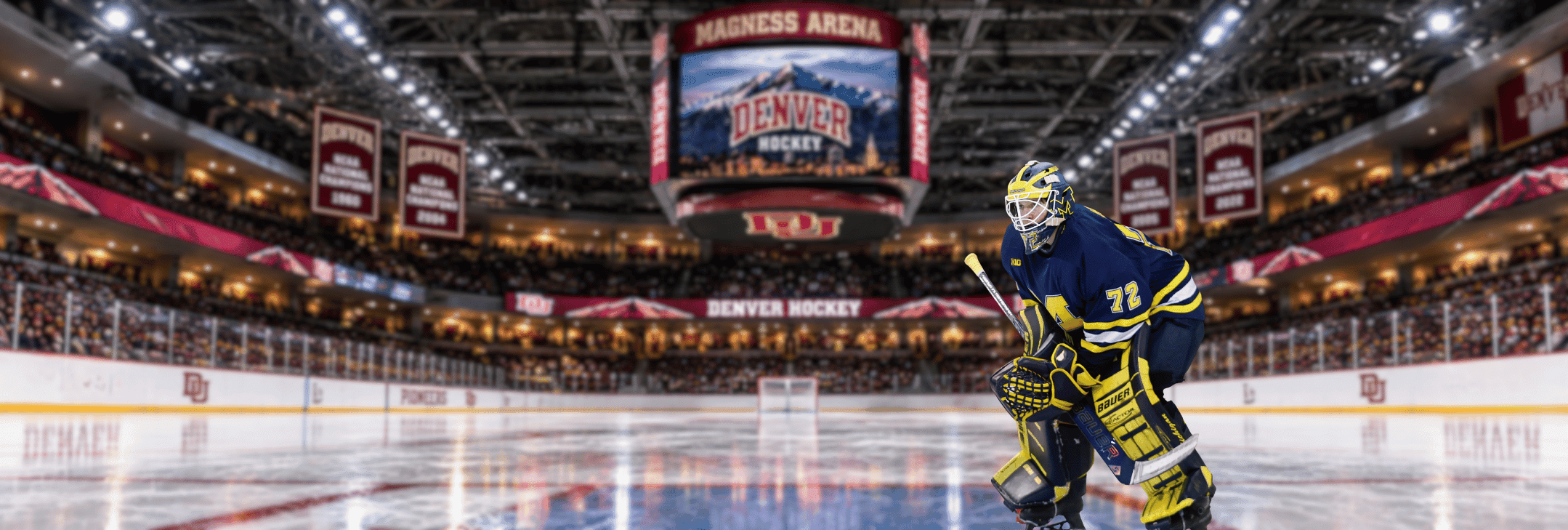

The Wolverines survive Denver’s comeback and secure a road sweep with Asher Barnett’s late winner, improving to 6-0-0 for the second consecutive season.
The No. 2 Michigan Wolverines defeated the No. 1 Denver Pioneers 4-3 on Saturday, October 17, 2026, at Magness Arena in Denver, Colorado, completing a two-game road sweep against the defending national champions. The victory extended Michigan’s record to 6-0-0 and established a program milestone, as the Wolverines started consecutive seasons with six straight wins for the first time in their history. After earning a 4-1 victory on Friday, Michigan faced a significantly tighter contest in the rematch, one that tested its defensive resilience and ability to respond when momentum shifted. Denver finished with a 36-25 advantage in shots on goal and won 39 of 75 faceoffs, while Michigan won 36. The Pioneers also converted twice on the power play, forcing the Wolverines to withstand repeated pressure throughout the evening. Despite those statistical advantages for the home team, Michigan remained composed and found the decisive goal with 4:53 remaining in regulation. The result completed Michigan’s first two-game road sweep over Denver since November 1976 and improved the Wolverines’ all-time record against teams ranked No. 1 nationally to 15-14-3.
Both programs demonstrated why they entered the matchup among college hockey’s elite, combining dangerous offensive sequences with important defensive stops. Denver recovered from a two-goal deficit to tie the game in the third period, but Michigan answered with the play that ultimately decided the contest. The Wolverines’ ability to convert opportunities at critical moments, protect their goaltender during extended defensive stretches, and regain the lead after surrendering it highlighted the difference between the teams. For Denver, the narrow defeat was a frustrating conclusion to a competitive series in which the Pioneers generated considerable offense but could not secure a victory. For Michigan, the 4-3 result represented another significant early-season achievement and reinforced its unbeaten start against high-level competition.
First-Period Special Teams Help The Wolverines Take Control
Denver struck first at 8:47 of the opening period, converting a power-play opportunity after Michigan was penalized for roughing. The Pioneers needed only 20 seconds with the extra skater to capitalize, putting the home side ahead and immediately challenging the Wolverines to respond. Michigan answered through captain Garrett Schifsky, who tied the game after an offensive-zone faceoff created a dangerous opportunity in front of the Denver net. Jack Nesbitt took the initial attempt, sending the puck off the crossbar before Schifsky finished the rebound in the crease. The official Michigan recap places the equalizer at 10:57, although the box-score scoring summary lists 10:50; the scoring summary provides the more precise reference for the official game record. The goal restored Michigan’s momentum and rewarded the Wolverines for maintaining pressure around the net rather than allowing Denver’s early advantage to dictate the period.
Michigan then took the lead at 16:12, capitalizing on a Denver too-many-men penalty. Adam Valentini finished a well-executed power-play sequence involving Landon DuPont and Henry Mews, putting the Wolverines ahead 2-1. The conversion came just seven seconds into the advantage, demonstrating Michigan’s ability to recognize space and execute quickly. The Wolverines finished the opening period with a 15-7 advantage in shots on goal and a narrow 13-12 edge in faceoffs. Both teams had scored once on the power play, making special-teams execution an important early factor. Denver had opened confidently, but Michigan’s response showed its ability to recover from an early setback, exploit an opponent’s penalty, and establish offensive pressure. The first period ended with the visitors holding a one-goal lead and a statistical advantage in shots, although the Pioneers remained firmly in contention.
Perron Extends Michigan’s Lead Before Denver Responds
Michigan increased its advantage to 3-1 at 4:10 of the second period when Jayden Perron scored his ninth goal of the season. Will Horcoff and Michael Hage assisted on the play, which saw Perron enter the offensive zone along the right side and shoot into the narrow space above the goaltender’s left shoulder. The goal extended Perron’s scoring streak and gave Michigan a two-goal cushion, but Denver steadily increased its pressure. The Pioneers reduced the deficit at 11:45 when they converted another power play, bringing the score to 3-2. That goal followed a high-sticking penalty against Michigan and demonstrated Denver’s ability to punish defensive mistakes. The home team continued generating chances, eventually taking a 22-21 lead in shots on goal by the second intermission. Denver also held a 29-25 advantage in faceoffs at that stage, creating a difficult defensive assignment for Michigan as the period progressed. The Wolverines faced another major test late in the frame when Drew Schock received an interference penalty and Cole McKinney was called for tripping just eight seconds later.
Michigan’s penalty killers successfully defended the ensuing shorthanded situation, while goaltender Jack Ivankovic made crucial saves during Denver’s late two-man advantage. Ivankovic finished the game with 33 saves on 36 shots, providing the defensive stability Michigan needed to preserve its lead. His performance became increasingly important as Denver generated more attempts and forced the Wolverines to defend for extended stretches. Michigan entered the third period ahead 3-2, but the narrow margin offered little room for error. Denver had already shown that its power play could change the game, and its growing advantage in shots suggested that another scoring opportunity was likely if the pressure continued.
Denver Levels The Score Before Barnett Delivers The Game-Winner
Michigan began the third period by successfully killing the remaining penalties carried over from the previous frame, preventing Denver from immediately capitalizing on its man advantage. The Wolverines then received a power-play opportunity of their own at 1:07, but could not convert. Denver continued pressing and eventually tied the game at 3-3 at 5:38, when captain Kieran Cebrian scored after an initial shot struck Ivankovic in the mask. The equalizer erased Michigan’s lead and placed the Wolverines under renewed pressure, with the Pioneers looking to complete their comeback in front of their home crowd. Michigan, however, continued competing for offensive opportunities instead of retreating into a purely defensive approach. The decisive moment arrived with 4:53 remaining in regulation. Defenseman Asher Barnett sent a long-range shot toward the Denver goal, and the puck caromed off the end wall before bouncing off the goaltender and into the net.
The goal was initially waved off because of a suspected high stick, but Michigan immediately challenged the decision. The successful challenge overturned the initial ruling, restoring Michigan’s 4-3 advantage. Nick Moldenhauer and Hage received the assists on Barnett’s game-winning goal. Denver had fought back from 3-1 down to tie the contest, but the late defensive breakdown proved costly. Michigan then protected its narrow lead through the closing minutes, denying the Pioneers another equalizer. Barnett’s goal ultimately separated the teams in a game where Denver had produced more shots and controlled slightly more faceoffs. The sequence also demonstrated the importance of persistence and situational awareness: Michigan kept attacking, challenged the initial ruling, and received the decision needed to reclaim the lead. With less than five minutes remaining, the Wolverines had the advantage they needed to complete the sweep.
Team Statistics Underscore Michigan’s Efficiency And Denver’s Missed Opportunity
The final statistics illustrate how Michigan prevailed despite Denver’s advantage in offensive volume. The Pioneers recorded 36 shots on goal compared with Michigan’s 25 and won 39 faceoffs to the Wolverines’ 36. Denver also scored twice on six power-play opportunities, while Michigan converted once on three chances. Michigan accumulated eight penalties for 16 penalty minutes, compared with Denver’s five penalties for 10 minutes. Ivankovic’s 33 saves were central to the result, as he helped Michigan withstand Denver’s sustained pressure and preserve the opportunity to win late. The Wolverines received goals from Schifsky, Valentini, Perron, and Barnett, showing that their scoring came from multiple contributors rather than one player alone. Hage recorded two assists, reaching 100 career points in his 78th game and joining Michigan’s Century Club. Denver received goals from Kristian Epperson, Sam Harris, and Cebrian, with Epperson and Harris each contributing a goal and an assist.
Although the Pioneers generated more shots and successfully erased a two-goal deficit, they could not find the equalizer after Barnett’s late goal. Michigan’s sweep improved its record to 6-0-0 and established a historic start to the season, while Denver fell to 2-2-0. The Wolverines were scheduled to return to Yost Ice Arena on Friday, October 23, to face Western Michigan in another important early-season matchup. Denver, meanwhile, would need to regroup after two consecutive defeats against Michigan and find ways to turn its offensive pressure into more favorable results. Saturday’s contest demonstrated the quality of both teams, but Michigan’s timely finishing, resilient penalty killing, and decisive late goal secured the difference. The 4-3 victory gave the Wolverines a memorable road sweep and another significant result in their pursuit of a successful season.