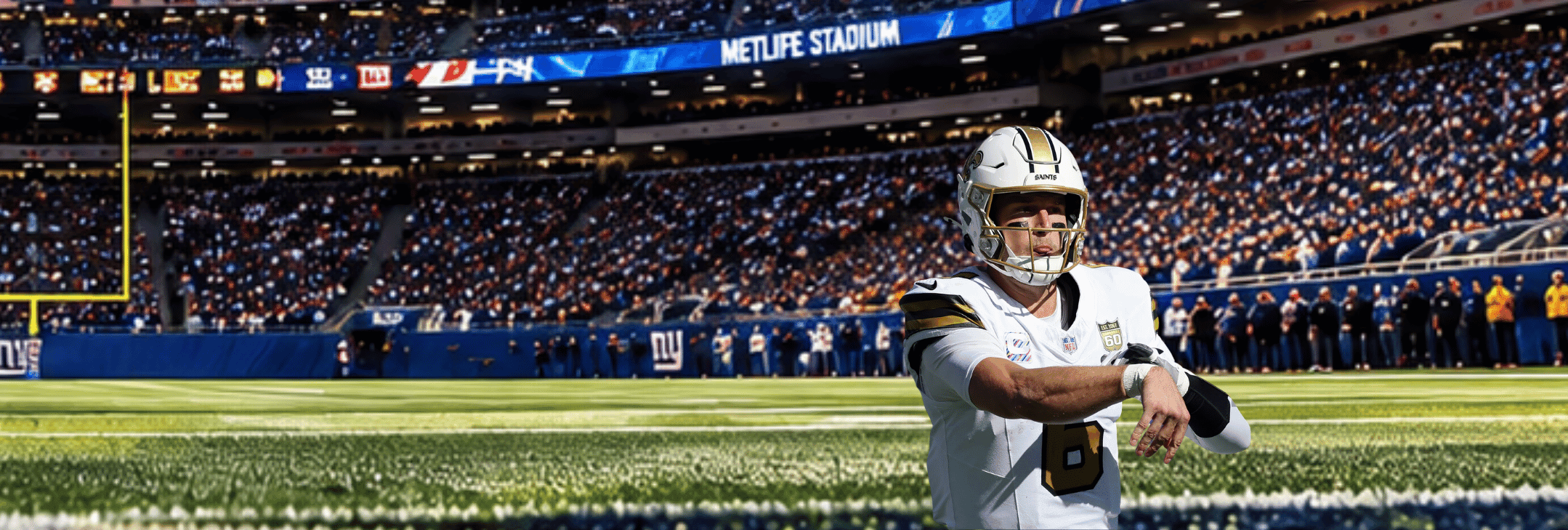

Tyler Shough Accounts For Four Touchdowns As New Orleans Overcomes An Early Deficit, Forces Three Interceptions, And Holds Off A Fourth-Quarter Comeback Attempt At MetLife Stadium.
The New Orleans Saints secured a 34-27 victory over the New York Giants on Sunday, October 18, 2026, at MetLife Stadium in East Rutherford, New Jersey, snapping a three-game losing streak and improving their record to 2-4. The Giants fell to 3-2-1 after surrendering an early advantage and mounting a late comeback that ultimately fell short. New York established its initial control in the first quarter when quarterback Jameis Winston connected with running back Tyrone Tracy Jr. for a 17-yard touchdown. Dominic Zvada added the extra point, giving the Giants a 7-0 lead. New York extended its advantage to 10-0 in the second quarter with Zvada’s 34-yard field goal, putting the Saints under pressure to respond. New Orleans began its comeback with Daniel Carlson’s 58-yard field goal, cutting the deficit to 10-3. The Saints then benefited from a critical special-teams turnover when Isaiah Stalbird forced a fumble on a kickoff and rookie tight end Oscar Delp recovered the ball.
The takeaway gave New Orleans an opportunity to capitalize before halftime. Quarterback Tyler Shough converted that opportunity by throwing a two-yard touchdown pass to Bryce Lance, tying the game at 10-10. The touchdown was particularly significant for Lance because it marked his first NFL scoring reception. The Saints carried that momentum into the second half, where their offense became more productive and their defense continued creating problems for Winston. New Orleans scored on five consecutive possessions during its turnaround, building a 34-10 advantage early in the fourth quarter. Although that margin appeared decisive, the Giants responded with three scoring drives of their own, turning the closing minutes into a tense contest. The final result reflected the Saints’ ability to capitalize on key opportunities and establish a commanding lead, while New York’s late offensive surge demonstrated its resilience without erasing the damage from the earlier scoring drought.
Tyler Shough Delivers Four Touchdowns In Balanced Saints Attack
Shough played a central role in New Orleans’ victory, completing 16 of 30 passes for 144 yards, three touchdowns, and no interceptions. He also rushed five times for 32 yards and a touchdown, finishing with four total touchdowns. Rather than relying on a high-volume passing performance, the Saints combined efficient scoring plays with a productive ground attack. Their first touchdown came on Shough’s short pass to Lance, which tied the game before halftime. In the third quarter, Shough connected with Alvin Kamara on a 31-yard touchdown reception, giving New Orleans its first lead at 17-10. Kamara’s score also marked a career milestone, as he surpassed 5,000 yards in both rushing and receiving during his NFL career. The Saints continued their scoring run when Shough crossed the goal line on a one-yard rushing touchdown, extending the lead to 24-10. Carlson then converted a 51-yard field goal to make it 27-10. Early in the fourth quarter, Shough delivered another important scoring pass, finding Chris Olave for an 18-yard touchdown that pushed the advantage to 34-10. The Saints’ rushing production was equally important in helping control the game.
Kendre Miller led the team with 70 rushing yards on 20 carries, while C.J. Donaldson added 39 yards on six attempts and Kamara contributed 34 yards on seven carries. Shough’s 32 rushing yards gave New Orleans another threat on designed runs and short-yardage situations. The Saints finished with 175 rushing yards and 319 total net yards, using their ground game to sustain drives and complement Shough’s touchdown production. Olave finished with four receptions for 43 yards and a touchdown, while Kamara recorded two catches for 35 yards and a score. The combination of rushing production, red-zone execution, and a turnover-free performance from Shough helped New Orleans establish control. However, the late collapse in defensive momentum meant that the Saints’ offensive success was not enough to make the finish comfortable.
Giants’ Passing Game Produces Yardage Despite Turnovers
New York generated 461 total net yards, substantially more than New Orleans’ 319, but struggled to turn that production into enough points to win. Winston completed 14 of 26 passes for 152 yards, one touchdown, and two interceptions before being replaced by J.J. McCarthy early in the fourth quarter. His touchdown pass to Tracy gave the Giants their initial lead, but the two interceptions disrupted their ability to maintain control. McCarthy entered the game and completed 11 of 21 passes for 243 yards, one touchdown, and one interception. His passing performance helped fuel the late comeback and gave New York a more aggressive downfield attack. Malik Nabers was the Giants’ leading receiver, finishing with 12 receptions for 165 yards. Isaiah Likely added six catches for 99 yards and a touchdown, while C. Jones recorded two receptions for 66 yards. Tracy contributed two catches for 27 yards and a receiving touchdown, in addition to scoring on a five-yard rushing attempt during the fourth-quarter rally.
Despite the impressive receiving totals, the Giants finished with only 84 rushing yards, compared with New Orleans’ 175. That imbalance limited their ability to complement the passing game with a consistent ground attack. The Saints’ defense also played a decisive role in the outcome by recording three interceptions. Cornerback Martin Emerson Jr. intercepted a pass from each Giants quarterback, while safety Julian Blackmon intercepted Winston as well. The Saints’ official recap credited the defense with four turnovers overall, including the earlier kickoff fumble recovery. Those takeaways gave New Orleans valuable opportunities and contributed to the Saints’ five consecutive scoring drives. New York also committed 10 penalties for 73 yards, compared with seven penalties for 52 yards by New Orleans. The Giants’ higher total yardage showed that their offense could move the football, but turnovers, penalties, and limited rushing production undermined their efficiency. The result highlighted the difference between accumulating yardage and consistently converting possessions into points. New York’s passing game was productive, but the offense needed better ball security and a more balanced approach to avoid falling into such a substantial deficit.
McCarthy Sparks Fourth-Quarter Comeback Attempt
The Giants’ comeback transformed the closing quarter after New Orleans had established a 34-10 advantage. McCarthy’s entry provided an immediate spark, allowing New York to attack more aggressively through the air. The Giants first cut into the deficit when Tracy scored on a five-yard rushing touchdown. McCarthy then connected with Likely on the two-point conversion, reducing the score to 34-18. New York continued its push with a 24-yard touchdown pass from McCarthy to Likely, bringing the Giants within 10 points at 34-24 after the failed two-point conversion attempt. Zvada subsequently converted a 41-yard field goal, narrowing the margin to 34-27. The scoring sequence gave the Giants a realistic opportunity to complete the comeback, especially after McCarthy produced 243 passing yards despite entering the game in the fourth quarter. Likely’s receiving touchdown and Tracy’s rushing score illustrated how New York could generate points through multiple offensive options when its passing attack found a rhythm.
Nabers remained an important target throughout the game, and his 165 receiving yards helped provide the offensive foundation for the late push. However, the comeback could not fully compensate for the Giants’ earlier struggles. New Orleans had built its advantage by scoring on five consecutive possessions and forcing multiple turnovers, leaving New York with little margin for error. The Saints’ defense faced increasing pressure as the Giants attacked downfield, and the late scoring drives exposed the difficulty of protecting a large lead against a quarterback capable of producing explosive plays. Still, New Orleans made the necessary stops to prevent the Giants from tying the game. The final possession ended with McCarthy unable to complete a pass into the end zone with 12 seconds remaining. The unsuccessful final attempt preserved the Saints’ seven-point advantage and ended New York’s comeback bid. McCarthy’s performance gave the Giants a reason for encouragement, but the overall result remained a loss shaped by the turnovers and scoring opportunities they could not overcome earlier in the contest.
Saints Secure Road Win As Giants Assess Areas For Improvement
New Orleans left MetLife Stadium with a 34-27 victory that ended its three-game losing streak and provided a much-needed boost to its season. The Saints’ success came from a combination of Shough’s four total touchdowns, 175 rushing yards, timely special-teams execution, and a defense that generated three interceptions. Miller’s 70 rushing yards helped the team maintain its ground-game production, while Kamara and Olave supplied important receiving touchdowns. Emerson’s two interceptions and Blackmon’s takeaway also proved influential in preventing the Giants from maintaining their early momentum. Nevertheless, New Orleans will need to examine its fourth-quarter defense after allowing New York to score 17 points and reduce a 24-point deficit to a single score. Protecting leads more effectively will be important as the Saints move forward in the season. For the Giants, the loss was disappointing given their 461 total yards and the late surge that brought them within striking distance.
Nabers’ 165 receiving yards and Likely’s 99 yards and touchdown showed the potential of their receiving group, while McCarthy’s fourth-quarter performance gave the offense a productive alternative after Winston was benched. However, the Giants must address their turnovers, penalties, and inability to sustain a consistent rushing attack. Winston’s two interceptions and McCarthy’s additional interception contributed to a difficult afternoon for ball security, while the team’s 84 rushing yards left too much responsibility on the passing game. New York’s late rally demonstrated determination, but the earlier deficit proved too large to overcome. The Saints, meanwhile, can take confidence from a road victory in which they responded to an early 10-point deficit, scored 34 points, and made the defensive plays required to preserve the result. The official final score was New Orleans Saints 34, New York Giants 27, on October 18, 2026, at MetLife Stadium.