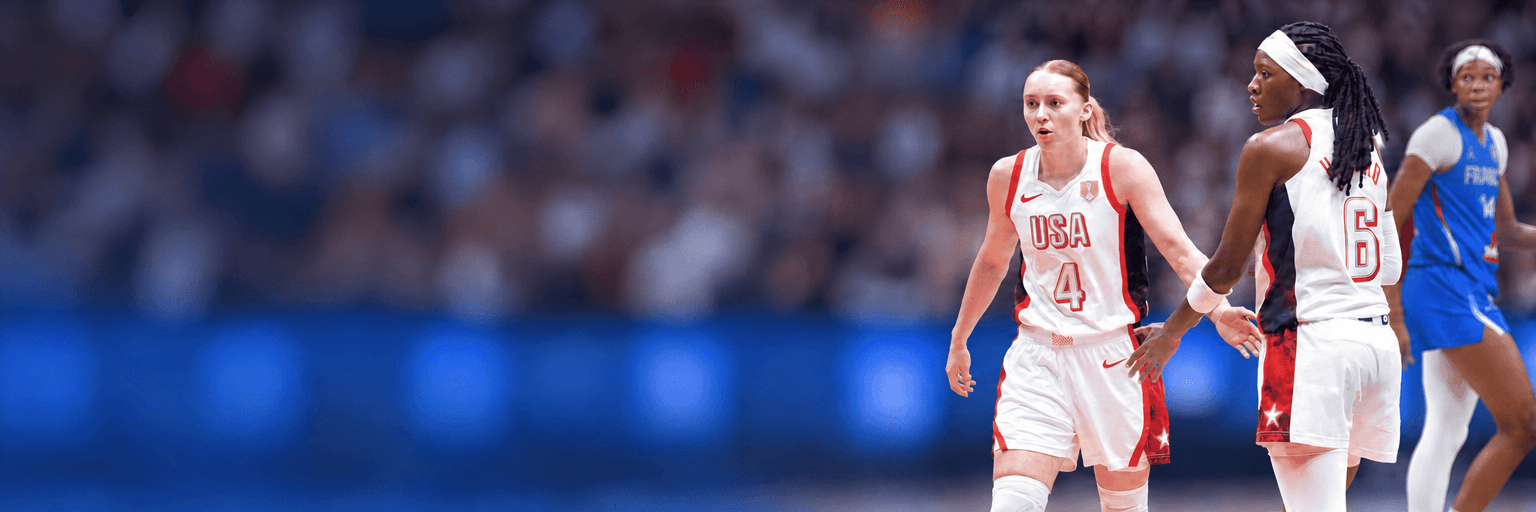

USA triumphs over France 97-79 in the 2026 FIBA Women's Basketball World Cup final, securing their fifth consecutive title.
The United States women’s national basketball team once again stands atop the international game after overcoming a dramatic early challenge from France to win the 2026 FIBA Women’s Basketball World Cup final, 97-79, in Berlin. The Americans entered the championship game seeking their fifth consecutive World Cup title and were pushed harder than expected by a French team appearing in its first-ever World Cup final. France looked capable of producing one of the biggest upsets in tournament history when it built a 14-point advantage in the first half, but the United States responded with veteran poise, defensive pressure and an overwhelming third-quarter performance. The victory extended the Americans’ record total to 12 World Cup championships and continued their extraordinary run of success in major international competition. The U.S. has now gone two decades without losing an Olympic or World Cup game, an unprecedented level of sustained dominance in women’s basketball.
France's Strong Start
France delivered exactly the kind of opening that could have changed the entire tournament narrative. After a relatively even start, the French produced a stunning 21-2 scoring burst and surged ahead behind the shot-making and aggression of Gabby Williams. France eventually led by as many as 14 points, taking advantage of its perimeter shooting and defensive intensity while forcing the Americans to work for every possession. Williams was particularly influential during the opening half, while Dominique Malonga provided another major offensive threat. France went into halftime still holding the advantage at 45-43, but the momentum had already begun to shift. Caitlin Clark hit a crucial three-pointer late in the second quarter, helping the Americans reduce what had been a substantial deficit to only two points at the break. That sequence proved important because it prevented France from carrying a commanding lead into halftime and gave the United States an opportunity to reset.
USA's Dominant Response
The decisive change came immediately after halftime. The United States raised its defensive intensity, attacked the offensive glass and began generating transition opportunities that had been largely unavailable during France’s first-half surge. Back-to-back three-pointers from Kahleah Copper and Jackie Young helped ignite the American comeback, while Breanna Stewart took control at both ends of the floor. The third quarter became the turning point of the championship game as the United States overwhelmed France with physicality, rebounding and efficient offensive execution. The Americans outscored France 30-12 in the third quarter, transforming a two-point halftime deficit into a commanding lead. By the beginning of the fourth quarter, the United States had stretched its advantage to 19 points, effectively taking control of the championship. France, which had shot exceptionally well from three-point range in the opening half, struggled to maintain that efficiency once the American defense increased its pressure.
Key Performances
Stewart was the centerpiece of the American response and finished with a game-high 22 points while also contributing ten rebounds, providing the veteran leadership the United States needed when the final appeared to be slipping away early. Young added 18 points, while Copper contributed 15 as the Americans received important production from several experienced players. Clark finished with 12 points, including the important three-pointer that helped stabilize the United States before halftime. The Americans also controlled the rebounding battle, finishing with a 36-27 advantage, a difference that became increasingly significant as the game progressed. France was led by Malonga, who scored 21 points, while Williams finished with 20 after a spectacular first half. However, the American defense succeeded in limiting France’s leading offensive threats after halftime, and the French attack could not recreate the rhythm that had produced its early advantage.
Conclusion
The championship was ultimately a powerful demonstration of why the United States remains the benchmark in international women’s basketball. France entered the final undefeated and had been one of the tournament’s most impressive teams, making its first appearance in a World Cup championship game after consistently overwhelming opponents throughout the competition. Its ability to build a double-digit lead against the Americans showed just how much the international field has improved. Yet the United States demonstrated the difference that experience, depth and composure can make under championship pressure. Rather than panic after falling behind, the Americans gradually changed the game through defense, rebounding and transition play. Once the third-quarter surge began, France could not find an answer. The final 18-point margin was therefore misleading in one respect: for much of the first half, France had Team USA under genuine pressure. But it was also an accurate reflection of how completely the Americans controlled the game after halftime.
For the United States, the 97-79 victory represents another defining chapter in an extraordinary era. The Americans captured their fifth consecutive FIBA Women’s Basketball World Cup championship and their 12th overall, further separating themselves from every other nation in the history of the competition. The result also reinforced the importance of Stewart and the veteran core while highlighting the contributions of players such as Young, Copper and Clark. France leaves Berlin with its first World Cup silver medal and the knowledge that it came within one strong half of producing a historic upset. Instead, the United States once again found a way to respond when the stakes were highest. France’s first-half brilliance made the final competitive, but America’s second-half dominance made the championship its own.