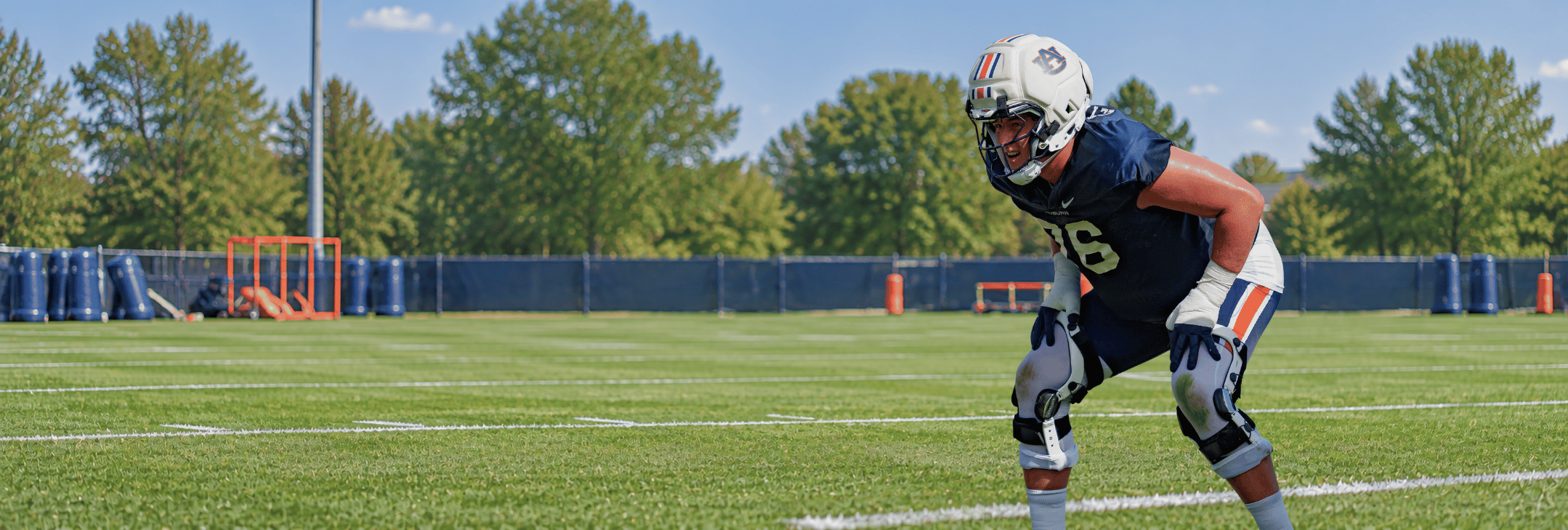

How Auburn’s Veteran Offensive Lineman Turned Adversity Into a New Beginning
After five seasons at Stanford, offensive lineman Jack Leyrer brought his experience, academic accomplishments, and determination to Auburn for the 2026 season. Following an injury that sidelined him throughout 2025, the Dallas native embraced a new program and another opportunity to compete at the highest level of college football.
For an offensive lineman, success is often measured by what never happens. A quarterback remains untouched. A running back finds a gap. A crucial third down becomes a first down because five players up front execute their assignments together.
The players responsible for those moments rarely receive the attention given to the athletes carrying the football. Yet their work can determine the outcome of a game.
Jack Leyrer understands that responsibility. Standing 6 feet 5 inches tall and weighing 314 pounds, the Auburn Tigers offensive lineman has built his college football career around the physical demands, preparation, and collective trust required to compete in the trenches.
His journey has taken him from Highland Park High School in Dallas, Texas, to Stanford University, where he appeared in 26 games and made 16 starts. It also included an injury that kept him off the field throughout the 2025 season.
Rather than allow that setback to define his career, Leyrer pursued another opportunity. He transferred to Auburn for the 2026 season, bringing experience from multiple offensive line positions and a renewed appreciation for the game.
In a July 2026 interview published by Auburn Athletics, Leyrer explained that his motivation extended beyond individual achievement. The relationships formed with teammates, the shared challenges of a season, and the opportunity to win together remained central to why he continued playing.
For a veteran approaching the final chapter of his college career, that perspective says as much about him as any statistic.
- Full Name: Jack Leyrer
- Sport: American Football
- Position: Offensive Lineman
- Jersey Number: 76
- Height: 6 feet 5 inches
- Weight: 314 pounds
- Hometown: Dallas, Texas
- High School: Highland Park High School, Dallas, Texas
- College: Stanford University; Auburn University
- Current Team: Auburn Tigers
- Season: 2026
- Previous Team: Stanford Cardinal
- Years Active: College football from 2021 through 2026, including a redshirt season and an injury-related absence
- Pronunciation: LAY-er
Leyrer's football development began in a community where the sport was deeply embedded in the local culture. Growing up in Dallas, he attended Highland Park High School, a program that provided the environment and coaching necessary to develop his abilities along the offensive line.
In an interview with Auburn Athletics, Leyrer recalled the strength of that football community and credited two of his high school offensive line coaches, James Farnsley and Grayson Wells, with helping shape him as both a player and a person.
Their influence extended beyond technique. Leyrer specifically acknowledged the lessons he learned away from the field, suggesting that his early development involved more than improving his physical abilities.
His mother, Shannan, also played an important role. According to Auburn's interview, she drove him to practices and training camps while encouraging him to become the best version of himself. Leyrer described his parents' sacrifices as instrumental in creating the opportunities he eventually received.
That support helped establish the foundation for his next step: playing college football at Stanford, where academic ambition and athletic development could coexist.
Highland Park also provided tangible evidence of his potential. Leyrer was ranked No. 37 among offensive tackle prospects by ESPN and No. 52 by PrepStar. He received recognition as a 2020 Dallas Morning News preseason all-area selection and a 2020 Dave Campbell's preseason all-state selection in Texas Class 5A Division I.
He also earned recognition as a 2019 all-district player. His high school teams captured a state championship in 2018 and district and area titles in 2019.
Those accomplishments helped establish him as a promising offensive line prospect before he entered the college game.
Leyrer's collegiate career began at Stanford, where he redshirted in 2021. That initial season provided an opportunity to develop within a college football program before he began accumulating playing experience.
In 2022, he appeared in four games and made three starts. His ability to work at different positions became an important feature of his development, with starts at both left and right tackle.
The following season, Leyrer appeared in 10 games and started three times, all at left tackle. The increased number of appearances offered further experience against the physical and technical challenges of college football.
His most extensive season came in 2024. Leyrer played in all 12 games and made 10 starts, including two at left tackle and eight at left guard. That versatility became a significant part of his football résumé.
Across his Stanford career, he played in 26 games and recorded 16 starts. Those appearances included six starts at left tackle, eight at left guard, and two at right tackle, according to Auburn's official profile.
The experience matters because offensive line positions demand different combinations of footwork, leverage, angles, and coordination. A player who has worked at several spots gains familiarity with the adjustments required to protect the quarterback and support the running game from different alignments.
Leyrer's college career was not uninterrupted, however. He did not see game action in 2025 because of an injury, ending what had been an important period of development with a season spent away from competition.
For an athlete whose role depends on repetition, timing, and physical readiness, such an absence presents a difficult challenge. It interrupts the routine of preparing for weekly games and forces a player to confront uncertainty about when he can return.
Leyrer later explained that injuries had given him perspective on what mattered most in football. He described watching teammates compete while he was sidelined as difficult, but said the experience reinforced his appreciation for the sport's relationships and team environment.
Offensive line play is built on details that can be difficult to appreciate from a distance. Every snap requires players to coordinate their movements, recognize assignments, and respond to defensive pressure in a fraction of a second.
Leyrer's background across left tackle, left guard, and right tackle demonstrates experience in multiple positions. His most extensive starting experience came at left guard, where he made eight starts during the 2024 season.
That versatility gives him a foundation for contributing wherever a coaching staff needs experience and competition along the offensive front. It does not automatically guarantee a starting role, but it provides a range of previous assignments on which to draw.
Leyrer's own description of offensive line football emphasizes collective responsibility. In his Auburn interview, he explained that five linemen must work toward one mission and trust one another for the unit to function effectively.
That observation captures an essential aspect of the position. A lineman can execute his individual assignment, but the play's success depends on how well his work connects with the movements of the other four players.
Preparation is equally important. Leyrer described daily attention to detail as fundamental to getting ready for competition. His approach reflects the repetitive nature of offensive line development, where consistency must be established in practice before it can be relied upon during a game.
Leyrer's story extends beyond football. His decision to attend Stanford was influenced by the opportunity to combine athletics with a strong academic experience.
He completed a degree in Science, Technology and Society and was selected to the Atlantic Coast Conference All-Academic Team during his Stanford career. These accomplishments demonstrate a commitment to education alongside the demands of college football.
His mother remained a central influence in that journey. Leyrer credited Shannan's encouragement and his parents' sacrifices with helping him reach the position he occupies today. His father is Matt Leyrer, and he has a sister named Lauren, according to Auburn's official player profile.
The injury-related absence in 2025 also influenced how he viewed his athletic career. Rather than treating football solely as a pursuit of individual achievement, he emphasized the relationships formed through shared experiences and the importance of being part of a team.
That outlook became especially relevant when he considered his future beyond Stanford.
Leyrer transferred to Auburn seeking to become the best football player he could be while taking advantage of another year of eligibility associated with his injury history. He also identified finance or consulting as possible career paths after football, although he expressed a desire to continue playing for as long as opportunities remained.
His willingness to consider life beyond sports reflects the balance he has pursued throughout his college experience: developing as an athlete without neglecting the education and preparation that can support his future.
Leyrer's arrival in Auburn represented more than a change of uniform. It gave him an opportunity to begin again within a different program and compete under head coach Alex Golesh.
He spoke positively about Auburn's football culture, describing the community's investment in the team as something distinctive in his experience. He also praised Golesh for caring about players individually and helping establish a culture built around accountability.
Entering the 2026 season, Leyrer was listed on Auburn's roster as a fifth-year offensive lineman wearing No. 76. His experience at Stanford positioned him among the team's more experienced offensive line options, although his exact role remained subject to the coaching staff's decisions and competition during the season.
The opportunity also carried personal significance. After missing the 2025 season, he had another chance to compete, develop relationships with teammates, and contribute to a program pursuing its goals.
As of October 31, 2026, the season remains underway. A complete assessment of his year should therefore account for the remaining schedule and verified final statistics rather than treating the campaign as finished.
Leyrer's legacy is still developing, and it would be premature to measure it through championships, professional achievements, or long-term influence that have not yet been established.
His documented career already reflects several meaningful accomplishments: recognition as a highly regarded high school prospect, 16 starts across 26 appearances at Stanford, academic achievement, experience at three offensive line positions, and the decision to pursue another opportunity after an injury-related season away from competition.
At Auburn, he also brings lessons accumulated through years of college football. He has spoken about the importance of sharing experience with younger teammates and understanding the trust required among offensive linemen.
Those contributions can matter even when they do not appear in a box score. Experienced players help establish expectations in practice, communicate assignments, and reinforce the understanding that individual success depends on collective execution.
Whether Leyrer's Auburn chapter ultimately produces a starting role, a standout statistical season, or further opportunities beyond college football remains to be seen. What is clear is that he entered this chapter with substantial experience and a stated commitment to preparation, teamwork, and continued development.
Jack Leyrer's football journey has been shaped by strong early coaching, family support, academic ambition, collegiate experience, and the challenge of returning from injury.
His move from Stanford to Auburn represents the continuation of a career built through opportunities earned and setbacks endured. Rather than defining himself exclusively by what he lost during the 2025 season, he has focused on what remains possible.
For an offensive lineman, the job ultimately comes down to showing up, mastering the details, and trusting the teammates working beside him. Leyrer's own words reflect that understanding.
As he pursues his final season of college eligibility, his story is not simply about a change of schools. It is about recognizing the value of another chance and approaching it with the experience accumulated over years of preparation.
The next chapter will be determined on the field. But Leyrer's journey already offers a compelling reminder that resilience in football is not always about a dramatic comeback or an individual accolade. Sometimes, it is about returning to the work, rebuilding trust in one's abilities, and giving a team everything possible when another opportunity arrives.