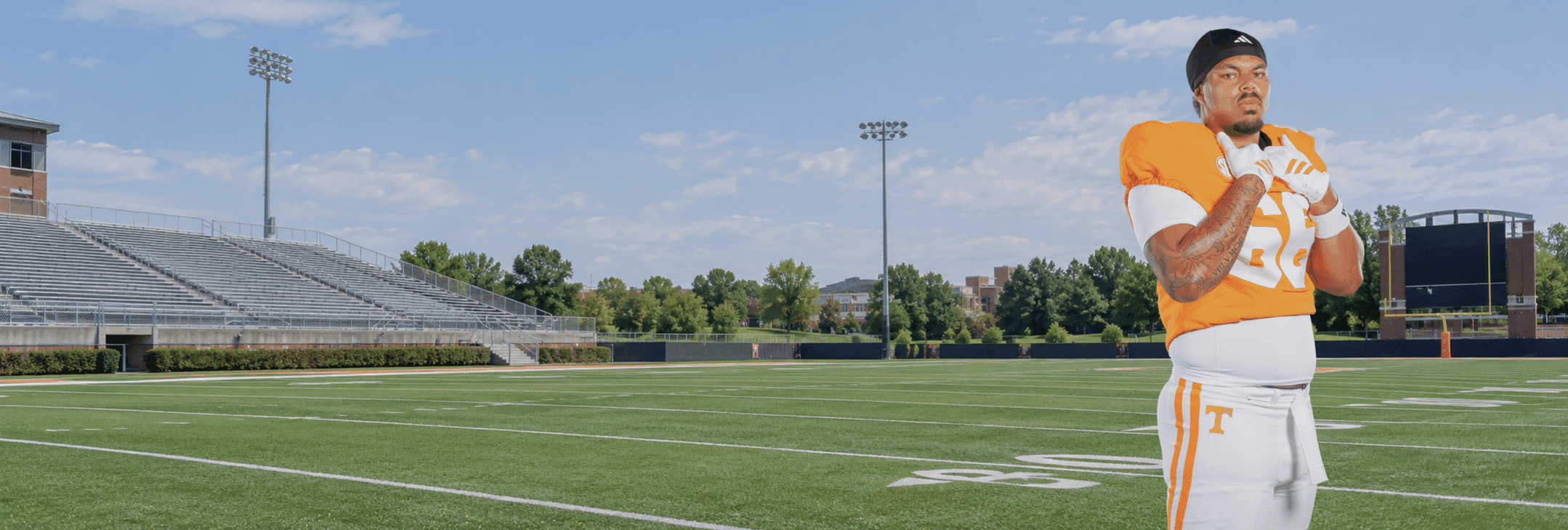

Tennessee’s Homegrown Offensive Tackle Making His Future on Rocky Top
From a standout two-way career at Kirkwood High School in Clarksville to the SEC spotlight, Kamari Blair has emerged as one of Tennessee’s promising young offensive line prospects. A consensus four-star recruit with a rare combination of size, versatility and defensive production, the freshman represents the next step in the Volunteers’ investment in homegrown talent.
At 6-foot-6, Kamari Blair has the physical dimensions college football coaches covet in an offensive tackle. But his journey to the University of Tennessee is about more than height, weight or recruiting rankings. Before arriving in Knoxville, Blair established himself as a standout at Kirkwood High School in Clarksville, Tennessee, where he demonstrated his abilities on both sides of the football.
His high school résumé tells an unusual story for an offensive line prospect. During his senior season, Blair recorded 51 tackles, 15 tackles for loss and six sacks on defense while also producing 36 pancake blocks on offense across 12 games, according to his Tennessee athletics profile. Those numbers illustrate a player who contributed well beyond a single position.
Now wearing No. 66 for the Tennessee Volunteers, Blair enters the next stage of his development in the demanding environment of Southeastern Conference football. The transition from high school standout to college offensive lineman requires patience, technical refinement and physical consistency. For Blair, the challenge is to turn the potential that attracted national attention into dependable performance at the highest level of college football.
His story is still unfolding. What makes it compelling is the foundation already established in his home state and the opportunity to build upon it at one of the state's most prominent football programs.
- Full name: Kamari Blair
- Sport: American football
- Position: Offensive lineman
- Jersey number: 66
- Height: 6 feet, 6 inches
- Weight: 293 pounds on Tennessee's 2026 roster
- Birthplace: Not publicly verified; hometown is Clarksville, Tennessee
- High school: Kirkwood High School, Clarksville, Tennessee
- College: University of Tennessee
- Current team: Tennessee Volunteers football
- Class: Freshman, 2026 season
- Recruiting status: Consensus four-star prospect
- Academic major: Sport management
- High school coach: Chad Watson
Blair developed his football identity in Clarksville, a Tennessee city whose high school sports programs have helped prepare athletes for the state's competitive college football landscape. At Kirkwood High School, he became known as a physically imposing lineman whose contributions extended to both the offensive and defensive fronts.
His progression through high school reflects a steady physical development. MaxPreps records him at approximately 240 pounds as a sophomore in 2023, 270 pounds as a junior in 2024 and around 290 pounds as a senior in 2025. By the time he reached Tennessee, he had grown into a 293-pound college offensive lineman.
That growth was accompanied by experience in multiple roles. Blair played offensive tackle and defensive end, learning to operate both as a blocker responsible for protecting an offensive play and as a defender tasked with disrupting one. The positions demand different technical skills, but both reward leverage, physicality, balance and an ability to engage opponents in close quarters.
Blair's rise accelerated during the 2026 recruiting cycle. He became a consensus four-star prospect and one of the most highly regarded players in Tennessee, attracting interest from programs across the country. Tennessee's official profile lists him among the state's top 10 recruits, with 247Sports, Rivals and ESPN each placing him among the leading in-state prospects.
His recruitment was competitive. Blair committed to South Carolina in July 2025 after considering multiple schools, including Tennessee and Ole Miss. On August 21, 2025, he reversed course and announced his commitment to the Volunteers. Reports at the time noted that he had drawn 28 other Division I offers, including interest from Power Four and Southeastern Conference programs.
The decision carried a distinct local significance. Rather than leaving Tennessee to begin his college career elsewhere, Blair chose to continue his development in his home state. His move also strengthened the Volunteers' effort to recruit highly rated Tennessee high school players.
In an interview excerpt published by The Tennessean and republished by Yahoo Sports, Blair described growing up watching Tennessee football and becoming increasingly comfortable with the program through repeated visits. He highlighted the relationships among the coaches and offensive linemen, as well as the opportunity to compete while receiving a college education.
Those comments offer a useful window into his decision. Recruiting is often framed through star ratings, facilities and national rankings, but Blair's explanation emphasized familiarity, trust and a sense of belonging. His eventual commitment suggested that Tennessee offered a combination of competitive opportunity and an environment in which he could envision himself developing.
After committing, Blair enrolled early and participated in Tennessee's spring practices ahead of the 2026 season. That early arrival gave him an opportunity to begin adjusting to college-level coaching, terminology, strength and conditioning, and the demands of an SEC offensive line.
Blair's statistical profile offers an unusual illustration of his versatility. As a senior at Kirkwood, he recorded 36 pancake blocks in 12 games, according to MaxPreps figures cited by Tennessee. On defense, he registered 51 tackles, 15 tackles for loss and six sacks. He also established school career records with 25 tackles for loss and eight sacks.
For an offensive tackle, pancake blocks are an especially telling measure of physical dominance: they represent blocks that knock defenders to the ground. Although the statistic does not capture every aspect of offensive line play, Blair's total suggests that he could finish blocks effectively in high school competition.
His defensive production adds another dimension. Playing on the defensive line requires recognizing offensive movement, reacting quickly and using leverage to penetrate gaps. That experience may help him understand the techniques and intentions of the defenders he will face as a college offensive tackle. It is a potential advantage, though its ultimate value will depend on how effectively he applies those lessons against SEC opponents.
At Tennessee, Blair's size gives him an imposing physical framework. College offensive line development, however, involves much more than adding strength. Hand placement, footwork, pass protection, communication and recognition of defensive fronts all become increasingly important against faster, stronger competition.
There is not yet enough publicly available college game data to make a definitive assessment of Blair's performance against SEC defenses. His high school production establishes a promising starting point, not proof that he has already mastered the college game.
Blair's accomplishments before college include several significant milestones:
- Consensus four-star recruit: Recognized by multiple national recruiting services.
- Top-10 in-state prospect: Ranked among Tennessee's leading recruits in the 2026 class.
- 2025 Tennessee Titans Mr. Football semifinalist: Earned recognition in the Class 5A category.
- Kirkwood career records: Finished with 25 tackles for loss and eight sacks.
- Senior-season production: Recorded 51 tackles, 15 tackles for loss, six sacks and 36 pancake blocks.
- Playoff milestone: Helped Kirkwood earn its first TSSAA playoff victory, a 31-7 first-round win over Brighton.
- College commitment: Chose Tennessee after considering multiple major college programs.
Tennessee lists sport management as his major, a field that can connect athletic experience with the business, administration and organizational side of sports.
His recruiting comments also point toward the importance he placed on relationships and honesty. Blair spoke positively about Tennessee's coaching staff and the connection within its offensive line group. That emphasis matters in a position where success depends on coordinated movement and shared responsibility. An offensive tackle can execute his assignment perfectly and still need the players beside him to recognize the same defensive threat.
For a freshman, adapting to that environment is a central part of the job. The transition requires learning when to trust physical instincts and when to rely on technique, preparation and communication. It also requires accepting that college football development rarely follows a straight line.
As of October 2026, Blair is listed on Tennessee's official roster as a freshman offensive lineman wearing No. 66. The university lists his measurements at 6-foot-6 and 293 pounds. Its public player statistics page does not provide individual season statistics for him, so his current playing time and game-by-game contributions cannot be established from that record alone.
The immediate question is how quickly Blair can translate his physical tools and high school experience into a consistent college role. Offensive line prospects often require time to develop the technical precision and strength necessary to handle experienced defensive linemen. His early enrollment and spring practice participation gave him a head start in learning Tennessee's system, but his longer-term role remains to be determined.
His potential value extends beyond an individual depth-chart position. Tennessee recruited Blair as part of a broader effort to strengthen its offensive line and keep elite in-state talent within the program. If he develops as projected, he could become part of the foundation protecting future Volunteers quarterbacks and supporting the team's running game.
Kamari Blair developed into a highly regarded prospect at Kirkwood, excelled on both sides of the ball, earned recognition among Tennessee's top high school players and chose to continue his career at a major program in his home state.
The next chapter will be defined by the less visible work of college football: repetition, film study, strength training, technical adjustments and competition for playing time. For an offensive lineman, those details often determine whether promising physical traits become lasting on-field contributions.
Blair's story is therefore not yet one of college stardom. It is a story of opportunity, preparation and potential. From Clarksville to Knoxville, he has earned the chance to test himself against the best competition available to him. What follows will depend on how he develops, how he responds to the demands of the SEC and how consistently he turns promise into performance.
For now, No. 66 represents a young Tennessee player with a substantial foundation and a long road ahead. His most important achievements may still be waiting to happen.