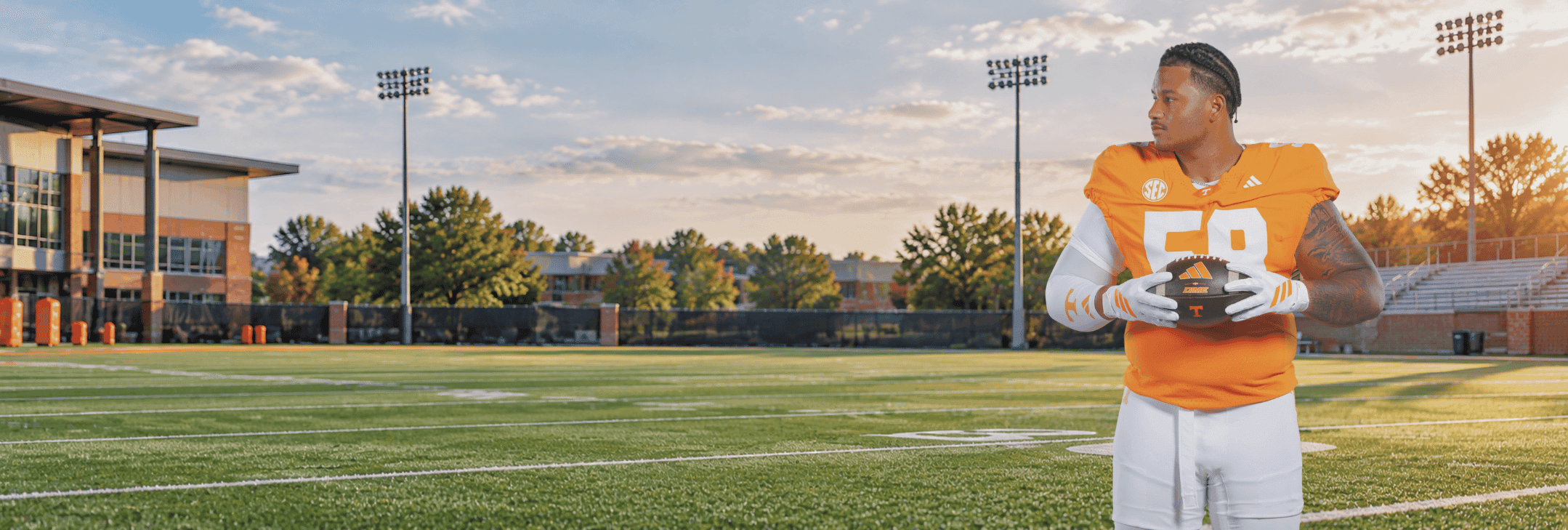

Inside the Making of a Versatile Volunteers Offensive Lineman
In football, some of the most important contributions happen without a player ever touching the ball. A running back’s burst through an opening, a quarterback’s clean pocket, or an offense’s ability to sustain a long drive can begin with an offensive lineman winning a matchup that most spectators barely notice.
For Nic Moore, that responsibility has become an increasingly important part of his development with the University of Tennessee Volunteers.
A native of Talbott, Tennessee, Moore arrived in Knoxville as a highly regarded in-state recruit from Jefferson County High School. His combination of size, strength, and experience on both sides of the football made him an intriguing prospect. By his sophomore season in 2026, he had begun translating that potential into meaningful opportunities, earning starts at left guard and center while helping Tennessee maintain its physical identity up front.
According to Tennessee Athletics, Moore has played without allowing a sack across his first 226 career offensive snaps. That figure offers a tangible measure of his early progress and underscores why his development deserves attention beyond the offensive line room.
- Full Name: Nic Moore
- Sport: American football
- Position: Offensive line; interior offensive lineman, including center and guard
- Jersey Number: 58
- Height: 6 feet, 3 inches
- Weight: 312 pounds, according to Tennessee’s 2026 roster
- Birthplace/Hometown: Talbott, Tennessee
- High School: Jefferson County High School, Tennessee
- College: University of Tennessee, Knoxville
- Current Team: Tennessee Volunteers
- Class: Sophomore in 2026
- Years Active: High school career followed by collegiate football beginning in 2025
- Career Honor: 2025 Fall SEC Academic Honor Roll
Moore’s football journey began in East Tennessee, where he developed into one of the region’s notable high school prospects. At Jefferson County High School, he became a versatile player whose responsibilities extended well beyond the offensive line.
He played left tackle and center on offense while also seeing time at defensive tackle. That experience required him to understand the game from different perspectives: protecting teammates and creating running lanes on one side, then attacking opposing blockers and disrupting plays on the other.
His defensive production demonstrated that he was more than an offensive lineman with a large frame. During his senior season in 2024, Moore recorded 56 tackles, including 11 tackles for loss, while continuing to anchor Jefferson County’s offensive front. He was named the 2024 Region 1-6A Offensive Lineman of the Year, recognizing his work in the role that ultimately became his college position.
Moore also participated in track and field. At the 2024 Tennessee Secondary School Athletic Association Outdoor State Championships, he finished third in the shot put. Competing in the event provided another outlet for his strength and athletic development, although his football performance remained the primary foundation of his college recruitment.
His high school career established him as a multi-dimensional athlete with experience that translated naturally to the demands of college line play.
By the time Moore reached his senior year, college programs had taken notice. Tennessee listed him as a consensus four-star prospect for the 2025 recruiting class, placing him among the top 300 players nationally according to the recruiting services cited in the university’s biography.
ESPN ranked him the nation’s No. 6 interior offensive lineman in that class and the No. 4 overall prospect in Tennessee. The 247Sports rankings cited by Tennessee placed him as high as No. 200 nationally.
Those evaluations helped make Moore an attractive recruit, but his decision also carried a local connection. He committed to Tennessee in June 2024, choosing the Volunteers over 10 other Division I offers, including seven Power Four programs, according to the university.
The decision allowed him to continue his football career in his home state while taking the next step toward competing in the Southeastern Conference. He enrolled at Tennessee in January 2025, beginning the transition from a high school standout to a college offensive lineman.
Another connection made the transition particularly meaningful: Jefferson County had been coached by former Tennessee offensive lineman Spencer Riley, a member of the Volunteers’ 1998 national championship team. Moore therefore came from a program with a direct link to Tennessee football history.
The adjustment to college football rarely happens overnight, particularly along the offensive line. Players must learn more complex protections, recognize defensive fronts, communicate assignments, and execute against defenders who possess greater size and speed than most high school opponents.
Moore’s first season at Tennessee was primarily a developmental year. The Volunteers redshirted him in 2025 after he appeared in three games. He saw action at center late in victories over ETSU and New Mexico State, and he also participated against Arkansas on the point-after-touchdown unit.
Although those appearances did not establish him as a regular starter, they gave him early exposure to the pace and expectations of college football. The redshirt designation preserved an opportunity for continued development while allowing him to gain limited game experience.
His second season brought a larger role. Tennessee’s official 2026 biography identifies Moore as a backup center who can also play guard, a valuable combination for a program managing the physical demands of a long SEC schedule.
His first career start came at center against Furman on September 5, 2026. Moore played 62 snaps as Tennessee produced 638 total yards, including 329 rushing yards. According to the university’s account of the game, he did not allow a pressure, as measured by Pro Football Focus.
That performance provided an early indication that he could handle a substantial workload. His ability to contribute at center was especially important because the position requires more than winning individual blocks: the center must also help coordinate the offensive line and deliver consistent snaps to the quarterback.
Moore subsequently played 11 snaps at center in Tennessee’s September 19 victory over Kennesaw State, again without allowing a pressure, according to the program’s biography.
In the win over Auburn, he started at left guard and played all 67 offensive snaps without allowing a sack. Tennessee rushed for 237 yards in that game, giving the offensive line an important role in the team’s ground production.
The following week, Moore played every one of Tennessee’s 64 offensive snaps at left guard in a road victory over Arkansas on October 10. He did not surrender a sack while the Volunteers generated 414 yards of total offense.
These assignments illustrate a significant development in his young career: Moore was no longer limited to occasional appearances. He was taking on full-game responsibilities at multiple interior positions against SEC competition.
Moore’s early collegiate résumé suggests that versatility is one of his most valuable assets. Tennessee has used him at both center and left guard, allowing the coaching staff to consider him for multiple roles along the interior offensive line.
The center position requires a distinctive combination of physical technique and mental discipline. Beyond blocking assignments, a center must deliver reliable snaps, recognize defensive alignments, communicate with teammates, and respond to changing fronts. Guards face their own challenges, including interior pass protection, double-team blocks, and creating space against defensive tackles.
Moore’s ability to handle both positions gives Tennessee flexibility when arranging its offensive line. His participation in full games against Auburn and Arkansas also demonstrates that he has been trusted with sustained responsibility rather than isolated assignments.
The most concrete measure of his pass protection is his record of zero sacks allowed through 226 career offensive snaps, as reported in Tennessee’s official biography. That statistic does not tell the entire story of offensive-line performance, but it provides a useful benchmark for his development.
Moore’s accomplishments span high school recognition, college recruitment, academic distinction, and early playing opportunities at Tennessee.
His most significant milestones include earning the 2024 Region 1-6A Offensive Lineman of the Year award, finishing third in the shot put at the 2024 TSSAA Outdoor State Championships, and receiving consensus four-star recruiting recognition.
At Tennessee, his first career start against Furman in September 2026 marked a turning point. Subsequent starts at left guard against Auburn and Arkansas demonstrated his growing usefulness to the offensive line.
He also earned a place on the 2025 Fall SEC Academic Honor Roll. The recognition adds an academic dimension to his college résumé, although publicly available information does not specify his GPA or individual coursework achievements.
Moore’s story is rooted in his connection to Tennessee. Growing up in Talbott and playing at Jefferson County placed him close to the program he would eventually join. His decision to remain in-state gave his college career a local dimension that distinguishes him from recruits arriving from across the country.
Tennessee identifies his parents as Mark and Jennifer Moore.
His stated priorities during his high school years provide a more direct glimpse into his character. In a December 2024 interview with Volquest, reported by On3, Moore explained that one of his goals during his senior season was to instill confidence in younger Jefferson County players. He wanted to leave the program with more than a reputation as a blocker, encouraging younger athletes to recognize their potential and continue working.
That sentiment offers a meaningful perspective on leadership. Moore’s contribution to a team was not limited to his physical role on the field; he also expressed an interest in helping the next generation of players develop.
Academically, Moore is majoring in journalism and media with a concentration in sports communication, according to Tennessee. The field connects his studies to the wider world of sports, although he has not publicly established a specific career plan beyond football.
As of October 18, 2026, Moore’s most recent documented performances show a player earning greater responsibility during his sophomore season. His starts at center and left guard suggest that Tennessee values his ability to provide interior depth and step into a larger role when needed.
The next stage of his development will depend on continued consistency, technical improvement, and his ability to maintain performance against increasingly challenging defensive fronts. Sustaining reliable pass protection while improving communication and run-blocking execution will be important as he competes for a more permanent place in the rotation.
Tennessee’s official profile identifies him as the program’s backup center who can also play guard. It does not establish a future starting position or guarantee a particular role for the remainder of the season. His long-term prospects should therefore be viewed as an opportunity rather than a certainty.
Offensive linemen rarely receive the same public attention as quarterbacks, running backs, or wide receivers. Yet their work determines how much time a quarterback has to throw and how effectively a running game can function.
Moore is still early in his college career, making it premature to assign him a lasting legacy at Tennessee. Nevertheless, his progression from a versatile high school athlete to a multi-position contributor in the SEC illustrates the importance of preparation and adaptability.
Nic Moore’s journey at Tennessee is a developing story, one shaped by local roots, a decorated high school career, and the demanding transition to SEC football.
His early college performances have provided measurable signs of progress: three career starts, experience at center and left guard, and no sacks allowed across 226 career offensive snaps, according to the university’s official profile. Those achievements do not guarantee future success, but they establish a credible foundation.
For Moore, the next challenge is to turn promising performances into sustained production. If he continues to develop his technique, strengthen his understanding of the offense, and contribute wherever Tennessee needs him, he can become an increasingly important part of the Volunteers’ offensive line.
His story reinforces a fundamental truth about football: success often begins with the players working in the trenches, where preparation, trust, and consistency can change the outcome of a game without ever appearing on the scoreboard.