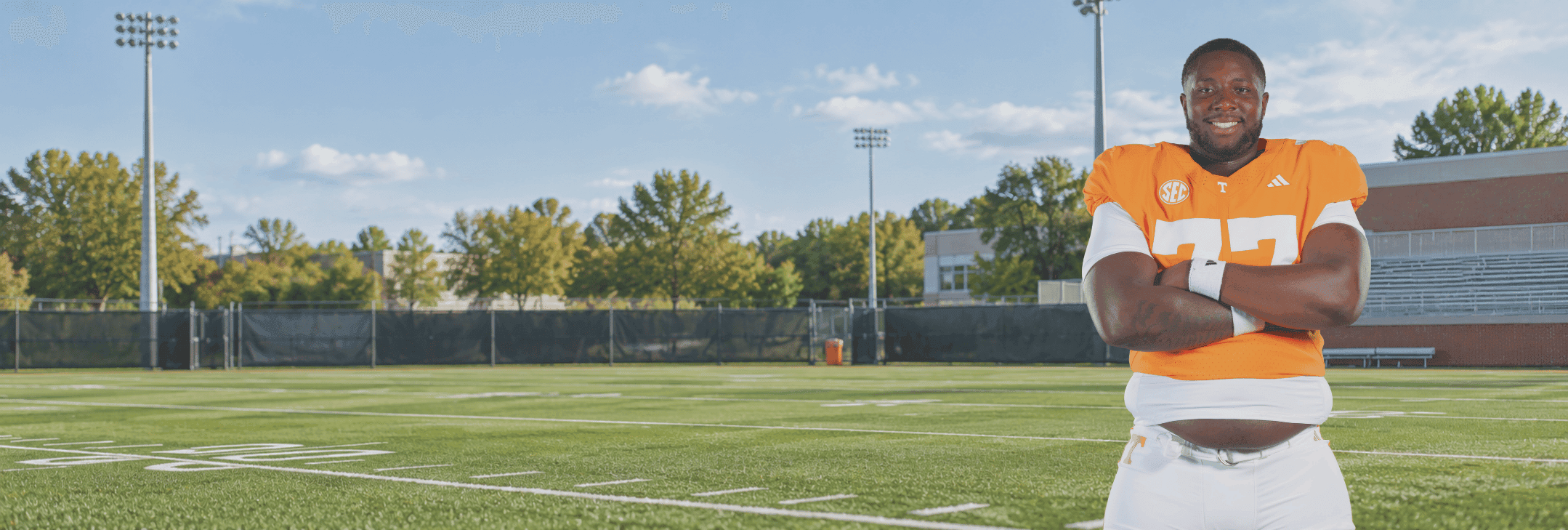

The Journey of Tennessee’s Towering Offensive Lineman
Standing 6-foot-8 and bringing experience from LSU, offensive lineman Ory Williams is carving out his place in Tennessee football. From his development at San Marcos High School to his transition into the Southeastern Conference, Williams’ journey reflects the technical discipline, patience, and physical preparation required to compete at college football’s highest level.
In football, some of the most important contributions happen far from the spotlight. While quarterbacks receive attention for spectacular throws and running backs earn recognition for explosive touchdowns, offensive linemen work in the trenches, where positioning, timing, and physical toughness often determine the outcome of a play.
For Ory Williams, that responsibility comes with an imposing physical presence. At 6-foot-8 and 330 pounds, the Tennessee Volunteers offensive lineman possesses the size associated with the position, but his development has required more than physical attributes. His experience at Louisiana State University, his progression into a starting role at LSU, and his subsequent transfer to Tennessee have provided opportunities to refine his technique and prepare for the demands of SEC football.
Williams entered Tennessee in January 2026, beginning another chapter in a collegiate career that has taken him from Texas to Baton Rouge and Knoxville. Wearing jersey No. 77, he joined a program seeking to build a powerful, dependable offensive front under head coach Josh Heupel.
His story is one of continued development. Offensive line play rarely produces the statistics that dominate a box score, but Williams’ progress can be measured through his appearances, his growing responsibilities, and his ability to protect the quarterback while helping establish the foundation of an offense.
- Full Name: Oryntheius Williams
- Sport: American Football
- Position: Offensive Line
- Jersey Number: 77
- Height: 6 feet, 8 inches
- Weight: 330 pounds
- Birthplace: Born in northern Louisiana; exact birthplace is not publicly confirmed
- Hometown: San Marcos, Texas
- High School: San Marcos High School
- College: Louisiana State University; University of Tennessee
- Current Team: Tennessee Volunteers
- Conference: Southeastern Conference (SEC)
- Class: Junior, according to Tennessee’s 2026 roster
- Years Active: Collegiate football, 2024-present
- Previous School: LSU
- Major: Journalism and Media
Williams’ football journey developed in Texas, where he attended San Marcos High School. Although he was born in northern Louisiana, he moved to Texas and established himself as a promising athlete in his adopted home state.
At San Marcos, his size and athletic ability offered a foundation for offensive line play. The position demands a combination of strength, balance, coordination, and awareness. Linemen must recognize defensive movements, understand blocking assignments, and respond quickly to changes that can unfold in fractions of a second.
Williams distinguished himself through his work on the football field. He earned first-team All-District honors during both his junior and senior seasons, establishing himself as one of the notable players in his high school program.
His contributions also helped San Marcos develop a productive rushing attack. During his senior season, the offense averaged approximately 220 rushing yards per game, according to Tennessee's official player biography. Although that production reflected the work of an entire offensive unit, it illustrated the importance of the blocking responsibilities Williams and his teammates carried.
Football was not his only athletic pursuit. Williams also stood out in basketball, earning honorable All-District recognition. Playing multiple sports can help athletes develop coordination, spatial awareness, and body control, qualities that can prove useful when navigating the crowded spaces of the offensive line.
His high school achievements attracted college recruiting attention. Tennessee's official biography identifies him as a three-star prospect in the On3 Composite rankings and lists him among the nation's leading offensive tackle prospects in the 2024 recruiting class.
Those credentials helped open the door to Southeastern Conference football, where the demands of the position would become significantly more challenging.
Williams began his collegiate career at LSU in 2024. His first season was brief on the field, as he appeared in one game before earning a redshirt. He make his collegiate debut against Arkansas, participating in one offensive snap.
That initial appearance represented a starting point rather than a finished product. Offensive linemen frequently need time to adjust to college defensive fronts, more complicated blocking schemes, and the physical demands of playing against experienced defenders.
In 2025, Williams made meaningful progress. He appeared in 12 games for LSU and earned two starts at left tackle. Much of his playing time came on point-after-touchdown and field-goal units, but he also gained opportunities on offense.
His first career start came against Arkansas on November 15, 2025. Williams played 74 offensive snaps in that game without allowing a sack or quarterback pressure, according to Tennessee's official statistics. He started again the following week against Western Kentucky, gaining additional experience in a more substantial role.
Another encouraging performance came against Alabama on November 8, 2025. Williams played 32 offensive snaps without surrendering a sack or quarterback pressure. Against a prominent SEC opponent, that performance provided evidence of his ability to handle demanding assignments.
Across his LSU career, Tennessee's official profile credits Williams with 13 appearances and two starts. He also entered the transfer portal as one of the more notable offensive tackle prospects available in the 2026 cycle.
In January 2026, he enrolled at Tennessee and participated in spring practice with the Volunteers. The move gave him a fresh opportunity to compete for playing time while bringing experience from two seasons in LSU's program.
Transferring between SEC programs can mean learning a different offensive system, adjusting to new coaching expectations, and building trust with teammates. For an offensive lineman, those adjustments are especially important because successful blocking depends on communication and coordination across the entire front.
Williams' previous experience offered a useful starting point, but his Tennessee chapter required him to establish himself within a new group.
Williams' most obvious physical advantage is his frame. At 6-foot-8 and 330 pounds, he has the size to occupy space against defensive linemen and provide a substantial presence in pass protection.
However, effective offensive tackle play involves considerably more than size. Linemen must maintain appropriate leverage, control their balance, recognize pass-rush approaches, and coordinate their footwork with the quarterback's movements and the offensive scheme.
Williams' statistical record offers one measurable indication of his development. Tennessee's official career biography states that he had played 222 offensive snaps without allowing a sack, including his time at LSU and Tennessee as recorded in that profile. Such a figure highlights a notable area of production, although sack prevention alone cannot capture every aspect of an offensive lineman's performance.
His experience at left tackle for LSU also gave him exposure to the responsibilities of protecting the quarterback's blind side when operating on that side of the formation. At Tennessee, he has the opportunity to apply that experience wherever the coaching staff determines his skills best fit the offensive line.
His performance against Arkansas and Alabama in 2025 suggests an ability to execute assignments over extended stretches. The next stage is building consistency, improving his response to different defensive fronts, and translating individual execution into dependable unit-wide performance.
Williams' collegiate milestones include his 2024 debut at LSU, his first two starts in 2025, and his transition to Tennessee in 2026.
His high school résumé includes consecutive first-team All-District selections in football and honorable All-District recognition in basketball. He also helped San Marcos produce a productive rushing offense during his senior season.
At LSU, his ability to earn starts and contribute across multiple games represented important progress. His recorded performances against Arkansas and Alabama were particularly notable because he completed substantial offensive workloads without allowing a sack or quarterback pressure in either outing, according to Tennessee's official biography.
No major national individual award or championship specifically credited to Williams is established in the available official biography. His career to this point is more clearly defined by development, playing experience, and increasing opportunities than by individual honors.
Williams' journey includes an interest that extends beyond football. Tennessee's official biography lists journalism and media as his academic major, offering another dimension to his identity as a student-athlete.
Balancing academics with college football requires managing demanding practice schedules, team meetings, film study, travel, and coursework. For offensive linemen, preparation also involves understanding defensive tendencies and learning the responsibilities associated with each assignment. The combination of academic study and football preparation makes time management an important part of collegiate life.
His basketball background provides another glimpse into his athletic development. Competing in a second sport during high school gave him experience in a different competitive environment, where movement, positioning, and teamwork also mattered.
His path also illustrates an important reality of the sport: development is rarely linear. A first collegiate appearance can be followed by a season of limited offensive opportunities, then by starts that provide a clearer test of preparation and ability. For Williams, his two seasons at LSU helped build the experience he brought to Knoxville.
Williams' arrival at Tennessee in January 2026 placed him in a new competitive environment ahead of the Volunteers' fall campaign. He participated in spring practice and entered the season as a junior on the official roster.
He make his Tennessee debut against Furman on September 5, 2026. Williams played 48 offensive snaps in a 56-9 victory, helping the Volunteers produce 638 total yards. Although that team-wide offensive output cannot be attributed to one lineman, his substantial playing time marked an important early opportunity with his new team.
He also appeared in Tennessee's September 19 victory over Kennesaw State. According to the university's official biography, he played 15 snaps at left tackle and did not allow a pressure in the 42-9 win.
Those early performances offered tangible evidence of his transition into Tennessee's offense. His playing time also provided opportunities to develop familiarity with his teammates and demonstrate his readiness for SEC competition.
Tennessee subsequently faced a challenging stretch of conference games, including matchups against Texas, Arkansas, Auburn, and Alabama. The Volunteers defeated Arkansas 24-17 on October 10 and Alabama 26-10 on October 17, according to the available game records.
Williams' exact snap totals and individual blocking grades for every game in that stretch are not established by the official biography reviewed here. Accordingly, those team victories should be viewed as context for his season rather than evidence of individual statistics that have not been verified.
As the 2026 campaign progresses, his priorities will center on maintaining consistent execution, earning opportunities on the offensive line, and helping Tennessee sustain its offensive production against increasingly demanding opponents.
Williams is still developing his collegiate résumé, making it too early to define his long-term legacy. Nevertheless, his journey already illustrates several important elements of offensive line development: patience, adaptability, and the ability to turn limited opportunities into greater responsibility.
At LSU, he progressed from a one-snap debut to a season in which he appeared in 12 games and started twice. At Tennessee, he began another chapter, bringing SEC experience into a program with its own offensive identity and expectations.
For his teammates, offensive line performance is inseparable from collective execution. Communication between tackles, guards, and the center helps determine whether a protection holds together or a running lane opens. Every successful offensive possession depends in part on players performing those less visible responsibilities.
Williams' continued development could therefore matter beyond his own playing time. Greater consistency along the offensive front can help quarterbacks operate with confidence and give running backs opportunities to attack defensive gaps.
His academic interest in journalism and media also gives him a potential path beyond football, although his future professional plans have not been publicly confirmed. For now, his immediate challenge is to continue building his game and establish himself as a dependable contributor in Tennessee's program.
Ory Williams' story is still being written. From his early accomplishments at San Marcos High School to his development at LSU and his move to Tennessee, his career has been shaped by successive opportunities to learn, compete, and assume greater responsibility.
His 6-foot-8 frame and 330-pound build make him an imposing presence, but his most meaningful progress has come through documented playing experience, including two starts at LSU and his early opportunities with the Volunteers. His performances against Arkansas and Alabama in 2025 also demonstrated his ability to handle demanding assignments without allowing a sack or quarterback pressure.
At Tennessee, the next challenge is turning those encouraging moments into sustained performance across an entire season. That process requires technical discipline, communication, and a commitment to the details that often go unnoticed by casual observers.
Williams may not occupy the spotlight as often as the players who handle the ball, but his position places him at the center of every offensive possession. If he continues to develop and contributes to a stronger offensive line, his impact will be reflected in the opportunities he helps create for the entire team.
For now, his journey represents the ongoing work of a college football player building his place in the SEC one assignment, one practice, and one opportunity at a time.