
How the Bills are managing a $700 million cost overrun while turning fewer seats, premium suites, and long-term partnerships into lasting revenue.
Terry Pegula's new Highmark Stadium reached opening day about $700 million above its original price tag, but the government’s contribution didn't change. While New York State and Erie County stuck to their original $850 million limit, the Bills had to cover the difference as the project budget climbed from $1.4 billion to over $2.1 billion.
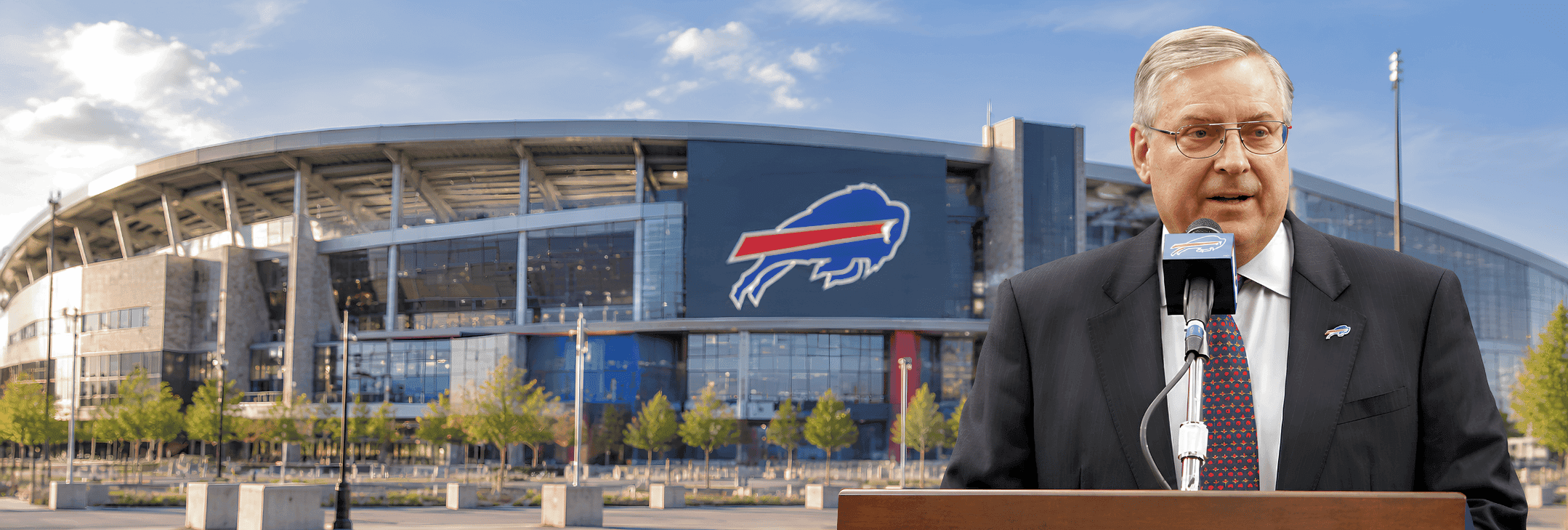
At the June 23 ribbon-cutting in Orchard Park, Pegula noted that fans picked up a big part of the tab through personal seat licenses (which are basically fees fans pay just for the right to buy season tickets).
“Our fans, the Bills Mafia, contributed $263 million through PSL purchases, and helped us finance what we're looking at here today. The Bills front office does not take this commitment by our fans lightly,” Pegula said.
Then the occasion became personal. His wife, Kim, helped shape the stadium and negotiate the deal before suffering a cardiac arrest in June 2022. Pegula grew emotional as he addressed her.
“Kim, I wish you could have finished this project with the same passion and hard work that you started with,” he said.
The moment explains why this building carries meaning beyond its price. But keeping that vision alive leaves the Bills with a tricky puzzle: how do you bring in more money every year when you actually have fewer seats to sell?
How the bill kept climbing
The size of the overrun really just depends on where you start counting. If you look back at the first announcement in 2022, the price jumped by $700 million. If you count from the actual budget set later on, it’s a $560 million increase. Either way, it's two different ways of looking at the same expensive project.
| Cost or funding source | Amount |
|---|---|
| 2022 announced price | $1.4 billion |
| 2023 construction budget | About $1.54 billion |
| Cost at opening | Just over $2.1 billion |
| State construction contribution | $600 million |
| County construction contribution | $250 million |
| NFL G-4 loan approved | $200 million |
| PSL sales reported in March | Over $262.3 million gross; about $259 million net |
Cost milestones and selected financing sources.
Cost milestones and selected financing sources.
To see how the Bills are covering their share, just look at the funding sources. Part comes from a $200 million NFL loan program, while the rest is split between the owners' pockets and fan seat licenses. Loans provide immediate cash but leave the team with future debt. It's corporate financing (meaning the team owner isn't simply writing a personal check for the entire overrun).
Inflation and labor costs drove some of the price jump, but the Bills also chose to upgrade the venue. As stadium executive John Polka noted, the team kept tweaking the design for the better.
“We could have stopped at some point and said, let's cut back. And that was not the case at all. In some cases, we've actually gone back in recent months and said, ‘Hey, we've got an idea or something that we think will enhance the fan experience or give us a better competitive advantage,’” Polka said.
Some cost increases were market-driven, but others came from upgrades the owners wanted. Because a contract clause shielded public funds from overruns, the Bills had to pay for those choices themselves, capping the county’s final share at just 12%.
New York owns the building and keeps some bills
Despite covering those overruns, the Pegulas won't actually own the stadium. Erie County officially handed ownership to New York State on Aug. 3, and the Bills will run it under a 30-year lease signed on March 29, 2023, which takes effect the day the building is delivered.
The agreement keeps public money involved:
- The team's initial $900,000 annual rent goes directly into a capital-improvement fund, with yearly inflation adjustments strictly capped at 2.2%.
- A 6% surcharge on tickets, concessions, merchandise, and parking will fund the county’s capital-improvement contribution.
- The state-controlled stadium entity contributes $6 million annually toward capital improvements, with capped inflation adjustments, plus $6.67 million annually for 15 years toward maintenance and repairs.
The Bills are responsible for operating and capital obligations outside those specific funds, meaning that capping construction support didn't fully close the taxpayer’s tab. New York’s original $1.6 billion tax-revenue forecast over 30 years is still just a projection, completely separate from the family’s private commercial return.
Fewer seats have to work harder
Those financial pressures explain why Highmark’s downsized layout deserves a closer look. With just 60,108 seats, the new stadium holds the NFL's lowest permanent capacity, a noticeable drop from the roughly 71,600 seats at their old venue. Because of this change, Buffalo has to maximize revenue from the fans inside the building instead of relying on bulk ticket sales.
The initial financial lift came directly from personal seat licenses (PSLs). March financial reporting showed gross sales topping $262.3 million, yielding about $259 million in net proceeds after accounting for selling costs, easily clearing the team's initial $225 million target. While owner Terry Pegula cited a rounded $263 million gross figure at the stadium ceremony, the takeaway remains the same (these upfront sales secure vital construction capital, while traditional season tickets still bring in a completely separate cash flow each year).
Premium inventory is where the team's recurring revenue really finds room to scale. The Bills completely sold out their 6,162 club seats alongside 1,755 suite and loge seats, with some corporate suite commitments locked in for up to 20 years.
These multi-decade agreements provide Buffalo with highly predictable income to budget against, though the team must still provide a high-end stadium experience to ensure those accounts actually renew.
Discussing the financial change with Sports Business Journal, former Raiders executive and adviser Brandon Doll explained the value of predictable commitments.
“The long-term win is shifting stadium economics toward contracted revenue that's predicted across cycles,” Doll said.
The logic makes sense: a standard ticket fills a seat today, but a multi-year corporate contract secures budgets for tomorrow. While a higher team valuation looks great on paper, it doesn't directly pay a construction invoice, meaning the returns on this stadium investment will hit the Bills' books on very different timelines.
Operating in a small market means the Bills have to look past Western New York to scale. The team is heavily targeting national sponsors and businesses in Southern Ontario, a cross-border push that already saw Canadian buyers lock down four suites per January financial reports. By selling specific Canadian sponsorship rights separately, the Bills are expanding their commercial footprint well beyond Orchard Park.
Non-gameday revenue from tours and private events provides another steady income stream. When discussing the stadium's distinct footprint with Pollstar in July, Legends Global revenue chief Chad Estis highlighted the bold design path the team took:
“In the new era of stadiums, this one is going to be unique because it was purposely left open with no roof. And there, more than likely, are not going to be a lot more of those stadiums in our future,” Estis said.
An open-air stadium with a natural grass field naturally limits massive winter events, but Highmark still boasts dedicated concert infrastructure. Even when filling the entire bowl isn't realistic, premium spaces can host mid-sized weddings and corporate gatherings. At the end of the day, a modern facility has to earn its keep on a random Tuesday, too.
Arctos bought into the business behind the stadium
This long-term focus also explains why recent shifts in ownership matter to the bottom line. Back in December 2024, NFL owners greenlit a deal for private equity firm Arctos to buy a 10% stake in the Bills. With other individual backers taking smaller minority pieces, Terry Pegula’s group was left holding roughly 79% of the franchise.
The timing invites an easy guess, but Bills executive Pete Guelli told the AP the sale was unrelated to rising construction costs. Public reporting does not establish where its proceeds went. Selling a minority interest nevertheless converted part of an appreciated asset into cash while Pegula retained control.
Pegula bought the franchise for $1.4 billion back in 2014, and a high-performing stadium directly pumps up the value of the 79% stake he kept. But the math on recovering those overruns is strict: if you spread that extra $700 million over their 30-year lease, the team needs to clear roughly $23 million net every single year just to break even before financing and everyday operating costs. Without access to their private ledgers, pinning down an exact break-even date is just guesswork.
Highmark's regular-season debut against Detroit on Sept. 17 moved the experiment into operation. Guelli warned Sports Business Journal that an opening-year revenue surge could lose momentum without a long-range plan. The real proof of concept will show up later in hard metrics: premium suite renewals, sustained corporate sponsorships, and whether fans keep spending money once the new-stadium novelty fades.