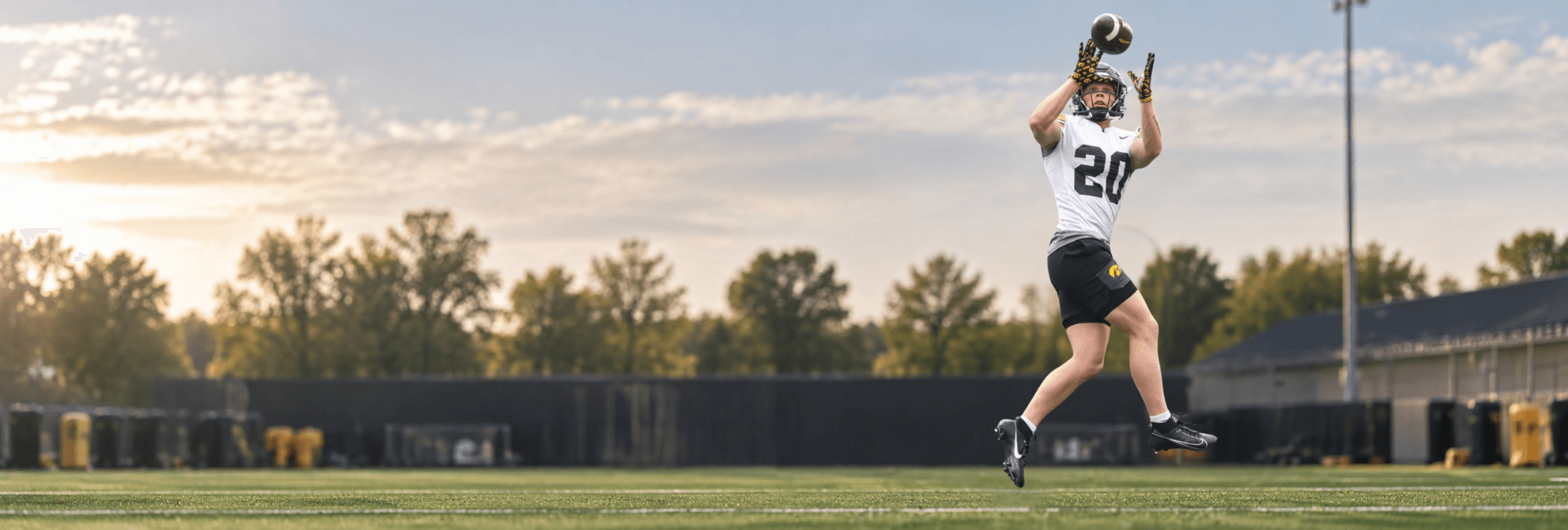

The Iowa Hawkeyes Defensive Back Forging His Next Chapter
From an award-winning high-school career in Michigan to opportunities in Big Ten football, Ty Hudkins has built his reputation on defensive production and perseverance. Now at Iowa, the defensive back faces another challenge: translating his early promise into a sustained collegiate role while navigating an injury concern during the 2026 season.
Defensive backs often make their greatest impact in moments when the opposing offense believes it has an advantage. A correctly anticipated route, a contested pass, or a decisive tackle can change the direction of a possession. For Ty Hudkins, those responsibilities have shaped a football journey that began in Grand Rapids, Michigan, and continued through two Big Ten programs.
Hudkins established himself as a productive defender at Forest Hills Central High School, recording interceptions, breaking up passes, and making tackles at a level that earned statewide recognition. His accomplishments helped him move to Purdue University, where he gained his first experience in college football before transferring to the University of Iowa.
His path has not been defined by uninterrupted playing time. After a season without game action in 2025, Hudkins entered the 2026 campaign seeking further opportunities with the Hawkeyes. An injury concern following Iowa's October 3 matchup against Ohio State added another development to his season.
His story illustrates the demands of college football: talent can create an opportunity, but development, preparation, and the ability to navigate setbacks help determine what comes next.
- Full Name: Ty Hudkins
- Sport: American football
- Position: Defensive back (DB)
- Jersey Number: 20
- Height: 6 feet, 0 inches
- Weight: 201 pounds
- Age: 21
- Birthplace/Hometown: Grand Rapids, Michigan
- School/College: University of Iowa
- Current Team: Iowa Hawkeyes
- Previous College: Purdue University
- High School: Forest Hills Central High School
- Years Active: 2024-present
Hudkins developed his football foundation at Forest Hills Central High School in Michigan. His high-school record showed an ability to contribute in several defensive situations, from tackling ball carriers to challenging passing attempts and creating turnovers.
According to Iowa's official biography, Hudkins was a three-star recruit ranked No. 18 among Michigan players by ESPN. He was also ranked No. 91 among safeties in his recruiting class. Those evaluations helped establish his profile as a prospect with the potential to continue his career at the college level.
His family includes his parents, Stacie and Greg Hudkins, and siblings Kate and Grace. Beyond those biographical details, extensive public information about his childhood, family influence, and earliest football mentors is limited. Specific personal anecdotes should not be presented as facts without additional reliable sources.
What his documented record does establish is that Hudkins developed into a productive high-school defender whose performance earned recognition beyond his local competition.
Hudkins's statistical progression at Forest Hills Central provided a foundation for his college opportunities.
As a sophomore, he recorded an interception and three defensive tackles. He also contributed on offense, catching six passes for 115 yards and a touchdown. Although defense became his primary position, that experience demonstrated his participation in more than one phase of the game.
His junior season marked a substantial increase in defensive production. Hudkins registered 85 tackles, 10 pass breakups, and two interceptions. Those numbers reflected involvement in stopping ball carriers and disrupting passing plays.
He followed that performance with an even stronger senior campaign, recording 98 tackles, eight pass breakups, and five interceptions. Across his junior and senior seasons, he totaled seven interceptions and 18 pass breakups.
The Associated Press named Hudkins Michigan Player of the Year for Divisions Three and Four, and he earned first-team all-state recognition in both his junior and senior seasons. He also helped Forest Hills Central win a state championship as a senior after the team finished as the state runner-up during his junior year.
These accomplishments remain the strongest statistical evidence of his ability to influence a defense and compete successfully at the high-school level.
Hudkins began his college career at Purdue in 2024. As a true freshman, he appeared in all 12 games, primarily contributing on special teams. His only recorded tackle that season came in the opener against Indiana State.
Special teams participation provided an introduction to college football's physical demands and preparation requirements. For developing players, earning opportunities in that phase of the game can be an important step toward establishing a role within a program.
Hudkins did not see game action during the 2025 season, according to Iowa's official biography. The available record does not establish that his lack of appearances resulted from an injury, so it should not be described as an injury-related absence.
On April 30, 2025, Iowa announced that Hudkins had signed a scholarship agreement with the Hawkeyes. The move gave him a new environment in which to continue developing as a defensive back and compete for opportunities within another Big Ten program.
His transition to Iowa represented a new stage rather than a guaranteed breakthrough. Establishing a consistent college role requires adapting to a team's defensive system, executing assignments, and earning the confidence of coaches.
Hudkins's high-school numbers point to three areas of contribution: tackling, pass defense, and turnover creation.
His seven interceptions across his junior and senior seasons demonstrate a record of getting into positions to disrupt opposing passing attacks. His 18 pass breakups over those two seasons further reflect an ability to challenge throws, while his combined 183 tackles show that he contributed beyond interceptions alone.
Those statistics do not establish his current college-level speed, coverage range, or individual technique. Nor do they confirm a specific role in Iowa's defensive scheme. Such assessments require current film, coaching evaluations, and verified college performance data.
Nevertheless, Hudkins's high-school résumé provides a clear explanation for why college programs identified potential in him. His continued development will depend on translating those skills into the faster, more demanding environment of college football.
Hudkins's documented accomplishments include Michigan Player of the Year recognition for Divisions Three and Four, first-team all-state honors in consecutive seasons, and a high-school state championship.
His senior season featured 98 tackles, eight pass breakups, and five interceptions. As a junior, he recorded 85 tackles, 10 pass breakups, and two interceptions. He also appeared in every Purdue game during the 2024 season, primarily on special teams.
Hudkins's football journey includes the challenge of finding opportunities after a season without game action. His 2025 status and the injury concern reported during the 2026 season are separate matters and should not be treated as related without evidence.
Reports following Iowa's October 3, 2026, game against Ohio State indicated that Hudkins was dealing with an injury and subsequently missed the October 9 game against Washington, which Iowa won 41-24. The specific diagnosis, severity, and expected recovery timeline have not been independently established here.
His current medical status and return-to-play timeline therefore remain unconfirmed. It would be premature to describe him as fully recovered or to predict when he will return to the field.
Outside football, Iowa lists enterprise leadership as his academic major. Public information about his community involvement, charitable activities, hobbies, and personal ambitions remains limited.
Iowa's 2026 roster lists Hudkins as a third-year defensive back wearing No. 20. That listing confirms his place in the program, but it does not independently establish his current availability or full-season statistical totals.
The next stage of his development will depend on his recovery, continued preparation, and the opportunities available to him. For a defensive back, progress can involve demonstrating reliable coverage, making sound tackles, contributing on special teams, and executing assignments consistently.
Hudkins's long-term impact at Iowa remains a developing story. His high-school accomplishments established a strong foundation, while his college experience has introduced the challenges of competition, limited playing time, and an injury-related interruption.
Ty Hudkins's football career brings together high-school achievement, the transition between college programs, and the uncertainty that accompanies competitive athletics. His seven interceptions and 18 pass breakups across his junior and senior high-school seasons established his reputation as a productive defender. His time at Purdue introduced him to college football, and his move to Iowa opened another opportunity to develop.
The reported injury during the 2026 season adds an important chapter, although its precise nature and his recovery status require further confirmation.
For Hudkins, the next chapter will be measured by his ability to return to competition when cleared, continue improving, and earn opportunities within the Hawkeyes' program. His story remains unfinished, with the most meaningful assessment of his Iowa career still dependent on what he accomplishes on the field.