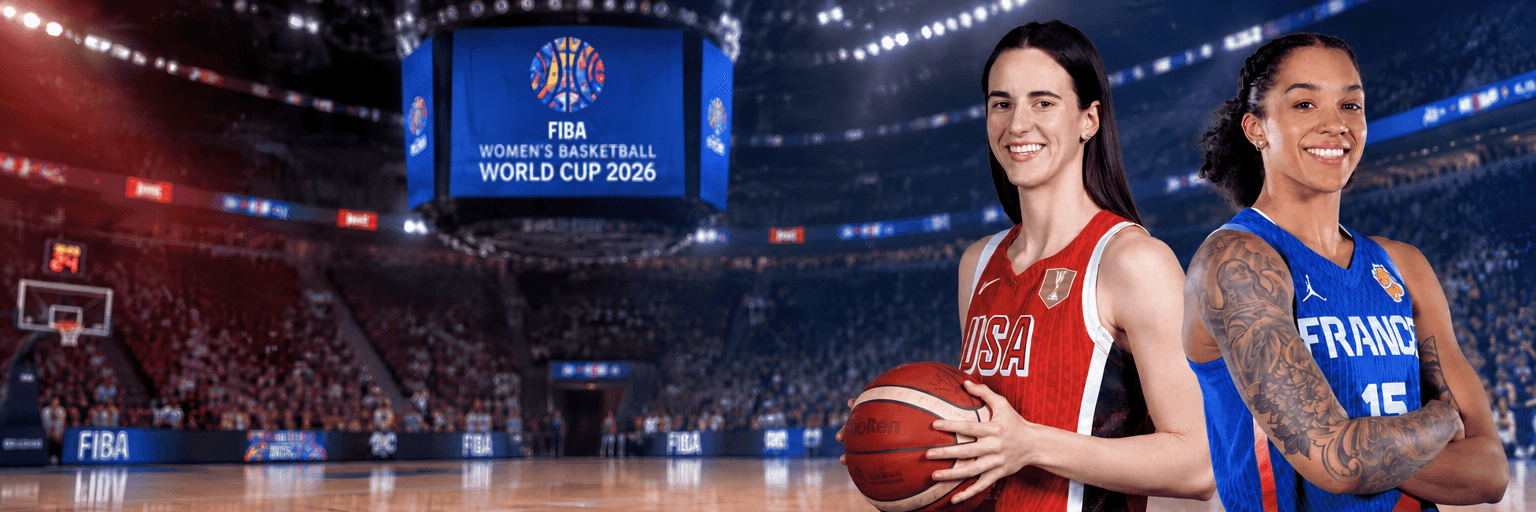

USA and France clash in the FIBA Women's World Cup final, a rematch of the 2024 Olympic showdown with gold at stake.
The stage is set for one of the biggest games in international women’s basketball. Team USA will face France in the 2026 FIBA Women’s Basketball World Cup final on Sunday, September 13, in Berlin, with the gold medal and world championship on the line. The matchup is especially significant because it is a rematch of the dramatic 2024 Paris Olympic final, when the United States defeated France 67-66. Two years later, the two programs meet again, but this time with a World Cup championship at stake. The United States is pursuing another title to extend its remarkable international dominance, while France is appearing in the World Cup final for the first time in program history.
Road to the Final
Team USA reached the championship game after defeating Spain 76-66 in Saturday's semifinal. The Americans were pushed throughout the contest and entered the fourth quarter tied at 58, but their defense and execution improved dramatically down the stretch. The United States held Spain to only eight points in the final period and pulled away to secure its place in the final. Breanna Stewart led the Americans with 16 points, while Kahleah Copper added 13 and Jackie Young contributed 12. The victory also extended the United States' World Cup winning streak to 35 games, with its last World Cup defeat coming in 2006.
Key Players and Strategies
Stewart's performance is particularly important heading into the final. The veteran forward has been one of the central figures for the United States throughout the tournament, providing scoring, rebounding, defense and championship experience. FIBA lists Stewart at 9.8 points and 7.0 rebounds per game through the games included in its player statistics, but her value extends beyond her scoring average. Against Spain, she delivered when the United States needed a stabilizing presence during a difficult semifinal. Her ability to play both inside and outside, defend multiple positions and make important plays in high-pressure situations gives the Americans an important piece for the championship matchup.
The American backcourt will also be critical against France. Caitlin Clark, competing in her first World Cup, provides elite passing and perimeter shooting, while Copper and Young give the United States additional scoring and athleticism. Clark's playmaking ability can become particularly important against a French defense that has been effective at creating pressure and forcing opponents into difficult possessions. The Americans will need efficient ball movement, disciplined shot selection and strong transition defense if they are going to handle France's physical style. After a semifinal in which Spain disrupted the United States for three quarters, avoiding another slow offensive start will be one of the key priorities.
France's Historic Run
France enters the final after producing one of the strongest performances of the tournament. The French defeated host nation Germany 86-64 in Saturday's semifinal, controlling the game and securing the first World Cup final appearance in the history of the French women's national team. France had already made history by reaching the semifinals for the first time since the inaugural World Cup in 1953, and the victory over Germany took the program another step forward. Whatever happens in the final, France is guaranteed its first World Cup medal since the bronze it won at the 1953 tournament.
Gabby Williams has been the centerpiece of France's run. She delivered another outstanding performance against Germany, finishing with 22 points, five rebounds, five assists and four steals. Her production demonstrated why she has become such an important two-way player for France. Williams can create offense with the ball in her hands, defend aggressively on the perimeter and generate turnovers that lead to transition opportunities. Her ability to influence the game in multiple areas will be one of the biggest storylines against the United States. France will need Williams to remain aggressive while also finding opportunities for teammates as the American defense attempts to limit her influence.
The Rematch and Historical Stakes
The biggest storyline surrounding the final is the rematch of the 2024 Olympic championship game. In Paris, the United States survived France 67-66 in one of the closest major international finals in recent history. France came within one possession of winning Olympic gold, with Williams involved in the decisive final sequence. Her late shot appeared to tie the game, but officials ruled that she had stepped on the three-point line, making the basket worth two points rather than three. The United States held on for the victory, while France settled for silver. That experience gives Sunday's final an emotional backdrop, although the French team has emphasized that the focus is on winning the World Cup rather than simply seeking revenge for Paris.
The United States also enters the final with an extraordinary World Cup record. The Americans are seeking their fifth consecutive World Cup championship and their 12th overall gold medal in the competition. They have reached the World Cup semifinals for the 11th consecutive time and are appearing in their fifth straight final. Those numbers demonstrate the depth and consistency of the American program, but the semifinal against Spain showed that this team can still be tested. France, meanwhile, has demonstrated the ability to play with confidence and physicality against elite opposition, making this a much different challenge from the earlier stages of the tournament.
Tactical Considerations
Another important factor is the absence of A'ja Wilson, who is not participating in this year's tournament. Wilson was one of the most important players for the United States during the 2024 Olympic final, scoring 21 points and grabbing 13 rebounds against France. Without her, the Americans have needed greater contributions from Stewart, Napheesa Collier, Aliyah Boston, Angel Reese and the rest of the frontcourt. France will likely attempt to use its physicality and size to challenge the American interior defense and create second-chance opportunities. The United States, in turn, will need to control the glass and prevent France from establishing an advantage inside.
The tactical battle could ultimately come down to defense, rebounding and turnovers. Spain demonstrated in the semifinal that the United States can be slowed when opponents disrupt its offensive rhythm. France has the defensive personnel to apply similar pressure, particularly through Williams and its athletic perimeter players. The Americans will need to move the ball, protect possessions and make France defend for extended stretches. On the other end, France must deal with an American roster that has multiple scoring options and considerable experience playing in championship environments.
Sunday's final represents two very different historical opportunities. The United States is attempting to continue one of the greatest championship runs in international basketball, while France is attempting to win its first World Cup title after reaching the final for the first time. The French program is guaranteed its first World Cup medal in 73 years, but the opportunity to turn that historic achievement into gold now stands directly in front of it.
The USA-France final is scheduled for Sunday, September 13, at 2 p.m. ET in Berlin. It brings together the defending world champions and the tournament's historic new finalist in a matchup that carries the weight of the 2024 Olympic final while creating an entirely new chapter in their rivalry. Team USA arrives with an unmatched World Cup legacy, while France arrives with confidence, momentum and the opportunity to win the biggest championship in the history of its women's basketball program. With gold on the line, Berlin will host a final worthy of the tournament's two most accomplished remaining teams.