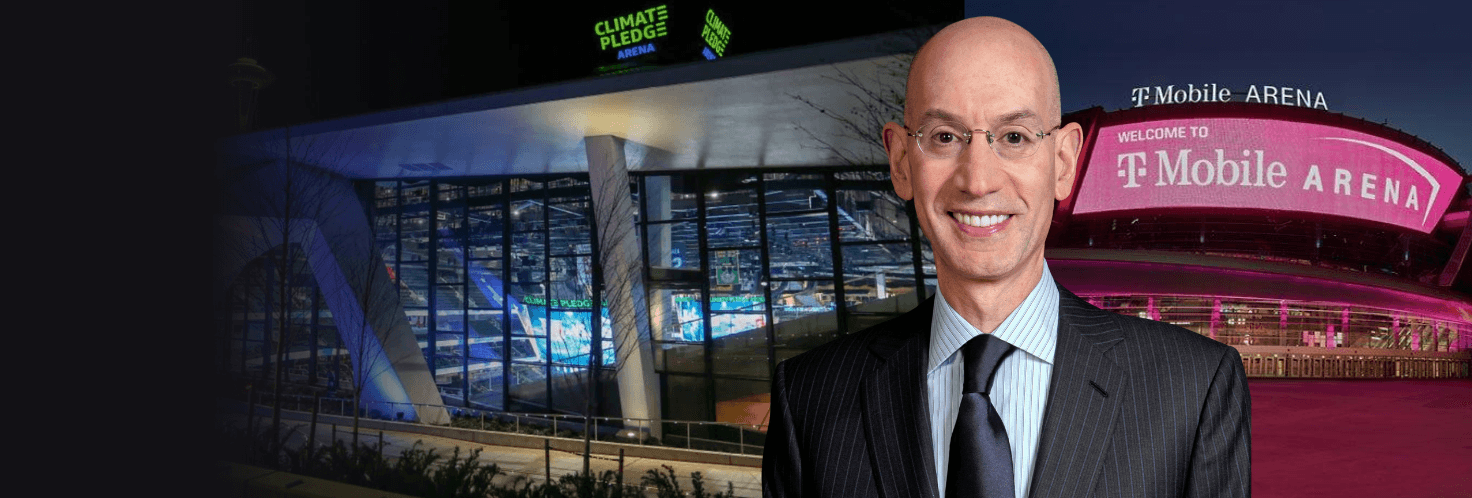

Adam Silver has turned NBA expansion from a debate about which cities deserve a team into a pricing exercise, and billionaire bidders are putting their offers together.
Las Vegas groups faced a second bidding deadline on Sept. 17, while Seattle’s process has moved more slowly. The NBA commissioner still wants a decision by the end of 2026, although a deadline for deciding is no promise of a team.
Industry executives have projected entry fees of $7 billion to $10 billion per team, and ESPN NBA reporter Shams Charania reported in September that Las Vegas proposals could exceed $10 billion. Silver has declined to set an official price, leaving bidders to show what membership is worth. His harder job is deciding whether their offers justify giving new owners a permanent share of future league revenue. The current owners would receive the expansion proceeds once, so the appeal of Seattle and Las Vegas must survive a question that outlasts the celebrations: what do they bring after paying to get in?
Silver is selling a share of the league’s future
Silver explained the problem on Dec. 16, 2025, speaking to reporters in Las Vegas before the NBA Cup final about why domestic expansion required careful consideration. He said, “Domestic expansion, as opposed to doing a new league in Europe, is selling equity in this current league. If you own 1/30 of this league, now you own 1/32 if you add two teams. So it’s a much more difficult economic analysis. In many ways, it requires predicting the future.”
To help price that future, the NBA hired investment bank PJT Partners in March to assess markets, ownership groups and arenas. At his March 25 news conference in New York, after governors authorized formal exploration, Silver invited buyers into the process. “If you are interested, I’ll say that to people who may be listening or watching, call the league office, PJT Partners directly in New York,” he said. A commissioner was openly asking investors to put a value on joining his league, while stressing that nobody had received a private commitment.
Charlotte shows how far entry prices have travelled. BET founder Bob Johnson paid a $300 million expansion fee for the Bobcats, who began playing in 2004 and subsequently lost tens of millions annually. Basketball great Michael Jordan acquired control in 2010 through a $275 million deal that included $150 million in debt. League economics have changed considerably since then, but paying for membership never guaranteed quick operating profits.
Today’s buyers have different reference points. The Celtics sold at a $6.1 billion valuation in 2025, while Thrive Capital founder Josh Kushner and former Disney chief executive Bob Iger agreed in August to buy the Lakers for $12.5 billion. Such prices show what investors will pay for scarce NBA ownership, although those clubs come with established fans, sponsors and operations (a useful head start when spending billions).
The Lakers' opportunity even drew Kushner and Iger away from expansion. Explaining that switch to the California Post in comments reported by ESPN on Aug. 12, Iger said, “We were involved in pursuing the new franchise in Vegas.” He added, “The deal came together in three days.” Silver’s bidders may also weigh the rare chance to buy a functioning club against the cost of building one.
Rising fees have caught the players’ attention, too. Expansion payments fall outside Basketball Related Income, the revenue pool used to determine their negotiated compensation share. Discussing expansion and NBA Europe with the Boston Globe in July, National Basketball Players Association executive director David Kelly challenged that exclusion. “We don’t think it should be the case. We don’t think it’s fair. Now, of course, fairness has nothing to do with the negotiation,” he said. Even before anyone pays, Silver faces competing claims on the proceeds, while assessing what each city could contribute afterward.
Why Seattle and Las Vegas lead the field
Seattle lost the SuperSonics to Oklahoma City in 2008 following an arena dispute. Now the building strengthens its case: Climate Pledge Arena reopened in 2021 after a privately financed $1.15 billion redevelopment and seats 18,300 for basketball.
At his Sept. 15 news conference in New York after the Board of Governors meetings, Silver explained why Seattle required less discussion. “You clearly have a state-of-the-art arena there. May require some modifications for NBA basketball,” he said. “If we were opening in five weeks, we could be ready in Seattle.” An existing venue reduces the risk of construction delays, which gives his bankers something firmer to assess than affection for the old Sonics.
From what it looks like, the arena question seems to be largely settled, but in terms of ownership, the question remains to be answered.
Samantha Holloway’s group can offer that operating foundation. She is majority owner and managing partner of One Roof Sports and Entertainment, the Seattle Kraken’s parent and Climate Pledge Arena’s controlling owner. Her bid has JPMorgan Chase and Moelis as advisers, while philanthropist Melinda French Gates announced a minority investment in One Roof in June, subject to NHL approval. These assets give Silver an existing sports business to examine, without settling who gets a team.
In Las Vegas, he has more visible competition among bidders. NHL Golden Knights owner Bill Foley submitted another bid before Sept. 17. The Review-Journal’s Sept. 20 report also named Walmart heiress Nancy Walton Laurie and her husband, Bill Laurie, alongside the Las Vegas Jacks group featuring former Phoenix Suns owner Jerry Colangelo and former NBA player and coach Vinny Del Negro. At least one group remained unnamed. Asked by the newspaper at the September meetings how many were active, Silver said, “Several active groups. I’ll leave it at that.”
The NBA knows the city through more than 20 years of Summer League. In March, Silver also cited the success of the WNBA’s Las Vegas Aces and Seattle Storm when explaining why these markets led the search. Both offer evidence that basketball can attract paying customers, although supporting an NBA club at these prices would be a different test.
For Las Vegas, Silver also sees customers beyond its residents. Discussing proposed arenas at the Sept. 15 news conference, he said, “It’s a unique market where you could truly see essentially 365-day-a-year activity.” Tourism and conventions could sustain demand for premium seats and corporate entertainment between visits from local fans.
However, bidders still need a workable venue. Silver said T-Mobile Arena would require significant improvements, while other groups proposed new buildings. Foley told the Review-Journal in July that renovations could cost $330 million to $400 million. The entry fee therefore covers only part of what owners need to operate, and Silver must judge whether their spending can produce a business that benefits the existing clubs.
The first payment has to justify years of sharing
If you are one of the 30 current owners, the first number looks wonderful. ESPN illustrated the appeal in March: $15 billion in combined fees would mean $500 million per existing franchise. Some teams have modeled $500 million to $600 million distributions, ESPN reported Sept. 11, although no final fee exists.
But stay in the owner’s chair a little longer, because the new partners remain after that payment arrives. The NBA’s 11-year national media agreements with Disney, NBCUniversal and Amazon began in 2025-26. The Star Tribune reported Sept. 15 that per-team payments would reach $153 million this season and $281 million by 2035-36. Adding clubs reduces each current team’s percentage share of shared revenue unless expansion creates enough additional value to offset it.
Silver said after the March 25 vote that governors had discussed projected reductions in existing teams’ revenue. Their decision involves comparing what they could do with the upfront payment against income they would surrender over time (the check arrives once, the sharing continues).
There is a case for accepting that trade. Industry executives told ESPN both cities could rank among the NBA’s top eight revenue generators. Still, strong local ticket sales would not automatically replace national revenue surrendered by other clubs. Silver needs confidence that new audiences and commercial opportunities can increase the league’s value.
Any expansion requires 23 of 30 governors’ approval, and Silver has kept one team, two teams or none on the table, with 2028-29 the earliest possible start. Explaining that choice at the March news conference, he said, “The market will determine the value of this team, of these teams, then we will decide whether that makes sense to move forward.” Bidders will name their price, and the owners must decide how much of tomorrow’s league they are willing to sell today.