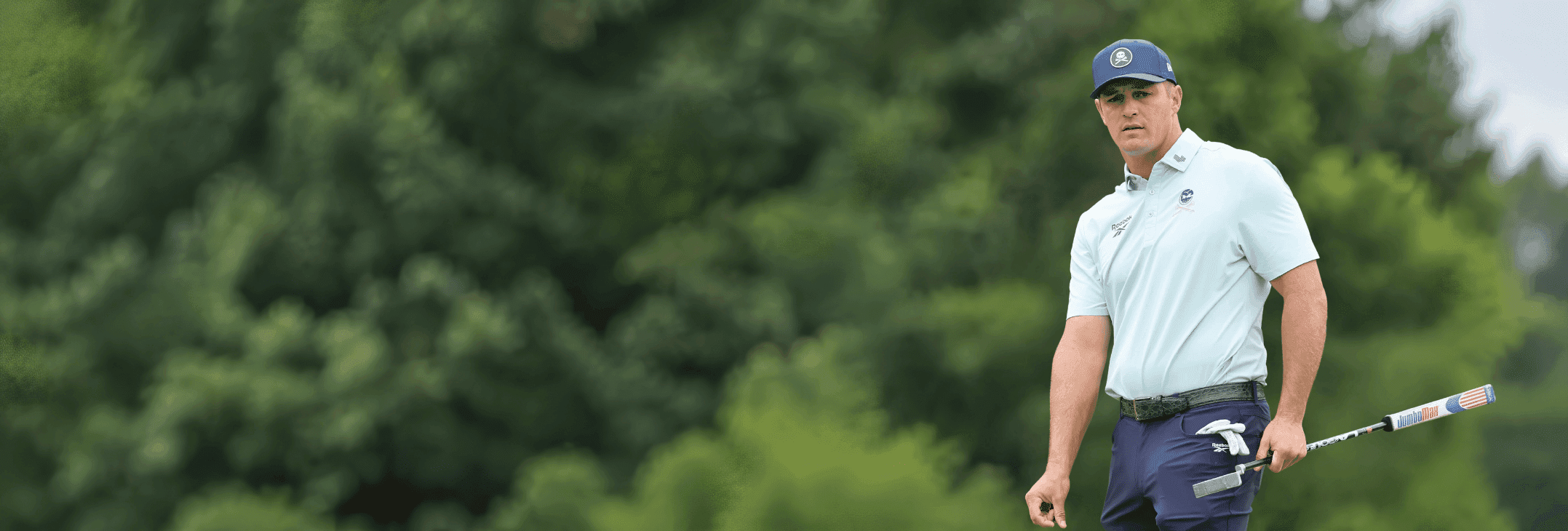

DeChambeau could turn his $5.77 million LIV claim into an ownership stake as the league restructures its future.
If you were chasing millions from a company ‘deep’ in bankruptcy, you would expect that the next conversation ought to be about getting paid. Now imagine that same company telling you to stay and help rebuild it as an owner. Well, that’s the situation taking shape for Bryson DeChambeau, one of LIV Golf’s most recognizable American players. The league’s proposed rescue could give him shares toward settling his $5.77 million claim, leaving him with a financial stake in keeping the league that owes him money in business.
The September 8 filing in New Jersey lists DeChambeau and BAD Enterprises at $5,769,230.77, behind Jon Rahm’s $7,472,527.47. Fourteen of its 30 largest unsecured creditors are players. But DeChambeau’s claim is contingent (dependent on a condition or event), and the court has yet to fix his recovery. His agency provides another reason to read carefully: LIV lists GSE Worldwide at $1,287,500, while GSE tells Front Office Sports it is owed nothing. These are LIV’s listed obligations, which creditors can contest; they cannot tell us what DeChambeau will receive or what his ownership stake might eventually be worth.
What Bankruptcy Changes for Players
LIV entered Chapter 11 with estimated liabilities of $500 million to $1 billion, assets of $100 million to $500 million, and about $15 million in cash. Those ranges leave uncertainty about recoveries. Vendors had sued to collect, but the filing generally pauses lawsuits over debts incurred before bankruptcy, allowing LIV to address them through one court process. Think of everyone waiting in one line instead of racing to the courthouse, although bankruptcy rules still give some creditors priority. The lawsuits and debts do not simply disappear.
LIV also asks to reject player contracts effective from the filing date because they do not fit its new compensation model. Rejection lets the league stop performing those agreements, while resulting damages generally become bankruptcy claims. For DeChambeau, recovering value under his old deal and agreeing to play under a new one are separate negotiations, even though LIV’s proposed rescue links them together.
How LIV Wants Creditors to Become Owners
The October 5 restructuring agreement tells us how. Participating players would receive equity toward settling allowed, eligible claims, subject to waiving certain claims and signing new agreements. They would also receive rights to acquire additional equity, bringing their collective common ownership to 52.5%, subject to adjustments. BC Partners and fellow investors would hold 45%, with management at 2.5%. Future playing services would bring separate terms, including signing bonuses, certain NIL (name, image, and likeness) rights, and roughly 30% aggregate player ownership in teams, on average. Individual allocations remain to be agreed, so DeChambeau’s $5.77 million does not translate into a known shareholding.
For DeChambeau, the difficult part is judging what those shares could earn. BC’s package includes loans and preferred equity, which carry financial rights ahead of ordinary shares. Players could therefore own most of the common equity while investors receive priority on some payments. The headline percentage gives them a stake in a recovery, but the detailed terms determine just how much of that recovery reaches them. Accepting ownership would leave them sharing LIV’s business risk as well.
CEO Scott O’Neil presents ownership as a reason to stay. He said on October 5, “We believe deeply in the future of this league and in the opportunity to build something distinctive alongside our players.” He continued: “We’re delivering on our major milestones, and while there is still work ahead, today marks meaningful progress toward a player-owned, team-focused, truly global league that complements the wider game and creates new opportunities for players, fans, partners, and the next generation of golfers.”
However, players need clarity about their freedom before buying into that future. Sergio Garcia has asked the court to terminate his agreement. His filing says, “Termination of the agreement is consistent with [LIV Golf’s] statement that the agreement is ‘not part of [LIV Golf’s] go forward business plan’ and, accordingly, should not be objectionable to [LIV Golf].” His request shows why a promise of ownership cannot settle every golfer’s concerns about what comes next.
Nor does majority ownership give players a free hand. BC would appoint three of seven directors, and the amended agreement lets it decide whether enough players have committed to sustain a viable league. DeChambeau has commercial pull, but the terms give him no personal veto. Golf Channel reports an October 14 hearing on the agreement (the proposed restructuring still needs court approval).
PIF Is Financing the Transition
Getting there requires more Saudi money. PIF invested around $5 billion in equity before announcing in April that funding would end after the 2026 season. It remained LIV’s owner while adding a lender’s role through a June secured facility, with roughly $495 million outstanding when LIV filed. Its $49.6 million bankruptcy loan (debtor-in-possession financing) keeps the process moving. The October 5 papers propose increasing that facility to $53.6 million, with BC funding the extra $4 million, subject to court approval. The original backer is helping finance LIV’s attempt to survive without its continuing support.
The revenue explains why replacing that support will take work. Sponsorship supplied roughly 49% of 2025 revenue, about $102 million, while broadcasting supplied just 5%. LIV built a sponsorship business, but television rights contributed little toward paying its bills. BC’s proposed $300 million financing package supports a smaller operation, and O’Neil describes 10 events for 2027, split between five in the United States and five international team events. Players would share the gains if this model works, along with the risk that their equity disappoints.
DeChambeau Has a Business Outside LIV
DeChambeau holds a card most creditors do not have, and it sits on YouTube. Front Office Sports counted 2.6 million subscribers in January, giving him an audience he can reach without a tour arranging the broadcast. Asked then about combining content creation with major championships, he said, “That’s an incredibly viable option, I’ll tell you that.”
He explained, “Doing the course record series, and playing Break 50s, it does keep me quite dialed in for tournament golf. That is why I do it right before competition. So, it’s a possibility. The financial opportunities are there, and I’m excited to see what comes in the future.” His channel gives him room to negotiate because his commercial life can continue beyond LIV, though he still needs to weigh his competitive future.
A PGA Tour return brings obstacles. LIV players face at least a year out after their last appearance, with eligibility depending on their circumstances. Brooks Koepka’s January return used a special program and cost him five years of potential Player Equity Program awards, which the Tour estimates at $50 million to $85 million. The offer closed in February. On September 15, Tour CEO Brian Rolapp said, “In terms of where we are today, we are not currently contemplating a returning-member program like the one you saw in January.”
A September 29 report said DeChambeau remained undecided. He enters this process as a creditor and could emerge as an owner, but his recovery would then depend partly on the business LIV builds and the players who join it. The amended agreement gives the required players until October 25 to commit.