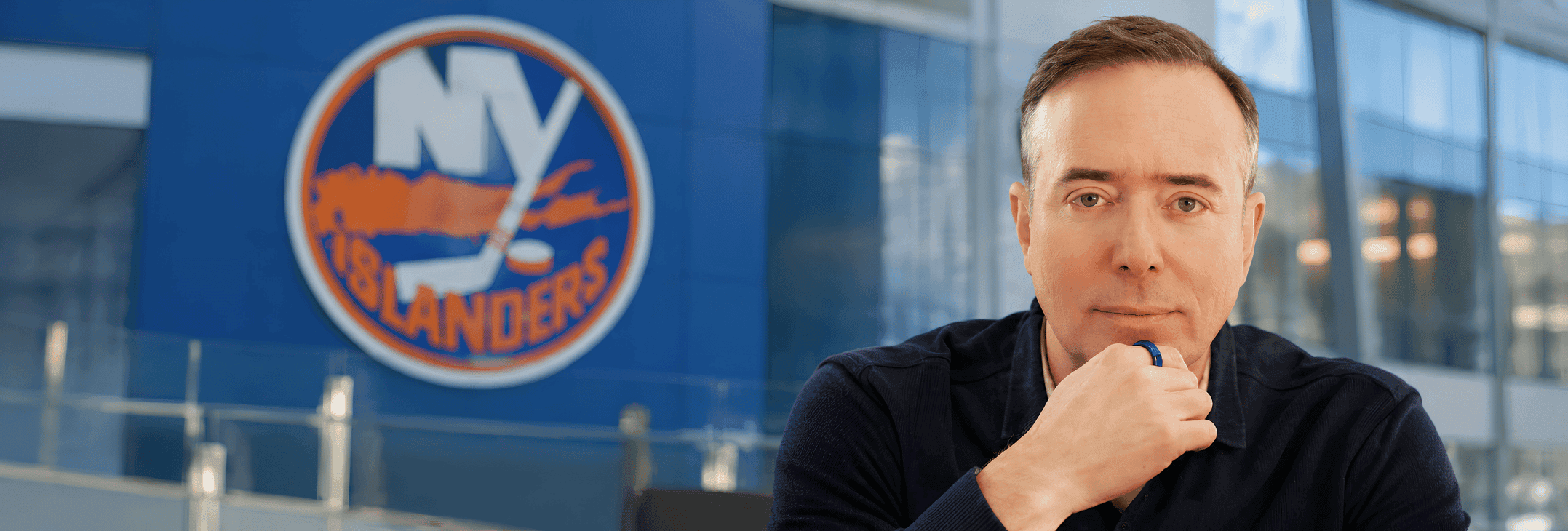

David Shuman is buying into the New York Islanders without buying the grounds to run them. The venture capitalist’s arrival as a limited partner, announced Aug. 31, subject to NHL approval, leaves the team’s operating leadership in place. The Islanders disclosed neither his percentage nor his price. Scott Malkin remains the controlling owner, while Shuman gains an economic interest in a franchise whose reported value had climbed sharply.
Less than a month later, another minority transaction put a much higher number on the Islanders. Per Sportico, as of Sept. 28, the club agreed to sell roughly 15% at a $3 billion valuation, pending league approval. The new investors remain unidentified. Shuman’s investment was announced separately, though, so the latest figure cannot categorically show what he paid or how much of the team he owns.
Together, the transactions help explain why minority positions in major sports franchises can attract substantial capital without handing investors the controls. A smaller stake offers participation in potential franchise appreciation at a fraction of the capital needed for outright ownership. The trade-off is substantial (investors accept limited authority and an investment they may have to hold long after they would prefer to sell).
What Shuman Bought Without Buying Control
The Islanders’ ownership chart looks a bit like a family photo where one person holds the car keys. Malkin serves as governor and Jon Ledecky as alternate governor, with Dewey Shay, Oliver Haarmann, and operating partner John Collins also among the others. The club specifically said Shuman’s arrival would not alter the day-to-day business operations, hockey operations, or front office leadership. His precise voting and contractual rights remain undisclosed.
If you own part of an NHL team, you do not automatically get to pick the general manager or approve a trade. The controlling owner typically retains major management authority, while the ownership agreement defines the minority investor’s rights, including access to information, voting protections, and transfer restrictions. Shuman’s agreement is private, so the public cannot know the full package he negotiated. An unchanged front office does not have the answer to every single ownership question.
The capital requirement explains much of the appeal. A reported $3 billion franchise valuation puts control in a financial category available to very few buyers, although acquiring control would require its own negotiation (including the treatment of debt and any premium for authority). A smaller position lets an investor participate economically without financing the entire enterprise. The opportunity rests on future appreciation and possible distributions, neither of which comes with a guarantee.
Investing in businesses that other people manage is familiar territory for Shuman. He founded Lateralus Holdings in 2016, and chairs smart ring maker Oura and artificial intelligence company webAI. His venture background helps explain his familiarity with minority investments, but it doesn’t quite reveal his private investment thesis for the Islanders. His public explanation centers on a relationship with hockey that began well before his business career.
In the Aug.31 announcement, Shuman credited the 1980 Miracle on Ice and the Islanders’ four consecutive Stanley Cups with deepening his passion. “Hockey has been a constant in my life since childhood, both as a fan and a player,” he said. “My childhood bedroom was covered in newspaper photos and magazine covers of Mike Bossy, Bryan Trottier, Clark Gillies, Denis Potvin, Billy Smith, John Tonelli, and Bobby Nystrom. Being part of this organization today is a full circle moment. I’m honored to help support the Islanders’ future and their drive for a fifth Cup.”
Ledecky explained what the group sees beyond the fandom. “David is one of the most passionate Islanders fans I know and an extraordinary builder of companies,” he said in the announcement. “That mindset will be invaluable as we continue to invest in this organization and in this community.” The Islanders value his business experience while keeping their operational leadership in place. Expertise can have value without coming with the final say.
Rising Valuations Explain the Financial Appeal
Shuman’s fandom explains his connection to this franchise. Its ownership history gives us a better understanding of the financial attraction. In 2014, Malkin and Ledecky agreed to buy a substantial minority interest from Charles Wang, in a transaction reported at a $485 million franchise value. They took majority control in 2016. Their agreement included a path to control, making it a different proposition from Shuman’s publicly described investment. Nothing disclosed gives him a comparable path.
A clearer minority benchmark arrived in 2023 when Haarmann bought 10% at a reported $1.75 billion valuation. His purchase offers a closer comparison because it involved a limited piece of the same franchise. Sportico’s subsequent estimate put the Islanders at $1.93 billion, before the new $3 billion transaction. The transactions show buyers agreeing to higher franchise valuations, although differing rights and terms prevent those figures from becoming a simple return calculation for any individual owner.
The valuation climb also coincides with a major change in the business underneath the team. UBS Arena opened in November 2021, bringing premium seating, sponsorship space and concerts into the commercial picture. Islanders ownership participates alongside arena partners, although Shuman’s announced stake does not establish that he owns any arena interest. Next door, Belmont Park reopened Sept. 18 after a $555 million redevelopment, adding another attraction to the area. Neither development alone explains the latest valuation.
The wider NHL market provides useful perspective. Sportico valued the average franchise at $2.1 billion in 2025, which is more than double its 2022 average. The Islanders’ rising numbers fit that broader movement, even as the team missed the playoffs in both of the past two seasons.
Short-term hockey results and long-term franchise values do not necessarily move on the same timetable. An ownership investment can look promising while the season ticket holder still has complaints.
A Valuable Stake Can Still Be Hard to Sell
Rising valuations explain the attraction, while liquidity creates a separate problem. If you own shares of a public company, you can usually sell them off on a trading day with a few clicks. A private Islanders stake would require a willing buyer who can secure league approval. The ownership agreement may also require other owners’ consent or give them the first opportunity to buy. A valuable holding can remain stubbornly difficult to convert to cash.
The $3 billion headline does not tell us what Shuman’s slice would be able to fetch him tomorrow. Buyers may demand a discount for limited control and difficulty reselling. Some agreements let minority investors join a controlling owner’s sale (tag-along rights) or compel them to participate (drag-along provisions), but Shuman’s terms remain private. Those details influence both the price and the available exit. The headline valuation is a reference point, not an offer to buy every owner’s stake.
The NHL has deliberately made room for passive institutional capital. Its framework permits a qualifying fund to own up to 20% of a team, with funds collectively capped at 30%, and carries a reported five-year minimum holding period. More eligible investors can broaden the pool of potential buyers, even while these restrictions keep ownership from becoming freely tradable. The institutional rules describe wider, not Shuman’s undisclosed arrangement, and should not automatically be applied to him.
The Islanders open their season Sept. 30 in Toronto, with hockey decisions staying in the front office under the arrangement announced for Shuman’s investment. Less than a month after the club introduced him, another group reportedly valued the Islanders at $3 billion. Shuman’s own entry price remains private.