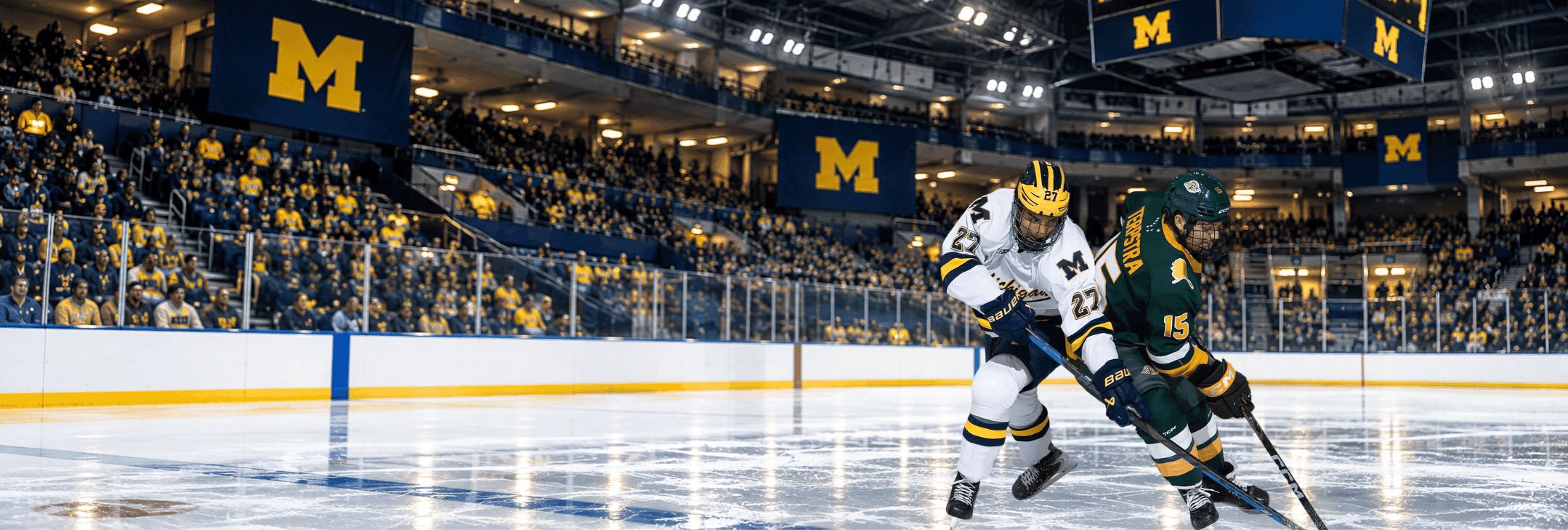

Jayden Perron Delivers A Hat Trick And Four-Point Performance As Michigan Completes Its Second Consecutive Sweep. Alaska Anchorage Gets Goals From Jalen Bianchet And Cooper Anderson But Cannot Overcome The Wolverines’ Offensive Pressure.
The No. 2-ranked Michigan Wolverines continued their strong opening to the 2026-27 NCAA men’s ice hockey season with a 7-2 victory over Alaska Anchorage on Saturday, October 10, at Yost Ice Arena in Ann Arbor, Michigan. The win completed Michigan’s second consecutive series sweep and improved its record to 4-0, while Alaska Anchorage fell to 0-4. After opening the weekend with a 10-1 victory on Friday, Michigan once again demonstrated its offensive depth, puck possession, and ability to generate scoring opportunities against a determined opponent. The Wolverines scored three goals in the first period, added three more in the second, and finished with one in the third to secure the result. Alaska Anchorage managed one goal in each of the opening two periods but could not find another breakthrough in the final frame.
Michigan finished with a substantial 48-22 advantage in shots on goal, consistently putting pressure on the Seawolves’ defense and testing goaltender Joey Rocha throughout the contest. The Wolverines also won 38 of 55 faceoffs, giving them a 69.1 percent success rate and a significant advantage in possession battles. Although the scoreline reflected Michigan’s control, Alaska Anchorage still produced two goals and showed that it could capitalize on opportunities when they emerged. The Seawolves’ challenge was maintaining defensive structure and finding ways to slow Michigan’s attack after conceding early goals. For the Wolverines, the victory reinforced their unbeaten start and showcased contributions from multiple offensive players. Michigan’s balanced scoring, effective special teams, and ability to sustain pressure proved decisive in completing the weekend sweep.
Early Goals Give Michigan Control Of The Opening Period
Michigan established its advantage with two goals in a span of 82 seconds. Jayden Perron opened the scoring at 7:22, finishing a feed from Ben Robertson, with Michael Hage earning the secondary assist. Drew Schock doubled the lead at 8:44, converting a one-timer from the right circle after Garrett Schifsky created the opportunity with a backhand pass from below the goal line. Defenseman Dakoda Rhéaume-Mullen recorded the secondary assist on Schock’s goal. Alaska Anchorage responded at 9:51 when Jalen Bianchet scored his first career goal, with Oren Shtrom and Tye Spencer credited with assists. The goal reduced Michigan’s lead to 2-1 and provided the visitors with an important response after conceding twice in quick succession.
However, the Wolverines regained their two-goal cushion late in the period. At 18:45, Cole McKinney scored on the power play to make it 3-1. Cam Reid and Malcolm Spence assisted on the goal, which capped a productive opening period for Michigan. The Wolverines entered the first intermission with a 16-5 advantage in shots on goal and a 15-9 edge in faceoffs. Their ability to generate chances from different areas of the offensive zone made it difficult for Alaska Anchorage to establish a consistent defensive rhythm. Bianchet’s goal demonstrated that the Seawolves could find openings against Michigan, but McKinney’s power-play finish ensured that the Wolverines maintained control heading into the second period.
Wolverines Add Three Goals As Alaska Anchorage Responds
Michigan continued its offensive production in the second period, scoring three times to strengthen its position. Malcolm Spence opened the period’s scoring at 5:21, converting a setup from Nick Moldenhauer to extend the Wolverines’ lead to 4-1. Perron then scored his second goal of the evening at 8:21, finishing a passing sequence involving Hage and Will Horcoff to make it 5-1. The goal highlighted the chemistry between Michigan’s forwards and gave Perron another opportunity to influence the game offensively. Alaska Anchorage answered at 14:02 when Cooper Anderson scored to reduce the deficit to 5-2. Anderson’s goal came on a shot from the blue line, with Jacob Terpstra and Aiden Westin recording the assists. The Seawolves had found a second scoring opportunity, but Michigan responded again before the period ended. At 17:26, Horcoff scored after Hage delivered a creative pass between his legs to set up the finish.
Perron earned an assist on the play, completing another productive sequence for the Wolverines’ forward group. Michigan carried a 6-2 lead into the second intermission after outshooting Alaska Anchorage 22-11 during the period. The Wolverines also dominated the faceoff circle, winning 17 of 19 draws in the second, an 89.5 percent success rate. By that point, Michigan had accumulated 38 shots on goal compared with 16 for the Seawolves. Anderson’s goal showed that Alaska Anchorage remained capable of creating offense, but the visitors struggled to prevent Michigan from answering whenever they found the net. The Wolverines’ ability to sustain pressure and convert opportunities from different lines left them firmly in control entering the final period.
Perron Completes His Hat Trick As Hage Records Four Assists
Perron delivered the final goal of the game at 3:16 of the third period, completing his hat trick on the power play. Positioned below the left circle, he finished a feed from Hage to extend Michigan’s lead to 7-2. Freshman defenseman Landon DuPont collected the secondary assist. Perron finished with three goals and one assist, giving him four points for the night and extending his point streak to 10 games. He also recorded five shots on goal and finished with a plus-three rating. Hage was another major contributor, recording four assists to match his collegiate career high. He finished with seven shots on goal and a plus-three rating, demonstrating his influence as both a playmaker and an attacking presence. Horcoff contributed one goal and one assist, while Spence also finished with a goal and an assist.
These performances underlined the depth of Michigan’s offense, with several players contributing to the result rather than one individual carrying the scoring burden. At the other end of the ice, Michigan goaltender Jack Ivankovic made 20 saves on 22 shots faced. Alaska Anchorage goaltender Joey Rocha stopped 41 of Michigan’s 48 shots, facing a much heavier workload as the Wolverines repeatedly tested him. Michigan finished two-for-four on the power play, while Alaska Anchorage went zero-for-two. The Seawolves were unable to add another goal in the third period, and Michigan protected its five-goal advantage until the final buzzer. Perron’s performance provided the standout individual achievement, but the result also reflected Michigan’s effectiveness in puck movement, special teams, and sustained offensive pressure.
Michigan Looks Ahead While Alaska Anchorage Regroups
Michigan’s 7-2 victory completed a weekend in which the Wolverines scored 17 goals across two games against Alaska Anchorage. The Seawolves scored three times across the series, with the Wolverines winning Friday’s game 10-1 before securing Saturday’s 7-2 result. Michigan’s performance on Saturday was supported by a 48-22 advantage in shots on goal, a 38-17 edge in faceoffs won, and two power-play goals. Alaska Anchorage recorded seven penalties for 14 penalty minutes, while Michigan had five penalties for 10 minutes. The statistics illustrated the challenge facing the Seawolves as they attempted to contain Michigan’s attacking options and establish more consistent possession. For the Wolverines, the 4-0 start provided an encouraging foundation as they prepared for their next series against defending national champion Denver on October 16-17. Maintaining their scoring depth and special-teams efficiency will be important against another high-level opponent.
Perron’s four-point performance and Hage’s four assists were major highlights, but Michigan also benefited from goals by Schock, McKinney, Spence, and Horcoff. That distribution of production gives the Wolverines several potential scoring threats as the schedule becomes more demanding. Alaska Anchorage, meanwhile, will return home to prepare for its October 16-17 series against Lake Superior State. The Seawolves will need to improve their defensive coverage, reduce the number of shots conceded, and create more sustained offensive pressure if they are to turn their early-season results around. Bianchet’s first career goal and Anderson’s second goal of the season offered positive moments, but the team will need more consistent contributions across all three periods. Michigan deserved the victory through its offensive execution, faceoff advantage, and power-play production. The result completed another successful weekend for the Wolverines while leaving Alaska Anchorage with clear areas to address before its next series.