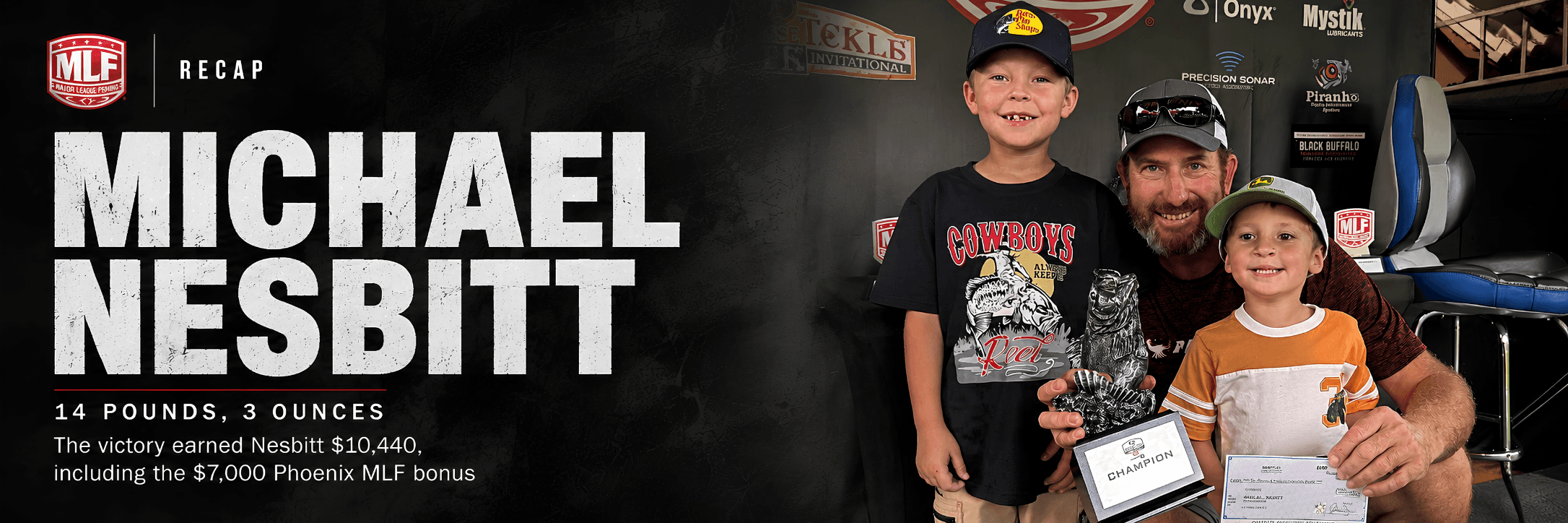

A carefully planned strategy built around regrowing vegetation, local water conditions, and a spinnerbait handcrafted by his father propelled the St. Paris angler to a commanding victory and a $10,440 payday in the Buckeye Division tournament.
Michael Nesbitt of St. Paris, Ohio, turned years of experience on Indian Lake into tournament success, winning the Major League Fishing (MLF) Phoenix Bass Fishing League (BFL) Presented by T-H Marine event with a five-bass limit weighing 14 pounds, 3 ounces. The victory earned Nesbitt $10,440, including the $7,000 Phoenix MLF bonus, during the third of five tournaments in the BFL Buckeye Division season.
Competing on his home waters, Nesbitt relied on an understanding of Indian Lake's changing vegetation and the impact of aquatic weed harvesting to develop a strategy that separated him from the field. Rather than following heavily pressured areas, he identified a location where submerged grass had been allowed to regrow after commercial weed-cutting operations had not passed through for approximately two weeks.
That decision paid immediate dividends.
Before many competitors had completed their launches, Nesbitt had already built the foundation of his winning catch. Fishing isolated grass in approximately 2 1⁄2 feet of water, he connected with three bass weighing around 3 1⁄2 pounds each during the opening 30 minutes of competition. Those early fish quickly provided a tournament-caliber limit and gave him confidence that his pattern was producing the quality bites needed to contend for the win.
According to Nesbitt, he and his co-angler committed to giving the spot only a brief window to produce.
"We're going to spend about 20 minutes there. That's it. We're either going to catch them or we're not," he said.
Using a spinnerbait, Nesbitt landed his first quality bass on just his third cast before adding two more fish of similar size shortly afterward. The rapid start confirmed that the area held one of the roaming groups of larger bass that Indian Lake is known for but that can often be difficult to locate.
Nesbitt explained that the weed-cutting schedule played a significant role in his tournament strategy. While another area that had previously held quality fish was heavily impacted by weed harvesters earlier in the week, the untouched section of regrowing vegetation continued to provide the cover and habitat that attracted bass.
"The weed cutter hadn't been in that area for about two weeks, so the grass was starting to grow back," Nesbitt said. "I had some other big fish located in another area, but the weed cutter had been in there Wednesday and trashed it."
After securing his early limit, Nesbitt adjusted his approach by targeting pad fields and matted vegetation with a frog. The move produced approximately 10 additional bass throughout the remainder of the day, although only one fish was large enough to improve his overall weight.
Despite the steady action, the three quality bass caught during the opening half-hour remained the cornerstone of his winning bag.
Nesbitt said landing the first 3½-pound bass immediately boosted his confidence because larger fish on Indian Lake often travel in small groups.
"Those fish are hard to come by up there," he said. "Usually when you get one there are more right there."
The victory was the result of extensive preparation. As a self-employed contractor, Nesbitt devoted significant time over the previous two weeks to scouting Indian Lake during the early morning hours while his employees managed work responsibilities. Interestingly, despite the hours spent on the water, he caught only a single fish from the eventual winning location during practice, a 4 1⁄2-pound bass on the Wednesday before the tournament.
That lone bite ultimately proved to be the key clue that led him back to the area on tournament day.
The winning spinnerbait also carried special sentimental value. Nesbitt revealed that the lure had been handcrafted by his father, making the victory even more meaningful. After helping secure the tournament title, the spinnerbait was too damaged to continue using, prompting him to retire it permanently.
To commemorate the win, Nesbitt drilled a hole in the lip of his Indian Lake BFL trophy and attached the battered spinnerbait to it, preserving the lure alongside one of the biggest victories of his competitive career.
The Phoenix Bass Fishing League event at Indian Lake highlighted how local knowledge, careful observation of changing habitat conditions, and disciplined execution can make the difference in tournament bass fishing. Nesbitt's understanding of how aquatic vegetation influences bass movement, combined with his confidence in a proven location, allowed him to capitalize when the opportunity arose and secure the Buckeye Division victory.