
Championship Dreams, Giant Smallmouth, and Zero Room for Error in Massena
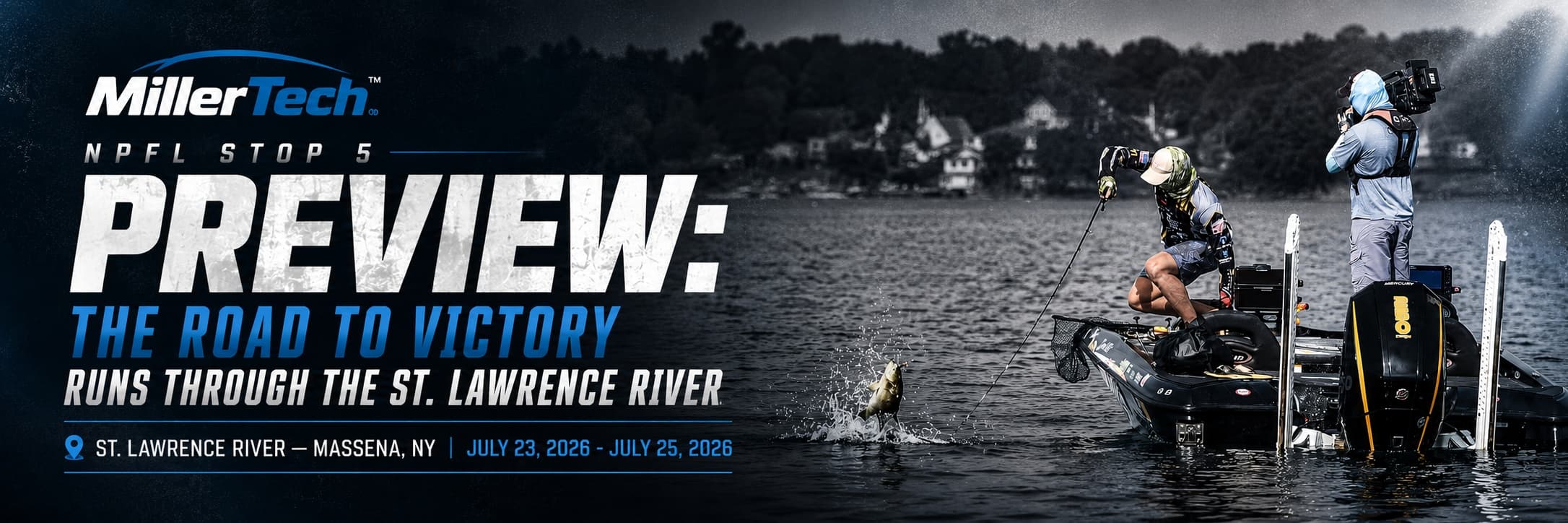
As the National Professional Fishing League (NPFL) enters the business end of the 2026 season, every cast carries greater significance than the last. The MillerTech NPFL Stop 5, scheduled for July 23-25 on the legendary St. Lawrence River in Massena, New York, is shaping up to be one of the most anticipated events of the year.
Widely regarded as one of the finest smallmouth bass fisheries in North America, the St. Lawrence River consistently produces heavyweight limits capable of rewriting tournament leaderboards in a matter of minutes. For anglers chasing victory, Angler of the Year points, or valuable momentum before the final event of the season, this tournament represents far more than another stop on the schedule, it is a defining opportunity.
With deep, crystal-clear water, expansive current systems, and thousands of productive offshore structures, the St. Lawrence River rewards preparation, precision, and confidence. Every competitor will arrive believing they have a chance to contend, but only those capable of adapting to changing conditions and making smart tournament decisions over three days will leave Massena with a trophy.
The St. Lawrence River Continues to Set the Standard
Few fisheries have earned the respect enjoyed by the St. Lawrence River.
Stretching between the United States and Canada while connecting Lake Ontario to the Great Lakes system, the river has become synonymous with world-class smallmouth bass fishing. Every season, tournament organizations return because the fishery consistently produces incredible catch rates, oversized limits, and dramatic finishes.
Unlike many lakes where anglers must spend valuable time searching for active fish, the St. Lawrence is overflowing with quality bass. The challenge isn't simply finding them, it's identifying the groups capable of producing tournament-winning weights day after day.
Massive schools of bronzebacks roam rocky flats, current seams, shoals, isolated boulders, and underwater humps. While numbers are rarely an issue, separating 3½-pound fish from 5-pound giants often determines the final standings.
History has shown that anglers capable of averaging exceptional weights throughout the event frequently find themselves battling for the title on Championship Day.
Big Smallmouth Will Dominate the Storyline
There is little doubt about what species will headline this event.
Although largemouth bass are present throughout portions of the fishery, the St. Lawrence River has earned its reputation because of its incredible population of trophy-class smallmouth bass.
Five-pound smallmouth are no longer considered rare, and multiple fish approaching or exceeding six pounds have become increasingly common during major tournaments.
That means competitors cannot simply rely on consistency, they must target quality.
A five-fish limit filled with respectable bass may keep an angler in contention early, but upgrading just one or two fish with true giants can completely transform a tournament.
Every decision regarding location, lure selection, and timing will revolve around maximizing opportunities for heavyweight smallmouth.
Electronics Will Play a Critical Role
Modern bass fishing continues to evolve, and nowhere is advanced electronics more valuable than on the St. Lawrence River.
Anglers will spend countless hours locating isolated rock formations, submerged reefs, bait schools, and roaming bass positioned over deep structure.
However, simply seeing fish doesn't guarantee success.
Some competitors excel at interpreting electronic information and adjusting presentations based on fish behavior, while others rely more heavily on instinct and historical patterns.
Those capable of combining both approaches often gain a significant advantage over the course of three competition days.
As the tournament unfolds, expect electronics to become one of the biggest talking points among fans and competitors alike.
Weather Could Become the Ultimate Equalizer
One factor that no angler can control is weather.
The St. Lawrence River is famous for changing conditions, and wind can quickly transform an otherwise manageable tournament into a true test of patience and boat control.
Calm mornings may allow anglers to make long runs across open water to isolated offshore structures, but afternoon winds can create dangerous waves and force competitors to alter their strategies.
Strong current, changing water levels, cloud cover, and fluctuating temperatures also influence how bass position throughout the river system.
Successful anglers must remain flexible.
Rather than forcing a single game plan, the best competitors understand when to adjust, relocate, or completely abandon an area in search of more productive conditions.
Tournament victories on northern fisheries often belong to anglers who adapt the fastest.
Timing Will Be Everything
Unlike many southern reservoirs, where fish frequently remain grouped around specific pieces of cover throughout the day, St. Lawrence smallmouth often feed in short but aggressive windows.
Current generation, wind direction, light penetration, and baitfish movement can all trigger feeding activity.
An area that appears lifeless during the morning may suddenly become one of the most productive spots on the river later that afternoon.
Because of this, experienced northern anglers often rotate between multiple locations before returning to productive schools during prime feeding periods.
Understanding these timing windows may prove just as important as finding fish in the first place.
Decision-Making Will Separate the Contenders
The St. Lawrence River rewards anglers willing to make difficult decisions.
Should they stay with a productive school and hope larger fish arrive?
Should they gamble on making a long run to isolated water?
Should they abandon an area after catching smaller bass?
These questions become increasingly important as the tournament progresses.
One risky move can produce a tournament-winning bag or eliminate any chance of climbing the leaderboard.
Successful professionals understand that tournament fishing isn't simply about catching fish. It's about making hundreds of strategic decisions while under constant pressure.
Those who consistently make the right choices often find themselves lifting trophies.
The Angler of the Year Race Adds Extra Pressure
As Stop 5 arrives late in the NPFL season, the Angler of the Year race becomes impossible to ignore.
Every finish carries valuable points that could dramatically reshape the standings heading into the season finale.
For anglers already near the top of the leaderboard, the objective may be protecting their position by avoiding costly mistakes.
Others sitting outside the upper tier may feel compelled to take greater risks in hopes of making up ground.
This contrast often creates fascinating tournament dynamics.
Some competitors will prioritize consistency, while others will swing aggressively for a victory.
The result is a tournament where every decision becomes magnified.
Expect Heavyweight Limits Every Day
If history is any indication, fans should prepare for spectacular weigh-ins throughout the week.
The St. Lawrence River has repeatedly produced some of the heaviest bags in professional bass fishing, with anglers regularly bringing in limits exceeding 20 pounds.
Multiple competitors could eclipse that mark each day, creating constant movement atop the leaderboard.
The difference between first place and tenth place may ultimately come down to only a few pounds or perhaps even a single fish.
That level of competition keeps fans engaged from the opening cast until the final weigh-in.
Who Holds the Advantage?
Several types of anglers traditionally perform well on the St. Lawrence River.
Competitors with extensive experience targeting northern smallmouth generally enter with confidence, understanding seasonal movements and productive structures.
Meanwhile, anglers who excel with finesse techniques, including drop shots, minnow-style soft plastics, tubes, Ned rigs, and football jigs often thrive in the river's clear water conditions.
Boat control also becomes an essential skill.
Maintaining precise positioning over deep structure while dealing with wind and current can make the difference between catching tournament-winning bass and watching opportunities disappear.
Ultimately, the angler who balances patience with aggression, trusts their preparation, and adapts to changing conditions will likely emerge as the champion.
A Tournament That Could Define the Season
Every professional fishing season features one or two events capable of changing everything.
The MillerTech NPFL Stop 5 at the St. Lawrence River appears destined to become one of those tournaments.
Championship aspirations, Angler of the Year races, and valuable career momentum all converge on one of the world's greatest bass fisheries.
For three days, fans will watch some of the sport's best anglers pursue giant smallmouth while navigating changing weather, evolving patterns, and immense competitive pressure.
When the final fish is weighed in Massena, one angler will celebrate a memorable victory, while many others will immediately turn their attention toward what remains in the championship race.
Regardless of the outcome, the St. Lawrence River is once again expected to deliver everything bass fishing fans love, big fish, dramatic moments, strategic battles, and unforgettable competition.