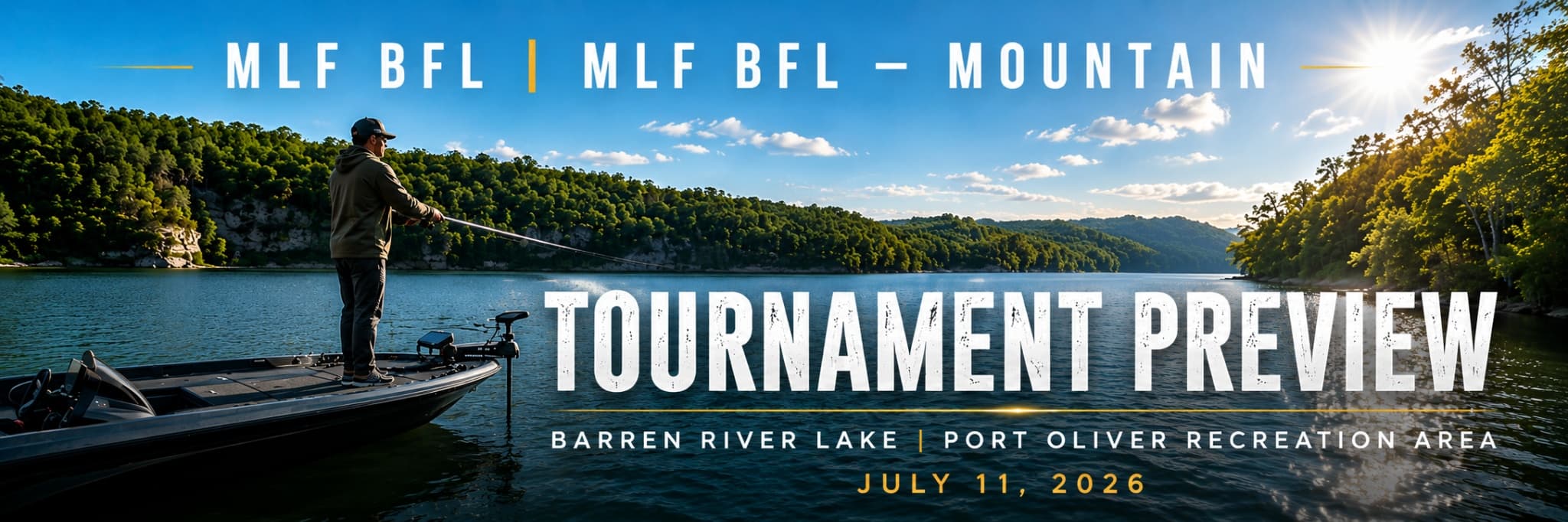

Kentucky's Premier Bass Fishery Awaits as Anglers Battle for Valuable Division Points, Tournament Glory, and Postseason Momentum
The Major League Fishing (MLF) Bass Fishing League (BFL) Mountain Division continues its 2026 season with an important stop on Saturday, July 11, as anglers head to the scenic waters of Barren River Lake in Kentucky. Launching from Port Oliver Recreation Area, competitors will take on one of the Bluegrass State's most consistent and productive bass fisheries in what promises to be an exciting midsummer battle.
With the Mountain Division season entering a critical stage, every tournament carries increased importance. Anglers are no longer focused solely on winning individual events, they are also chasing valuable divisional points, improving their standings, and positioning themselves for postseason qualification. Every fish weighed at the scales could make the difference between extending a successful season or falling short of championship aspirations.
Barren River Lake has long earned its reputation as one of Kentucky's premier bass fishing destinations. Year after year, the reservoir produces competitive tournaments thanks to its healthy bass population, diverse habitat, and ability to reward anglers who can successfully adapt to changing seasonal conditions. While largemouth bass are expected to dominate the leaderboard, the lake also supports quality populations of smallmouth bass and Kentucky spotted bass, providing competitors with multiple opportunities to build impressive five-fish limits.
As boats launch from Port Oliver Recreation Area on tournament morning, anglers will be greeted by classic summertime fishing conditions. July typically brings warm water temperatures, stable weather patterns, and fish that have fully transitioned into their summer locations. Success will depend on understanding these seasonal movements while making the proper adjustments throughout the day.
One of the defining characteristics of Barren River Lake during the summer months is how dramatically bass behavior changes as sunlight increases. Early in the morning, cooler temperatures and reduced light levels often encourage bass to move shallower in search of feeding opportunities. During these brief but productive windows, anglers can experience explosive topwater action around shoreline cover, secondary points, shallow brush, and vegetation.
Many competitors are expected to begin the tournament with aggressive topwater presentations in hopes of filling their livewells before the summer heat pushes fish into deeper water.
Walking baits, poppers, buzzbaits, prop baits, and hollow-body frogs are all expected to see plenty of use during the opening hours of competition. These lures allow anglers to cover water quickly while targeting actively feeding bass before conditions begin to change.
Capitalizing on the early morning bite could provide a significant advantage.
Tournament veterans understand that catching several quality fish before 9 a.m. often reduces pressure later in the day, allowing them to focus on upgrading rather than scrambling to complete a limit.
However, everyone competing at Barren River knows the morning bite rarely lasts forever.
As the sun climbs higher and water temperatures continue to rise, bass typically abandon shallow feeding areas and reposition around offshore structures where cooler water, current, and abundant forage create more favorable conditions.
This daily transition often determines the outcome of summer tournaments.
Competitors who successfully identify where fish relocate and more importantly, when they relocate are usually the anglers standing near the top of the leaderboard during weigh-in.
Offshore ledges become one of the primary targets throughout the afternoon. These underwater highways provide bass with quick access to varying depths while allowing them to ambush schools of baitfish moving through the reservoir.
Creek channel swings are another productive option.
As creek channels intersect with points, flats, and submerged timber, they create ideal travel routes and holding areas for bass throughout the summer. Fish often group together in these locations, rewarding anglers who can accurately locate active schools.
Brush piles will likely receive significant attention as well.
Whether naturally occurring or intentionally placed, submerged brush provides shade, protection, and ideal ambush cover. Some of the largest bass in Barren River Lake spend much of the summer positioned within or around these brush piles, making them prime tournament targets.
Locating productive offshore cover has become considerably easier with advances in modern electronics.
Forward-facing sonar, high-definition mapping, and side-imaging technology allow anglers to identify isolated structures with remarkable precision. These tools have transformed competitive bass fishing, particularly during offshore events where individual fish or schools can be located before a cast is ever made.
Still, electronics represent only one piece of the puzzle.
Finding fish does not guarantee success.
The anglers who consistently perform at a high level understand that presentation, timing, lure selection, and decision-making remain equally important.
Fish positioned around deep brush or ledges often become highly pressured during tournaments. Convincing those bass to bite requires patience, confidence, and an understanding of subtle changes in fish behavior throughout the day.
Several proven summer techniques are expected to dominate the tournament.
Deep-diving crankbaits remain one of the most effective tools for covering offshore structure while triggering reaction strikes from aggressive fish. Football jigs allow anglers to methodically work rocky bottoms and ledges where larger bass often position themselves.
Texas-rigged worms continue to be a favorite among competitors targeting submerged timber and heavier cover, offering a weedless presentation capable of reaching fish buried deep within brush piles.
Carolina rigs also become increasingly valuable during midsummer tournaments. Their ability to cover expansive offshore flats while maintaining bottom contact makes them particularly effective when searching for scattered schools.
Finesse techniques should also play a major role.
Shaky heads and drop-shot rigs excel when bass become less aggressive under bright skies and increased fishing pressure. These subtle presentations often generate critical bites that can dramatically improve an angler's final weight.
Choosing when to transition between power fishing and finesse tactics may become one of the defining decisions of tournament day.
Weather conditions could further complicate those decisions.
Although stable summer weather is expected, changing wind direction, cloud cover, and localized storms all have the potential to influence fish positioning and feeding activity.
A slight breeze across offshore points may stimulate feeding and improve crankbait patterns.
Conversely, calm conditions could make bass more difficult to catch, forcing anglers to slow down and rely on finesse techniques.
Cloud cover can dramatically extend the morning feeding window, allowing shallow fish to remain active much longer than expected.
Successful competitors will constantly monitor these environmental changes and adjust accordingly rather than remaining committed to a single strategy.
Time management also becomes increasingly important on expansive fisheries like Barren River Lake.
Competitors must carefully decide how long to remain in productive areas before moving elsewhere.
Leave too early, and they risk abandoning fish that may activate later.
Stay too long, and valuable fishing time disappears without additional weight.Making those decisions under tournament pressure often separates experienced anglers from the rest of the field.
Another important factor will be fish quality.
While catching a five-bass limit is always important, winning tournaments during the summer often requires locating larger-than-average bass.
One or two fish weighing four to five pounds can completely transform an otherwise average limit.
Because of this, many competitors may intentionally target fewer bites in areas known for producing larger fish rather than simply filling their limits with smaller keepers.
The Mountain Division standings add another layer of intensity to the competition.
Every ounce weighed contributes toward season-long points, making consistency just as valuable as individual victories.
Anglers sitting near the top of the standings will focus on protecting their position with another solid finish.
Those farther down the leaderboard understand that Barren River Lake presents an opportunity to make up valuable ground before the season reaches its conclusion.
Pressure will be present throughout the field from the opening cast until the final fish is weighed.
Fans can expect another exciting showcase of competitive bass fishing as experienced weekend anglers demonstrate the adaptability, decision-making, and technical skills required to succeed at the highest levels of grassroots tournament competition.
From explosive early-morning topwater strikes to patient offshore presentations around brush piles, creek channels, submerged timber, and ledges, Barren River Lake offers every ingredient necessary for a memorable summer tournament.
When boats leave Port Oliver Recreation Area on the morning of July 11, every competitor will begin with the same objective to unlock Barren River Lake's productive summer pattern, maximize every opportunity throughout changing conditions, and finish the day holding the championship trophy.
With valuable Mountain Division points, postseason aspirations, and tournament pride all on the line, the MLF Bass Fishing League event at Barren River Lake promises to deliver another thrilling chapter in the 2026 season. Whether victory comes through offshore structure fishing, shallow topwater action, or a combination of both, one thing remains certain: only the angler who best adapts to the changing conditions of a Kentucky summer day will emerge victorious.