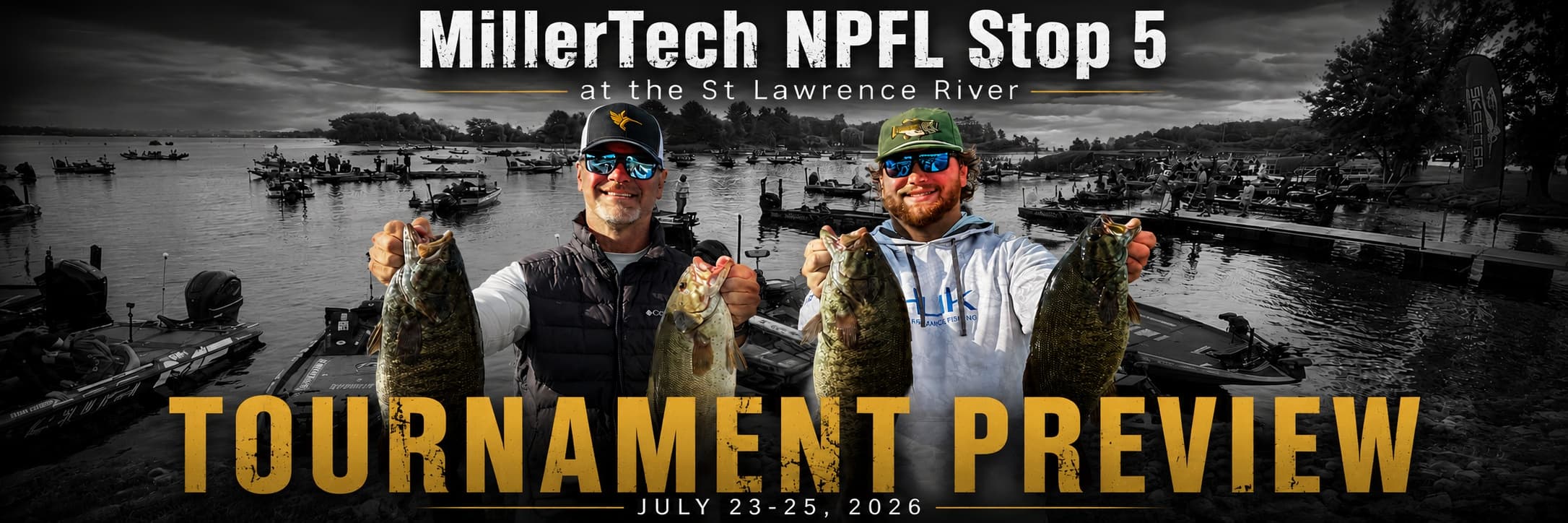

World-Class Smallmouth Fishery Awaits as Anglers Chase Victory, Angler of the Year Points, and Championship Momentum in Massena, New York
The countdown is on for one of the most anticipated tournaments of the 2026 MillerTech National Professional Fishing League (NPFL) season as the nation's top professional bass anglers prepare to compete on the legendary St. Lawrence River in Massena, New York, from July 23-25.
Widely recognized as one of the greatest smallmouth bass fisheries in the world, the St. Lawrence River has earned a reputation for producing giant bronze-backed bass, breathtaking scenery, and some of the most exciting tournament finishes in professional fishing. Every visit to this historic fishery raises expectations, and after a record-breaking event in 2025, anglers and fans alike are anticipating another unforgettable week on the water.
With the 2026 NPFL season entering its critical final stretch, Stop 5 represents far more than another tournament. It is an opportunity for anglers to position themselves for the Angler of the Year race, secure valuable championship points, and build momentum heading toward the season-ending finale. Every cast, every decision, and every ounce weighed could prove decisive as the league's elite battle on one of North America's most productive fisheries.
A Fishery Unlike Any Other
Stretching along the international border between the United States and Canada, the St. Lawrence River is unlike any other stop on the NPFL schedule. Crystal-clear water, powerful current, expansive rock structures, and seemingly endless opportunities to locate giant smallmouth bass make it one of the sport's premier destinations.
Competitors will have access to well over 100 miles of fishable water, creating limitless strategic possibilities. Anglers can target expansive shoals, submerged rock piles, offshore humps, gravel flats, current seams, and the famous Thousand Islands region, each offering unique opportunities to locate schools of heavyweight bass.
The abundance of productive water is both an advantage and a challenge.
Unlike smaller fisheries where anglers often compete within close proximity, the St. Lawrence rewards exploration and decision-making. Finding fish is only part of the equation. Competitors must also decide whether to commit to long-distance runs in search of untouched schools or remain closer to the weigh-in site to maximize valuable fishing time.
One poor decision regarding travel can erase an otherwise outstanding day.
Giant Smallmouth Expected Again
If history is any indication, fans should prepare to witness another spectacular display of heavyweight smallmouth bass.
The St. Lawrence River consistently produces some of the largest tournament limits in professional bass fishing. During late July, schools of mature smallmouth settle into stable summer patterns, often gathering around offshore rock structures and current-driven feeding areas where baitfish are abundant.
Tournament weights exceeding 25 pounds have become commonplace on this remarkable fishery.
In fact, daily limits weighing between 27 and 30 pounds would surprise no one. Multiple anglers are expected to eclipse the 25-pound mark each day, creating constant movement atop the leaderboard and leaving little room for error throughout the three-day event.
Unlike many fisheries where one exceptional catch can define a tournament, success on the St. Lawrence often requires anglers to consistently catch five bass weighing between five and six pounds each, a remarkable standard that highlights the incredible quality of the fishery.
Summer Patterns Will Shape the TournamentBy late July, smallmouth bass have fully transitioned into predictable summer patterns.
Many fish position themselves on deep rock piles, underwater humps, gravel bars, and current breaks where flowing water continually delivers food. Others suspend around isolated structures, requiring anglers to precisely locate and target roaming schools.
Forward-facing sonar has transformed the way anglers approach fisheries like the St. Lawrence, allowing competitors to identify individual fish and make precise presentations in open water. While electronics play an important role, technology alone cannot guarantee success.
Understanding current, interpreting underwater structure, recognizing feeding windows, and making accurate presentations remain the true difference-makers.
The anglers who best combine modern electronics with traditional instincts are often the ones standing atop the leaderboard at the end of the tournament.
Managing Time Becomes a Critical Factor
Few tournament venues test an angler's time management skills like the St. Lawrence River.
Some competitors may choose to make lengthy runs exceeding 50 miles in search of isolated schools capable of producing tournament-winning weights. Others will elect to remain closer to Massena, believing that more time with a lure in the water outweighs the potential benefits of distant locations.
Those decisions become even more significant over three days of competition.
Every additional minute spent running across the river is one less minute available for fishing. Yet one overlooked offshore shoal or remote reef could hold the winning school of bass.
Finding the proper balance between travel and efficiency may ultimately determine who hoists the trophy.
Wind Could Become the Biggest Opponent
As productive as the St. Lawrence River can be, it is equally respected for its ability to humble even the most experienced professionals.
Changing wind conditions frequently transform the fishery within hours.
Calm mornings can quickly give way to rough water capable of making long runs both difficult and risky. Strong winds not only affect travel but also alter current flow, boat positioning, and fish behavior.
Competitors must constantly monitor weather forecasts while remaining flexible enough to adjust their plans throughout each day.
History has shown that tournaments on the St. Lawrence are rarely won solely by locating fish. Success often depends on making intelligent adjustments when conditions change unexpectedly.
Every Point Matters
The timing of Stop 5 adds even greater significance to the competition.
As the NPFL season approaches its conclusion, anglers are no longer fishing solely for tournament victories. Every ounce contributes to the season-long Angler of the Year standings, making consistency more valuable than ever.
One outstanding finish can launch an angler into championship contention.
Conversely, one disappointing performance can erase months of hard work and force competitors into difficult positions heading toward the final events.
The pressure surrounding this tournament will be felt throughout the field.
Veteran professionals understand that championships are often decided not by spectacular victories alone, but by avoiding costly mistakes during the most challenging moments of the season.
Strategy Will Separate the Best
The St. Lawrence River offers numerous ways to catch bass, but choosing the correct approach will be essential.
Some anglers will rely heavily on finesse presentations such as drop-shot rigs, Ned rigs, and tube baits to tempt pressured fish relating to deep structure.
Others may target more aggressive schools using jerkbaits, swimbaits, or football jigs around rocky habitat and current breaks.
Because smallmouth frequently move throughout the day, locating active fish repeatedly becomes just as important as discovering productive areas during practice.
Many competitors will likely rotate through multiple locations, allowing schools time to replenish before returning later in the afternoon.
Executing those rotations efficiently often proves to be the difference between respectable finishes and tournament victories.
A Showcase of Professional Bass Fishing
Beyond the competition itself, Stop 5 represents another opportunity to showcase one of the world's finest fisheries to bass fishing fans everywhere.
The St. Lawrence River has become synonymous with giant smallmouth bass and dramatic tournament action. Spectacular aerial scenery, crystal-clear water, and incredible catches combine to create one of the most visually stunning events on the professional fishing calendar.
Every weigh-in is expected to feature impressive limits, with fans likely witnessing numerous bass exceeding six pounds throughout the tournament.
Such consistency has made the St. Lawrence a favorite among both anglers and spectators, further cementing its status as one of the premier destinations in competitive bass fishing.
The Road to the Championship Continues
When boats launch from Massena on July 23, every angler in the field will begin with the same objective,capture one of the most prestigious victories of the NPFL season.
Some competitors will chase their first NPFL title.
Others will look to strengthen their position in the Angler of the Year standings.
Several will simply hope to survive one of the most demanding tournaments of the season and keep their championship aspirations alive.
Whatever their goals, one thing remains certain: the St. Lawrence River rarely disappoints.
Its combination of trophy-class smallmouth bass, challenging conditions, strategic complexity, and breathtaking scenery consistently produces memorable tournaments that rank among the finest in professional fishing.
As the MillerTech NPFL enters the most important phase of its 2026 season, all eyes will turn to Massena, where one of bass fishing's greatest stages awaits another chapter of unforgettable competition.
With giant smallmouth, elite anglers, and championship dreams all converging on one remarkable fishery, Stop 5 promises to deliver exactly what fans have come to expect from the St. Lawrence River, world-class bass fishing at its absolute best.