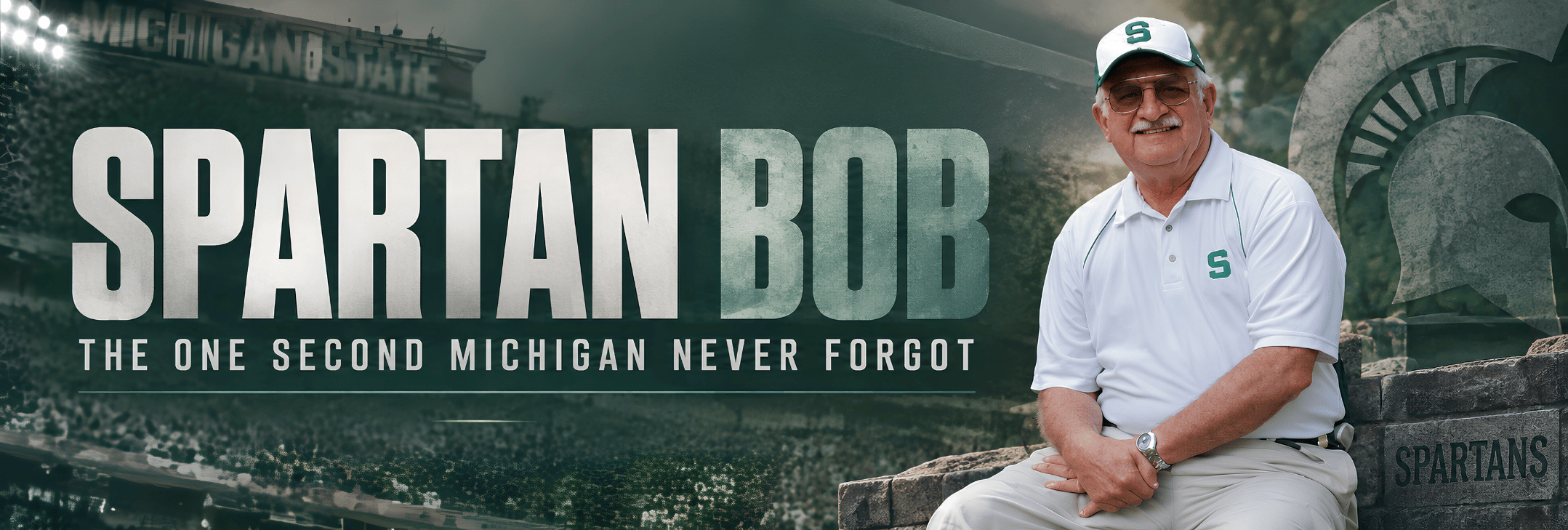

All the drama about the clock in Ann Arbor has fans remembering the “clockgate” debacle in 2001 between Michigan and Michigan State.
Every college football fan this weekend has had to have heard by now the controversy spewing from Ann Arbor, Michigan. Even if you are not a fan of college football, the news has been plastered everywhere. Earlier on Tuesday, September 8, the Mid-American Conference filed an appeal with the NCAA for Western Michigan to be recognized as the winner of the game against Michigan. All this craziness right now has fans and college football watchers thinking back to a similar moment involving Michigan 25 years ago. In a rivalry game against Michigan State.
“Clockgate” is what the game was referred to and the man behind it all being “Spartan Bob.” November 3, 2001, we are coming up on the 25th anniversary of this controversial game that changed how the clock operations were kept in college football. The Wolverines had a 6-1 record at the time of the game and were in East Lansing to take on the Spartans. Because the Wolverines were in East Lansing, that means Michigan State had a home clock operator, Bob Stehlin. Back in 2001 the home team had access to their own clock operators which influenced the outcome of clockgate.
The situation was that Michigan held a 24-20 lead late into the fourth quarter over the Spartans who were led by quarterback Jeff Smoker. MSU was down to its final drive and the final drive of the game as a whole after Michigan punted with 2:28 left in regulation. The Spartans drove all the way down to the Michigan three-yard line where they stopped the clock with 17 seconds left on it. After the spike to stop the clock on first down, Smoker ran to his right on second down and was tackled in bounds which kept the clock running. Smoker rushed to the line of scrimmage and spiked the ball with one second left on the clock. However, the broadcast crew and Michigan themselves argued that there should not have been a second left in the game. They thought that the clock operator Bob Stehlin, also known as “Spartan Bob,” had something to do with stopping the clock before the ball hit the ground. MSU utilized the one second left in the game as Smoker hit T.J. Duckett for a touchdown strike to win the game 26-24. The game would forever be known as “clockgate” and the man behind it all earned the nickname “Spartan Bob.”
Stehlin defended himself by saying that several different media outlets timed up the final play down to the hundredths of the second to confirm that Stehlin was right. That did not stop him from receiving multiple threats about the clock and how he stopped it early to give the Spartans that one final chance. The controversy from this game forced the Big Ten conference to change their official time keeping rules to ensure this would never happen again. “Spartan Bob” was appointed by Michigan State University to keep the time of the game, which is why the controversy happened, because it was the home team’s clockkeeper. The following season in 2002, the Big Ten made sure that it was a neutral official appointed by the conference, not the home team, to keep track of the clock. Not only did that change, but now the play would not have been given a chance to run because players cannot stop the clock by spiking the ball under three seconds. That rule was implemented in 2013. Everything about this final play debacle would not have been allowed in today’s college football landscape.
The result of the game made Michigan end the season with two conference losses instead of one and cost the Wolverines a tiebreaker with Illinois. It also robbed the Wolverines of a spot in the Rose Bowl. “Clockgate” had massive implications that shifted the rules of the Big Ten due to how controversial it was. With Western Michigan filing an appeal to be noticed as the winner of the Michigan game because a second was put back on the clock, it is easy to see why this controversy is resurfacing. Especially near its 25th anniversary. The Western Michigan versus Michigan game debacle cannot come close to the “Spartan Bob” game due to the implications it had on college football. It is just ironic how two of the most debated end-of-game clock scenarios have involved the University of Michigan at both ends of the spectrum.
“Spartan Bob” will forever live in infamy for the University of Michigan as fans remember “clockgate” at Spartan Stadium that fateful November. It is possible that this game against WMU becomes Michigan’s own version of “Spartan Bob” and “clockgate.” Until then, that game between the Spartans and Wolverines will live on as long as Bob Stehlin is remembered by fans and players alike.