
KKR backs Hometown Soccer Holdings to transform MLS NEXT Pro reserve squads into independent, commercial brands.
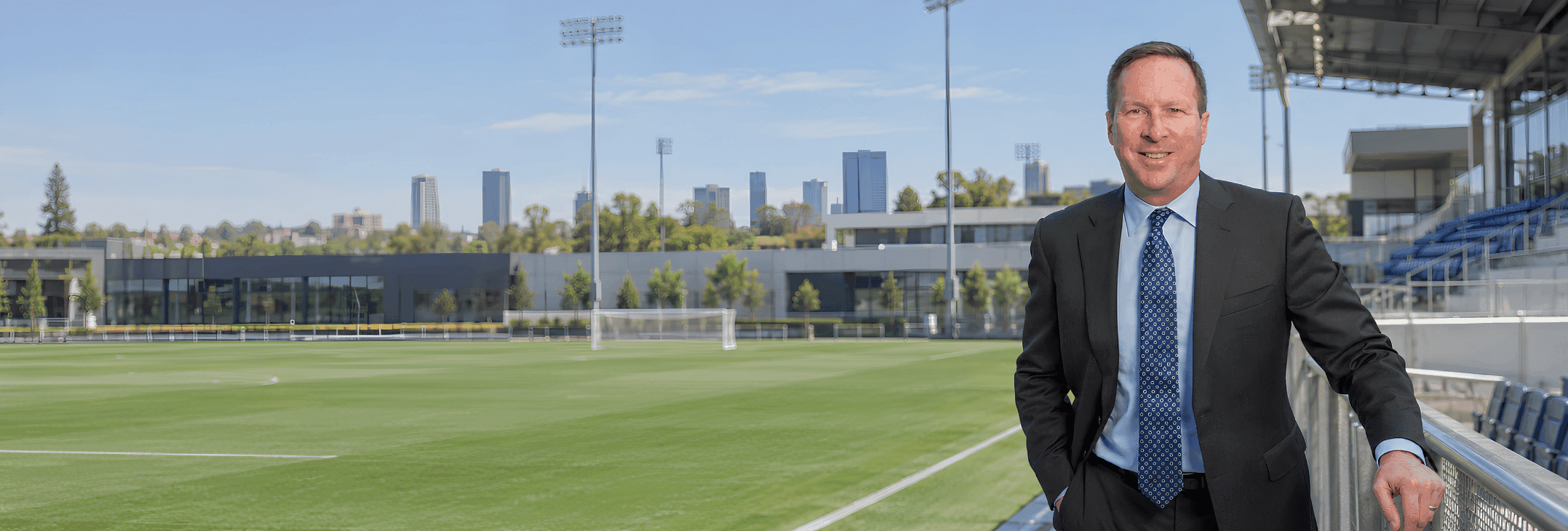
Tom Glick and Chris Klein are moving New York City FC’s reserve team to New Jersey and building a local soccer business around it with KKR’s backing. Starting in July 2027, NYCFC II will play in Middlesex County under a new identity (name, colors and crest) that their supporters help develop. Its home will be a 6,500-seat stadium inside the $350 million NEXUS sports and entertainment district. The first club under their Hometown Soccer Holdings operation gives the investment thesis an address.
NYCFC keeps control of the soccer. Hometown Soccer Holdings (HSH), the venture MLS and KKR announced April 30, handles the commercial business around participating affiliates, from selling tickets to building local brands. Glick, HSH’s chief executive, previously served as Manchester City’s chief commercial and operating officer. Klein, its president, spent 12 years as president of the LA Galaxy. Their assignment puts private equity further down soccer’s development pipeline, where reserve squads can become the foundation for businesses of their own.
The attraction becomes clearer when you look at the price upstairs. Sportico values the average MLS club at $767 million entering 2026. HSH gives institutional investors a way to build from a smaller starting point. Sportico’s reporting, summarized by law firm Pullman & Comley, puts KKR’s staged commitment at $150 million to $200 million. The parties have not disclosed full financial terms, but the reported scale suggests a rollout across many markets.
What KKR is building
Many reserve teams operate primarily to develop players, often in sparsely attended venues within their parent club’s market. Building a second fan base requires staff and attention an MLS front office may struggle to spare. HSH takes on that commercial work while participating MLS clubs retain coaching, contracts, and player development. KKR invests through Ascendant, its North American middle-market private-equity fund, placing HSH within a strategy focused on companies with room to grow.
Ted Oberwager, the KKR partner overseeing gaming, entertainment, media and sports in its Americas private-equity business, explained the appeal in an April 30 Sports Business Journal interview about the launch. “We’re going to have one unified platform over time versus buying a bunch of preexisting assets that you have to almost rework,” he said. Common technology and finance systems can reduce duplication from the start. Supporters can have distinctive clubs without each business paying to invent its own back office.
The commercial precedent sits in Huntsville, Alabama, where Nashville SC established Huntsville City FC in 2023 with its own identity and a renovated former baseball stadium. By November 2024, Sports Business Journal reported crowds consistently above 4,000 and more than 20 corporate partners across its first two seasons. Huntsville gives HSH something more persuasive than a presentation: evidence that people will buy into a local club built around another city’s developing players.
Where the money can come from
Venues give the business more to sell than match tickets. Discussing HSH’s plans on his May 5 appearance on The Soccer Business Podcast, Glick described mostly 6,000- to 8,000-seat stadiums and income from hospitality, concessions and events. “[A] well-planned, well-run club with the right facility and the right location, with good operation and good marketing, can be very successful,” he said. The qualification matters: a stadium needs customers beyond the soccer schedule, and operating costs keep arriving between games.
New Jersey illustrates the surrounding activity HSH hopes to tap. NEXUS includes premium seating, a restaurant and bar, and 14 nearby youth tournament fields. Families have reasons to visit even when the professional team is away. The announcement names Sports Facilities Companies as the district’s manager (HSH does not automatically collect every dollar spent there). Venue agreements determine which revenues reach the club, making the terms of each local partnership as consequential as the number of seats.
Sponsorship offers another way to grow across markets. Put yourself in a national sponsor’s seat: one agreement covering a dozen local clubs could save negotiating a dozen separate deals. HSH can combine that reach with local sales to businesses that want customers nearby. Its remit includes club and league-level sponsorship. Successful expansion could produce recurring income and increase the value of HSH’s commercial rights and business. Any appreciation depends on what it owns and earns, rather than automatically tracking MLS franchise prices.
Player development supplies the product those businesses need. As of August 27, 270 NEXT Pro players had signed MLS first-team contracts, while more than 1,300 academy players had appeared in the league. The pathway functions. HSH must make watching it locally worth paying for. You can see the appeal of following a teenager before an MLS breakthrough, but public disclosures establish no HSH entitlement to transfer fees. Talent helps sell the experience while player transactions remain with the sporting side.
Expansion brings competition
On the same May podcast, Glick said his group had identified 150 markets it believed could support professional soccer but lacked a club. He also acknowledged it did not have 150 teams to distribute. The list measures potential demand, not secured expansion. Each opening needs an MLS partner, a workable venue, and customers willing to return.
Des Moines is where those negotiations become tangible. Klein told the Des Moines Register on September 22 that HSH and Sporting Kansas City are exploring a downtown move and local rebrand for Sporting KC II. “This team would be directly tied to Sporting Kansas City in that league,” he said. The proposal offers a ready sporting operation. HSH would then have to establish the local business and stadium arrangements needed to give it a permanent home.
USL wants that market, too. Its president, Paul McDonough, made his case to local stakeholders on September 24, emphasizing a club belonging to Des Moines. USL is developing a separate league system with planned promotion and relegation, while HSH affiliates offer a direct player pathway to MLS parents. The competition extends beyond the pitch to stadium sites, sponsors and civic support. An attractive secondary market can attract several investors chasing the same supporters and public resources.
Private capital backs the competing system. Weatherford Capital joined USL’s investor group in February. Founding partner Drew Weatherford described sports as becoming a core institutional asset class in the announcement. “As a Tampa-based firm, we’ve seen firsthand how professional sports can transform a community and create lasting economic value,” he said. His firm’s investment reinforces the broader interest in building soccer businesses below MLS. It also gives HSH competitors with funding and ambitions of their own.
Local enthusiasm still needs renewing. Huntsville averaged just over 3,700 spectators in 2025, below its early crowds. The decline does not establish why people stayed away, but it challenges any assumption that attendance simply compounds. Development clubs also face an unusual sales problem: a favorite player’s success can remove him from the lineup. Keeping supporters attached to the club through those departures takes more than a new crest (however good it looks on a scarf).
In Des Moines, Mayor Connie Boesen says the city is examining its options after ending negotiations over the development district intended to support the proposed stadium. USL’s backers continue pressing their project, while HSH pursues discussions about its alternative. The city’s site-preparation grant is not tied specifically to USL, leaving room for a different arrangement. Klein has identified a team that could move. Des Moines still has to settle what it can build around it.